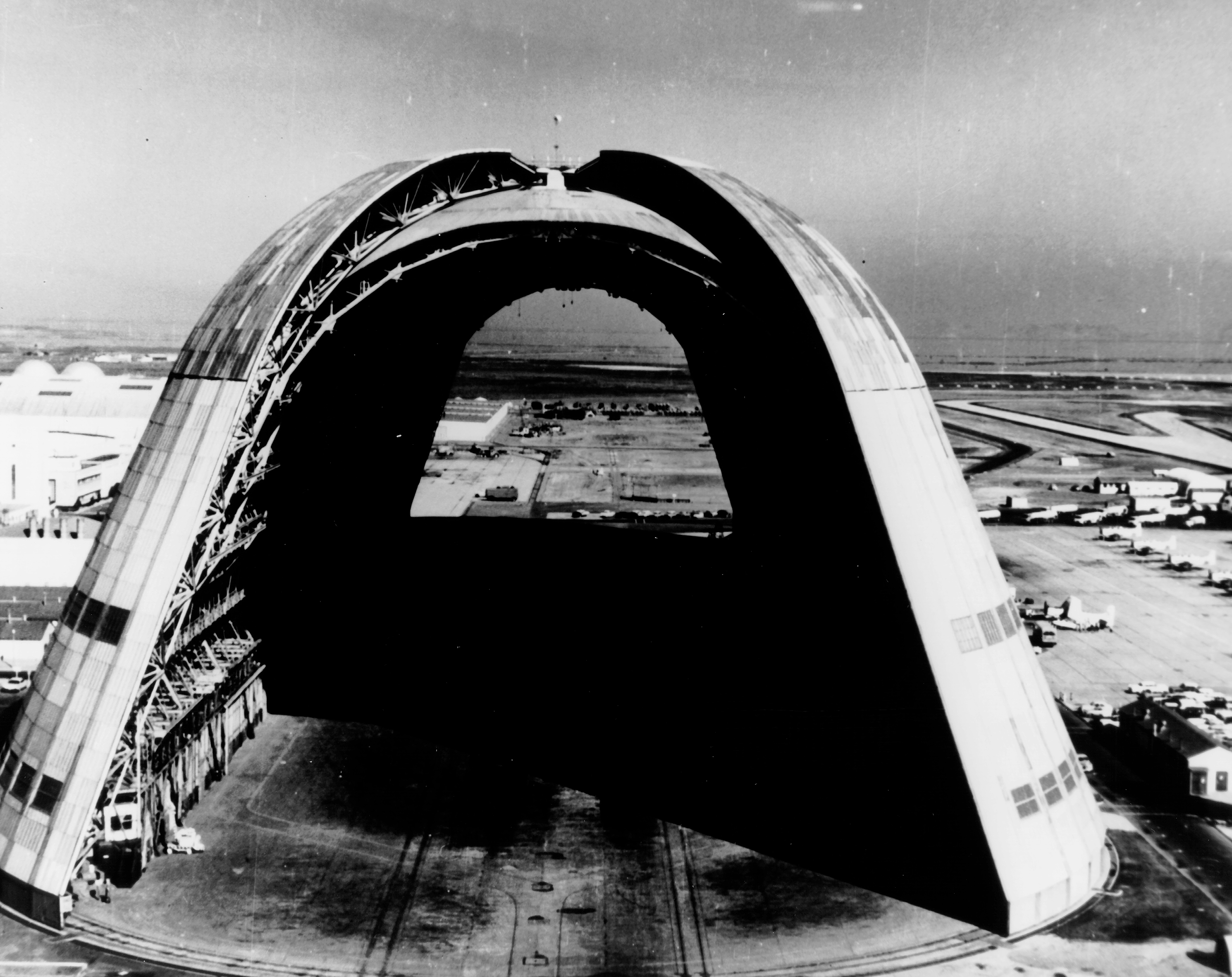
Hangar One (Moffett Federal Airfield)
It covers eight acres. Its interior is so vast that fog reportedly formed inside on humid days. Built in 1933 to house the Navy airship USS Macon, Hangar One at Moffett Field is one of the largest freestanding structures in the world, a cathedral of aviation engineering that has survived the demise of the airship age, decades of environmental contamination, and the slow march of military base closures to emerge, improbably, as a Google-leased landmark in the heart of Silicon Valley.
Built for Airships
The Navy constructed Hangar One in 1933 specifically to house the USS Macon, a 785-foot rigid airship that was the flying aircraft carrier of its era -- it could launch and recover small biplanes in flight. The hangar needed to be enormous: its doors alone were large enough to admit the Macon's 133-foot diameter. The structure rises 198 feet and stretches 1,133 feet long, its steel frame covered in a skin that enclosed a volume roughly equal to six football fields stacked atop each other. The Macon crashed into the Pacific off Point Sur in 1935, just two years after the hangar was completed, killing two of her 83 crew and ending the Navy's rigid airship program.
Contamination and Decay
After the airship era, Hangar One served various military purposes through World War II and the Cold War. But its original cladding, which contained PCBs and other contaminants, began to deteriorate. In 2003, the Navy stripped the exterior skin, leaving only the massive steel skeleton standing like the ribcage of a beached whale. The site was designated a Superfund cleanup area. For over a decade, Hangar One stood as a hollow frame, its future uncertain. Proposals ranged from demolition to conversion into a museum, a sports arena, or a research facility. The sheer cost of any option -- the structure covers eight acres and its steel frame weighs thousands of tons -- deterred most serious plans.
Google's Giant Garage
In 2014, Google subsidiary Planetary Ventures signed a 60-year lease with NASA for Moffett Field, including Hangar One. Google committed to restoring the hangar's exterior and maintaining the structure. The re-skinning began, and the hangar gradually regained its imposing profile against the Mountain View skyline. Google uses parts of the Moffett Field complex for aviation research and as a base for the executives' private aircraft. Hangar One, visible from Highway 101 and from the air across the entire south bay, has become an unlikely symbol of Silicon Valley's relationship with its military past -- a structure built for a Depression-era airship program, contaminated by Cold War chemicals, and restored by one of the wealthiest companies in human history.
From the Air
Located at 37.413N, 122.054W at Moffett Federal Airfield (KNUQ), Mountain View. Hangar One is unmistakable from the air -- an enormous curved structure visible from miles away. Note: Moffett is restricted airspace. Nearest public airport: KPAO (Palo Alto, 6nm NW). Best viewed at 2,000-5,000 ft AGL.