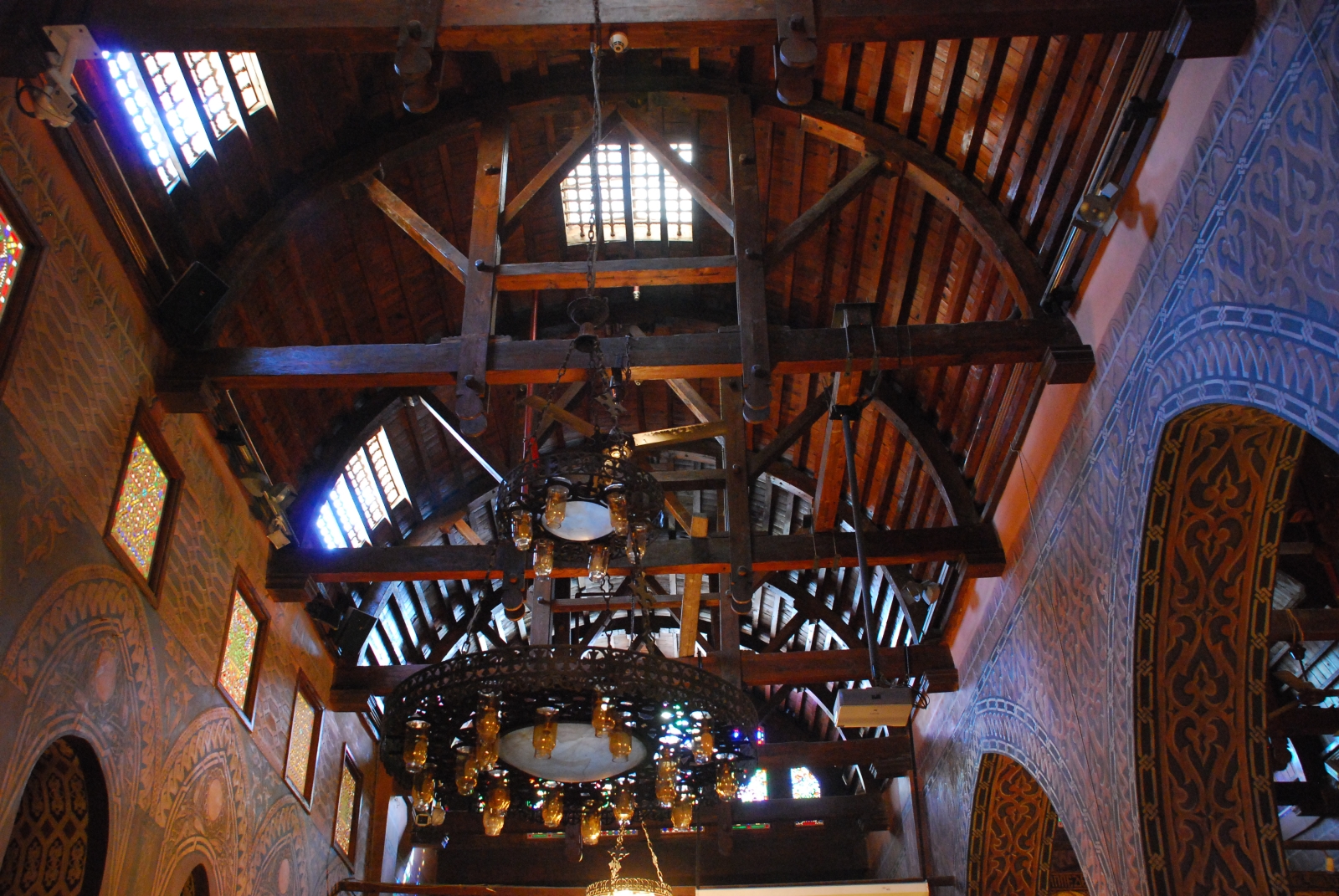
Hanging Church
Twenty-nine steps. That is what separates the narrow lanes of Coptic Cairo from one of the oldest churches in Egypt. Early travelers to the city climbed those steps so often they gave the building its second name: the Staircase Church. Its official name is the Saint Virgin Mary's Coptic Orthodox Church. But everyone calls it the Hanging Church, because it does something no church should be able to do -- it floats. Built atop the south bastions of the ancient Babylon Fortress, the church is suspended above the ruins of a Roman gatehouse, its nave held aloft by superimposed columns and brick arches added over the centuries to keep the whole improbable structure from collapsing into the stones beneath it.
A Church Above a Fortress
The Babylon Fortress was a Roman citadel whose origins are disputed even among Coptic historians. One tradition dates its foundation to the nineteenth century BC, when prisoners taken by Pharaoh Sesostris after defeating the Babylonians supposedly built a fortress around their settlement. Another version attributes it to Nebuchadnezzar in the sixth century BC, after his conquest of Egypt. What is certain is that by the time the Hanging Church was erected over the fortress's south bastions, the gatehouse below had already been ancient. Beneath the church floor lies the old atrium entrance, its niched walls once home to Roman statues now long vanished. The church's "hanging" quality comes from this positioning: it occupies the space above the gate, with the fortress ruins visible below, creating the sensation of a building suspended between eras.
Seventeen Centuries of Worship
The church was probably built during the patriarchate of Isaac, though an earlier structure may have existed as early as the third or fourth century. The earliest written mention appears in the biography of Patriarch Joseph I, who served from 831 to 849, when the governor of Egypt visited the establishment. Pope Abraham largely rebuilt the church between 975 and 978, and according to Coptic tradition, the Virgin Mary appeared to him in a dream during that period -- part of the story of how the Mokattam Mountain was said to have been moved by the faith of Simon the Tanner. The church has been restored many times since, most recently in a major renovation completed in 2011. Objects of historical interest that could no longer serve the congregation were transferred to the nearby Coptic Museum. A set of ten wooden panels from one of the church's doors, engraved with Christian iconography in 1300 AD, can now be found in the British Museum in London.
Sacred Spaces Within
The present structure comprises two distinct sections: a primitive church in the south, believed to date from the third to seventh century, and a principal church to the north, built between the fifth and seventh centuries. The church is dedicated to the Virgin Mary and contains sanctuaries to her as well as to Saints John the Baptist and George. The interior's character comes from its layered history -- columns and arches from different periods supporting a nave that has been continuously adapted to its congregation's needs for well over a millennium. Walking through the Hanging Church is less like visiting a museum than like reading a palimpsest, where each century has written over the last without entirely erasing it.
Old Cairo's Living Heart
The Hanging Church sits within Coptic Cairo, a neighborhood that concentrates Egypt's Christian heritage into a few dense blocks beside the remains of the Babylon Fortress. The Coptic Museum, founded in 1908, stands nearby, housing what may be the world's most significant collection of Coptic art and artifacts. This is not a preserved district frozen in time but an active religious quarter where services are still held, processions still wind through narrow streets, and the sound of hymns in Coptic -- a liturgical language descended from the tongue of the pharaohs -- drifts from open church doors. For a country overwhelmingly associated with pharaonic and Islamic heritage, the Hanging Church is a reminder that Egypt's Christian tradition is older than most European nations, and that it persists not as a relic but as a living faith.
From the Air
Located at 30.005N, 31.230E in Old Cairo (Coptic Cairo), on the east bank of the Nile south of central Cairo. The church is not individually visible from high altitude but the Coptic Cairo quarter -- a compact cluster of historic buildings near the Babylon Fortress ruins -- can be identified along the Nile's east bank. Nearest airport: Cairo International (HECA), approximately 22 km northeast. Recommended viewing altitude: below 2,000 ft AGL to distinguish the historic quarter from the surrounding dense urban fabric. The Mar Girgis metro station sits adjacent to the area.