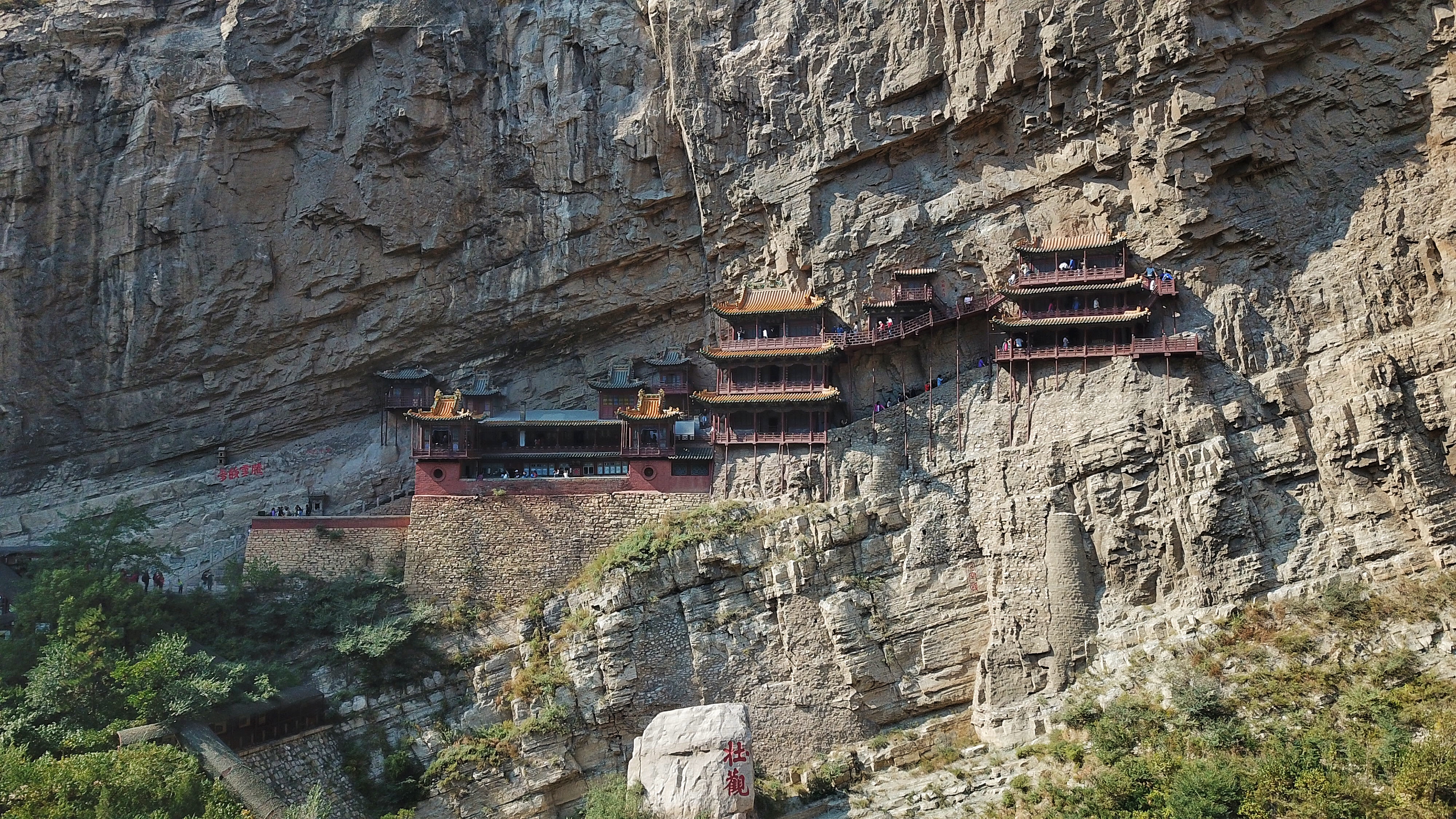
Hanging Temple
According to legend, a monk named Liaoran built it alone. In 491 AD, at the close of the Northern Wei dynasty, he began chiseling holes into the cliff face on the west side of Jinxia Gorge, driving oak crossbeams into the rock, and constructing what would become one of the most improbable buildings in the world. The Hanging Temple -- Xuankong Temple -- clings to sheer sandstone 75 meters above the ground near Mount Heng in Hunyuan County, looking from a distance as though it simply floats in midair. Over 1,500 years later, it is still there.
Between Sky and Earth
The temple's origin story is as dramatic as its architecture. Emperor Xiaowen of the Northern Wei, having admired the grand Buddhist temples of Luoyang, wanted something equally impressive for the north -- but with a twist. He ordered a Taoist priest to build a temple on the cliffs of Mount Hengshan that could "not reach the sky or the ground." The result was a structure suspended in the canyon basin, its main support hidden inside the bedrock, with 27 wooden beams carrying the weight of 40 halls and pavilions. Iron chains and additional beams reinforce the frame, but the essential trick is location: tucked beneath the summit's overhang, the temple is shielded from both rain erosion and direct sunlight, which has preserved its timbers far longer than open-air exposure would allow.
Three Teachings Under One Roof
What makes the Hanging Temple singular among Chinese religious sites is not just its engineering but its theology. While nominally a Buddhist temple, it houses the Hall of Three Religions, where statues of Sakyamuni, Laozi, and Confucius sit side by side. This arrangement reflects the Chinese philosophical concept of the Three Teachings Harmonious as One, an idea that gained particular currency during the Ming and Qing dynasties. The northern section contains the Wufo Hall dedicated to the Five Tathagatas and a hall for the bodhisattva Guanyin. The southern section rises three stories and includes the Chunyang Palace for the Taoist immortal Lu Dongbin and the Sanguan Hall, the largest space in the complex, where Ming-era clay sculptures of the Three Great Emperor-Officials of Heaven, Earth, and Water preside.
Holding On Against the Elements
Survival on a cliff face demands constant attention. The temple has been repaired and renovated repeatedly across its long history, most recently in a major overhaul approved by the China Cultural Heritage Administration in September 2015. The restoration addressed deteriorating paintings and oil decorations, and the scenic area remained closed until May 2016. The challenge is perpetual: exposure to wind, temperature swings, and the slow expansion of ice in rock fissures threaten the crossbeams that anchor the structure to the cliff. Each restoration must balance preservation of original materials with the practical necessity of replacement, a dilemma familiar to anyone responsible for keeping ancient wooden structures standing.
The View From Below
Approaching the Hanging Temple along Jinxia Gorge, visitors look up at a lattice of wooden walkways and red-painted balconies pressed against gray rock, connected by narrow staircases that thread between halls barely wide enough for two people to pass. The distance from the lowest to the highest point spans over 30 meters of vertical cliff face, with the complex growing taller as it extends northward along the mountain. From the air, the gorge itself is the dominant feature -- a narrow cut through the mountains southeast of Datong -- with the temple visible as a thin horizontal line of color against the cliff's neutral stone, a reminder that human ambition sometimes finds its best expression in the most impossible places.
From the Air
Located at 39.66°N, 113.71°E in Jinxia Gorge near Mount Heng, Hunyuan County, approximately 64 km southeast of Datong. The temple is built into a cliff face on the west side of the gorge. Nearest airport is Datong Yungang Airport (ZBDT). The gorge is narrow and mountainous terrain surrounds the site. Best observed from moderate altitude where the cliff formations are visible.