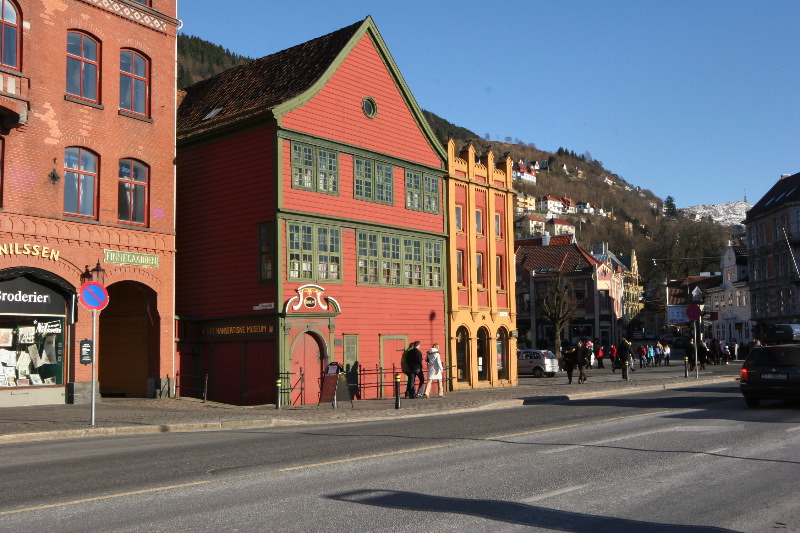
Hanseatic Museum and Schotstuene
Fire was forbidden in the wooden buildings on Bryggen. For four centuries, the German merchants of the Hanseatic League who lived and worked in Bergen's waterfront quarter cooked all their food in the Schotstuene -- communal assembly halls that served as kitchen, dining room, and gathering place for an entire commercial colony. The prohibition was not paranoia. Bergen has burned repeatedly throughout its history, and Bryggen's tightly packed timber warehouses, their gabled facades pressed together along the wharf, were kindling waiting for a spark. The Hanseatic Museum preserves this world inside Finnegarden, one of the surviving wooden buildings, with original artifacts collected before the old commercial way of life vanished entirely.
The German Wharf
By 1360, the Hanseatic League's German guild of merchants had established a permanent overseas office at Bryggen. For the next four centuries, this enclave functioned as a semi-autonomous commercial outpost, its merchants trading primarily in dried cod -- the stockfish that connected Norway's fishing grounds to European markets. The Hanseatic presence shaped Bergen profoundly: German was the language of commerce, German customs governed daily life within the wharf, and German merchants controlled access to one of northern Europe's most valuable trade goods. The buildings they occupied were functional rather than beautiful -- narrow wooden structures stretching back from the waterfront, with trading rooms at the front, storage above, and sleeping quarters tucked into every available space.
Finnegarden and the Schotstuene
The museum occupies Finnegarden, a conserved wooden building on Bryggen. The present structure dates to after the fire of 1702, when most of Bergen's city center burned. Inside, visitors find an authentic trading room with a merchant's office, sleeping quarters for the apprentice boys, and a guest room -- the physical infrastructure of Hanseatic commerce laid bare. The Schotstuene, the communal assembly halls, are also part of the museum's responsibility. These halls were essential because they were the only places where fire was permitted on the entire Bryggen wharf. Every meal, every warm drink, every heated moment in Bergen's relentless damp had to happen here, within stone-walled buildings designed to contain the flames that the surrounding timber could not survive.
Rescued From Oblivion
The museum's collection exists because of one family's persistence. Johan Wilhelm Wiberg, born in 1829, began collecting original Hanseatic artifacts from Bryggen and surrounding farms before the old commercial culture disappeared entirely. His son, Christian Koren Wiberg, expanded the collection and built it into a proper museum. The institution began in 1872 in a building owned by merchant Johan Wilhelm Olsen. As the collection grew, architect Conrad Fredrik von der Lippe designed an additional building called Murtasken to house the expanding holdings. In 1916, Bergen municipality assumed responsibility. Every item in the museum is original -- not a reproduction, but an actual artifact of Hanseatic daily life, collected from the buildings and farms where these objects had been used for centuries before anyone thought to preserve them.
Walking Through Trade
Bryggen is now a UNESCO World Heritage Site, and the Hanseatic Museum offers something the designation alone cannot: the interior experience of how these buildings functioned. The cramped sleeping quarters show what life was like for the boys apprenticed to Hanseatic merchants -- young Germans sent to Bergen to learn the trade, sleeping in narrow bunks in unheated rooms through Norwegian winters. The merchant's office reveals the commercial machinery: where deals were struck, accounts kept, and correspondence managed across a trading network that stretched from Bergen to Lubeck and beyond. The museum makes tangible what the exterior facades merely suggest -- that behind those photogenic gabled walls, people lived difficult, disciplined, commercially driven lives in a foreign country, bound to their trading posts by profit and guild obligation.
From the Air
Located at 60.40N, 5.33E on the Bryggen wharf in central Bergen. Bergen Airport Flesland (ENBR) is 18km south. From the air, Bryggen is immediately identifiable as the row of colorful gabled wooden buildings along the northeastern side of Vågen harbor. The museum is within the Finnegarden building in this UNESCO World Heritage row. Best viewed at 1,500-2,500 feet to see the distinctive wharf architecture. Bergenhus Fortress is immediately to the northwest.