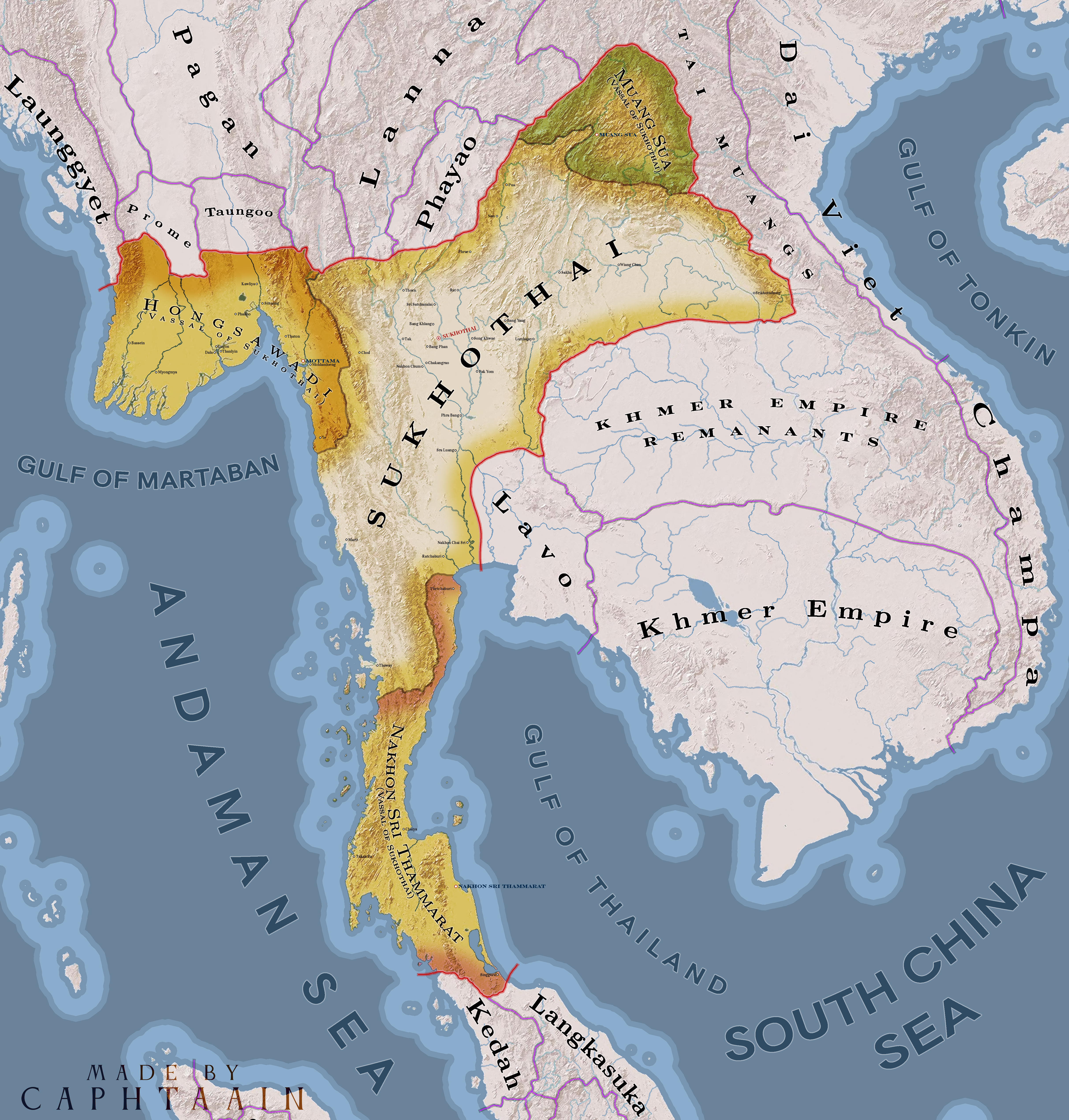
Hanthawaddy Kingdom
For a century, the merchants of Bago filled their king's treasury with Indian Ocean gold while monks carried Buddhist scriptures back and forth to Sri Lanka. The Hanthawaddy Kingdom -- known simply as Pegu to European traders who marveled at its gilded spires -- was the dominant power of Lower Burma from the late 1200s through the 1530s. Founded by Mon-speaking peoples in the chaos following the Pagan Empire's collapse, it spent its first decades as a loose, fractious federation. What transformed it into a golden age was not military conquest but something rarer: a succession of gifted rulers who chose commerce and religion over war.
Born from Collapse
When the Pagan Kingdom disintegrated in 1287 under Mongol pressure, the Mon people of Lower Burma seized the opportunity. King Wareru founded what he called Ramannadesa, a state nominally bowing to both the Sukhothai Kingdom of present-day Thailand and the Mongol Yuan dynasty. In practice, the new kingdom answered to neither. It became formally independent of Sukhothai by 1330, though independence brought its own problems. Three regional power centers -- the Irrawaddy Delta, Bago, and Mottama -- competed for influence, and the king in Bago often had little real authority over his supposed vassals. Mottama openly rebelled from 1363 to 1388. The kingdom was a federation in name and a contest of wills in reality.
The King Who Forged a Nation
Everything changed with Razadarit. Ascending to power in 1384, this energetic monarch spent his reign welding the three Mon-speaking regions -- Myaungmya, Donwun, and Martaban -- into a single functioning state. His great test came from the north. The Burmese-speaking Ava Kingdom dreamed of restoring the old Pagan Empire and launched the Forty Years' War, a grinding conflict that lasted from 1385 to 1424. Razadarit fought Ava to a standstill, even forcing the western kingdom of Rakhine into tributary status between 1413 and 1421. The war ended in stalemate, but for Hanthawaddy it was a triumph. Ava finally abandoned its ambitions of reunification, and Pegu emerged as a power that could not be ignored.
A Golden Age on the Indian Ocean
From the 1420s to the 1530s, Hanthawaddy entered a golden age that its people would remember for centuries. While rival Ava declined, Pegu flourished under a remarkable sequence of monarchs: Binnya Ran I, the warrior-queen Shin Sawbu, the reformer Dhammazedi, and Binnya Ran II. Their wealth came from the sea. Merchants trading across the Indian Ocean brought silk and spices to Bago's markets, and gold and silver flowed into the royal coffers. But the kingdom's reputation rested on more than commerce. Hanthawaddy became a celebrated center of Theravada Buddhism, forging strong religious ties with Sri Lanka and sponsoring reforms that rippled outward across the Buddhist world. Shin Sawbu, one of the few female rulers in Burmese history, personally donated her weight in gold to plate the Shwedagon Pagoda -- a gesture that spoke both to personal piety and to the staggering wealth at her command.
A Swift and Bitter End
The end came with shocking speed. By the early 1500s, the small Taungoo dynasty in Upper Burma had begun raiding Ava's territory, and its ambitious leaders -- King Tabinshwehti and his brilliant general Bayinnaung -- soon turned their attention south. Hanthawaddy's King Takayutpi commanded far greater resources and manpower, yet he could not marshal them effectively against Taungoo's disciplined forces. Bago and the Irrawaddy Delta fell in 1538-39. Mottama followed in 1541. Bayinnaung, shrewd as well as ruthless, offered the surrendered Pegu officials amnesty and restored them to their old positions -- absorbing the kingdom rather than destroying it. When Tabinshwehti was assassinated in 1550, Hanthawaddy flickered briefly back to life, but the revived "kingdom" barely extended beyond Bago's city walls. Bayinnaung crushed the rebellion in March 1552.
A Memory That Would Not Die
Though the Taungoo dynasty ruled Lower Burma for another two centuries, the Mon people never forgot Hanthawaddy's golden age. The memory of prosperous markets, gilded pagodas, and independent Mon rule persisted as both cultural pride and political aspiration. In 1740, when the Taungoo dynasty had weakened to the point of collapse, Mon leaders rose in rebellion and founded the Restored Hanthawaddy Kingdom -- an explicit claim to the legacy of those brilliant centuries. Today, the city of Bago still bears the traces of its former greatness. The ruins and reconstructions around the old capital speak to a kingdom that, for a time, turned the muddy flatlands of Lower Burma into one of Southeast Asia's wealthiest and most culturally influential states.
From the Air
Centered on Bago (formerly Pegu) at 17.33N, 96.47E, roughly 80 km northeast of Yangon. From altitude, the flat terrain of the Irrawaddy Delta stretches west while the Bago Yoma hills rise to the north. Nearest major airport is Yangon International (VYYY). The Sittaung River, which defined the kingdom's eastern frontier, is visible to the east. Best viewed at 5,000-10,000 ft for context of the delta lowlands that sustained the kingdom's trade wealth.