Harbor Defenses of New York
Fort Wadsworth on Staten Island claims the longest continuous military garrison in the former Thirteen Colonies, from a Dutch blockhouse built in 1663 to its closure in 1994. That is 331 years of soldiers watching the Narrows, the narrow channel where every ship entering New York Harbor must pass. They watched for Dutch retaliatory fleets, for British warships, for Confederate raiders, for Kaiser Wilhelm's U-boats, and finally for Soviet missiles. The enemies mostly never came to the harbor itself, but the defenses they inspired left behind a remarkable constellation of forts, batteries, and engineered islands that still ring the waterway.
From Dutch Blockhouse to British Surrender
The story begins with Henry Hudson's 1609 expedition for the Dutch East India Company. Within five years, Dutch traders had established Fort Nassau near present-day Albany and a blockhouse on Manhattan. By 1625, New Amsterdam was a permanent settlement, protected by Fort Amsterdam at the southern tip of the island. When an English fleet arrived in 1664 and demanded surrender, Director-General Peter Stuyvesant, bitter that the Dutch West India Company had ignored his requests for troops, handed over the colony without a shot.
The English renamed everything: New Amsterdam became New York, Fort Amsterdam became Fort James, and a new colonial era began. The wall that gave Wall Street its name went up for defense and came down in 1699 when it was no longer needed. By the time the Revolution erupted in 1775, the harbor had accumulated layers of fortification. George Washington rushed troops to the city in 1776, building Fort Washington in northern Manhattan and Fort Lee across the Hudson. Both were hastily constructed, lacking even basic ditches, and both fell to the British within months. New York remained under British occupation until Evacuation Day, November 25, 1783.
The Ring of Stone
After independence, New York fortified itself with an urgency that surpassed every other American port. Fort Jay rose on Governors Island, joined by batteries on Oyster Island, later Ellis Island, and Bedloe's Island, the future home of the Statue of Liberty. The state sold these islands to the federal government for one dollar each. When the Chesapeake-Leopard affair of 1807 threatened war with Britain, construction accelerated dramatically.
The result was the most heavily defended harbor in the United States. Castle Williams, a unique circular fort on Governors Island, became the country's first multi-tiered fortification, mounting 78 guns across three levels. Fort Wood on Bedloe's Island took the shape of an eleven-pointed star with 24 guns. Castle Clinton was built on an artificial island just off Manhattan's southern tip, its oval walls bristling with 28 cannon. Fort Lafayette, a diamond-shaped stone fortress, rose on an artificial island in the Narrows. By the War of 1812, the harbor bristled with so many guns that no enemy fleet attempted to enter. The strategy of overwhelming deterrence had worked.
The Civil War's Shadow
New York saw no combat during the Civil War, but the conflict shaped the harbor defenses profoundly. The city was the Union's principal entry point for immigrants and its most important media center, yet by 1864 it was also a stronghold of the Peace Democrats. Lincoln carried New York state by less than one percent. The draft riots of July 1863 killed at least 120 people in four days of violence, and garrison troops from the harbor forts likely served in restoring order.
A Confederate plot to burn the city on Election Day 1864 was initially forestalled but executed on November 25, when fires were set at hotels, P.T. Barnum's museum, and other landmarks. Most conspirators escaped to Canada, but former Confederate officer Robert Cobb Kennedy was arrested, court-martialed, and hanged at Fort Lafayette on March 25, 1865. The fort also served as a prison for Confederate soldiers and political prisoners. After the war, Fort Richmond was renamed Fort Wadsworth in honor of General James S. Wadsworth, killed in action the previous year.
Disappearing Guns and Atomic Obsolescence
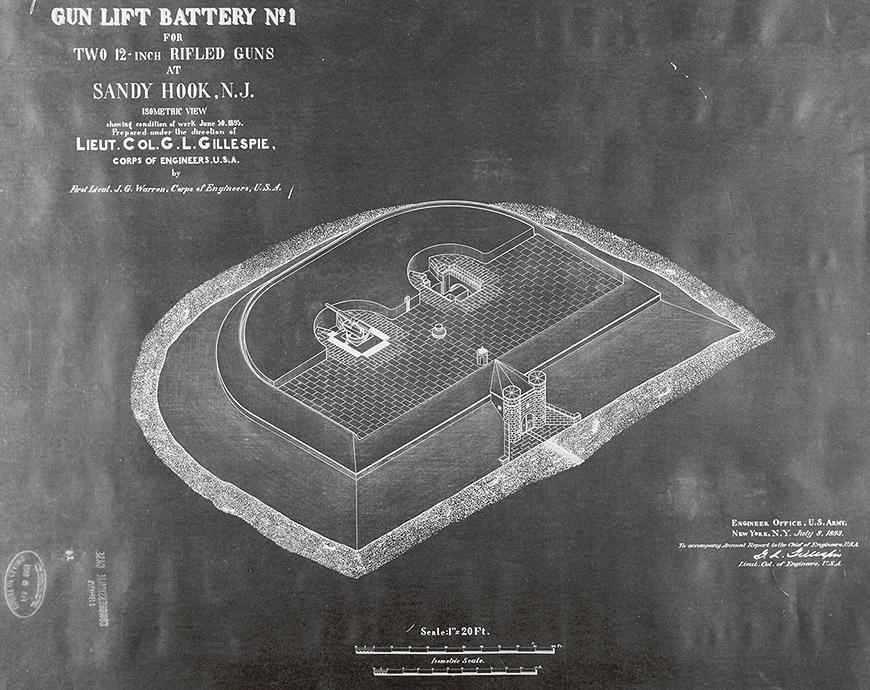
In 1885, the Board of Fortifications under Secretary of War William Endicott recommended replacing every coastal defense in the country. New York received the most elaborate upgrades. Disappearing guns, which hid behind concrete-and-earth parapets until raised to fire, replaced the old stone-walled forts. Fort Hancock at Sandy Hook, Fort Hamilton in Brooklyn, and Fort Wadsworth on Staten Island all received batteries of these ingenious weapons, along with controlled minefields in the harbor channels.
The Black Tom explosion of 1916, a sabotage attack on a munitions depot in Jersey City, demonstrated the harbor's vulnerability to unconventional threats. World War I brought rapid mobilization, and the Coast Artillery supplied experienced gun crews for heavy artillery on the Western Front. World War II saw another round of construction, including the installation of long-range 16-inch guns at Fort Tilden in Queens. But the atomic age rendered it all obsolete overnight. By 1948, the gun defenses were scrapped. Nike missile batteries replaced them in the 1950s, then were themselves removed in the early 1970s. Today, Fort Wadsworth, Fort Tilden, and Fort Hancock are parts of the Gateway National Recreation Area, and Castle Williams and Fort Jay welcome visitors to Governors Island.
From the Air
The harbor defense network spans the entire New York Harbor area, centered around the Narrows at approximately 40.609N, 74.032W. Key sites visible from the air include Fort Wadsworth on Staten Island (below the Verrazzano-Narrows Bridge), Governors Island in Upper New York Bay, Fort Hancock at Sandy Hook, New Jersey, and Fort Tilden in the Rockaways, Queens. Best viewed from 3,000-5,000 feet altitude over the harbor. Nearby airports: KJFK (John F. Kennedy International), KLGA (LaGuardia), KEWR (Newark Liberty International). The ring of former forts is clearly visible encircling the harbor approaches.