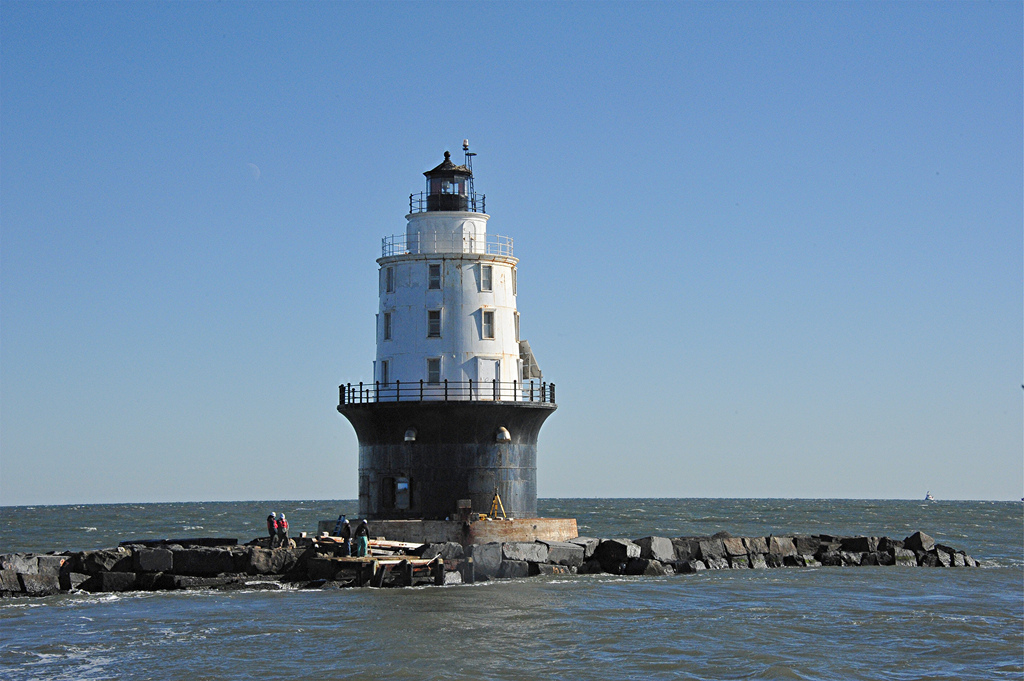
Harbor of Refuge Light
Waves moved the first lighthouse two inches off its foundation in 1918. Two more inches in 1920. By 1925, the United States Lighthouse Service gave up and tore it down. The Atlantic had won that round. But the story of Harbor of Refuge Light is really a story about stubbornness -- the federal government's stubborn insistence that ships needed safe harbor at the mouth of the Delaware Bay, and the ocean's equally stubborn insistence that nothing built by human hands would last there without a fight. The white conical tower standing today at the end of the outer Delaware Breakwater, just off Cape Henlopen, is the third attempt to mark this spot. It was engineered specifically to absorb the worst the Atlantic could deliver, and for a century now, it has.
A Harbor Worth Seventy-Six Years
The effort to build a breakwater off Cape Henlopen began in 1825, when Congress authorized construction of a stone barrier to shelter ships from storms at the mouth of Delaware Bay. That first breakwater took 44 years to complete, finished in 1869. But by then, the US Navy's newer and larger vessels drew too much water for the shallow harbor it created. So a second, outer breakwater was started in 1892, built roughly north of the original. Work on this new barrier was not completed until 1901. The protected waters between the two breakwaters became the National Harbor of Refuge -- a name that took 76 years of construction to earn. On January 1, 1902, a pair of temporary beacons went up at either end. A storm destroyed both the following year.
The Tower That Could Not Stand
In 1906, construction began on a permanent lighthouse for the southern end of the outer breakwater. The brown, cylindrical iron foundation was ready by 1907, and the hexagonal white frame tower -- three stories tall with lead-colored trim and a black lantern -- was completed on November 20, 1908. Inside sat a fourth-order Fresnel lens, flashing white every ten seconds. A first-class fog siren, powered by compressed air, completed the station. The original plans called for brick, but the final design used wood. That choice proved fateful. The station was immediately overmatched by its environment. Storms sent waves cascading completely over the top of the tower. The foundation shifted in 1918 and again in 1920, each time by two inches, until the structure was deemed uninhabitable. The Lighthouse Service dismantled it in 1925, and engineers went back to the drawing board.
Built to Take a Punch
The replacement, established on November 15, 1926, was designed from the ground up to endure the most intense Atlantic storms. The current tower is a white, conical cast-iron structure set on a cast-iron caisson built directly into the breakwater. The pier is lined with reinforced concrete inside; the tower itself is lined with brick. Everything rests on a solid block of concrete within the breakwater stone. The original four-panel fourth-order Fresnel lens revolved on ball bearings, driven by a clockwork mechanism powered by descending weights inside a hollow central iron column -- an elegant piece of engineering that flashed every ten seconds. The design was tested almost immediately. A 1929 storm brought 78-mph winds. Hurricane Donna broke a main-deck window in 1960. The Ash Wednesday Storm of 1962 partially flooded the lighthouse when a wave shattered a second-story window, submerging the breakwater entirely. A ship struck the caisson in 1986. Through it all, the tower held.
From Keepers to Volunteers
The lighthouse was automated in 1973, and keepers no longer climbed its stairs. The Fresnel lens gave way to a DCB-36 Aerobeacon around 1945, which served until 1997. Today a solar-powered Vega VRB-25 beacon flashes white every ten seconds, visible for miles, with two red sectors warning mariners of nearby shoals. The Coast Guard restored the exterior in 1999, the same year the Delaware River and Bay Lighthouse Foundation began its own preservation work. In April 2002, the nonprofit signed a lease to manage the structure. The first public tour was held in June 2003. In 2004, the U.S. Department of the Interior granted the Foundation ownership under the National Historic Lighthouse Preservation Act of 2000. But the lighthouse faces a threat its builders never anticipated: the deterioration of the breakwater beneath it, still owned by the federal government and maintained by the Army Corps of Engineers. An appropriation of nearly $350,000 arrived in the 2008 federal budget, but the Corps and the Foundation estimated at least $2.7 million was needed to stabilize the century-old structure.
The Light Endures
Harbor of Refuge Light remains an active aid to navigation, its solar-powered beacon still guiding vessels into Delaware Bay. Summer tours bring visitors across the water to climb the tower and see the bay as keepers once did -- the sweep of Cape Henlopen, the companion Delaware Breakwater East End Light to the north, the open Atlantic stretching to the horizon. The foundation volunteers who replaced the boarded-up windows, installed a new stainless steel door system, and repaired Hurricane Isabel damage carry forward a tradition that stretches back to 1825: the conviction that this spot at the mouth of the bay is worth defending against the sea, no matter how many times the sea pushes back.
From the Air
Located at 38.81°N, 75.09°W at the end of the outer Delaware Breakwater, just off Cape Henlopen at the mouth of Delaware Bay. The white conical tower is visible against the water from moderate altitude. Look for the long stone breakwater extending into the bay with the lighthouse at its southern tip. The companion Delaware Breakwater East End Light sits at the northern end. Cape Henlopen State Park provides a shoreline reference. Nearest airports: Sussex County Airport (KGED) approximately 15nm west; Delaware Coastal Airport (KGYX) approximately 20nm south. Cape May County Airport (KWWD) across the bay in New Jersey approximately 12nm east. Delaware Bay weather can produce fog, especially in spring and fall; expect sea breezes affecting visibility.