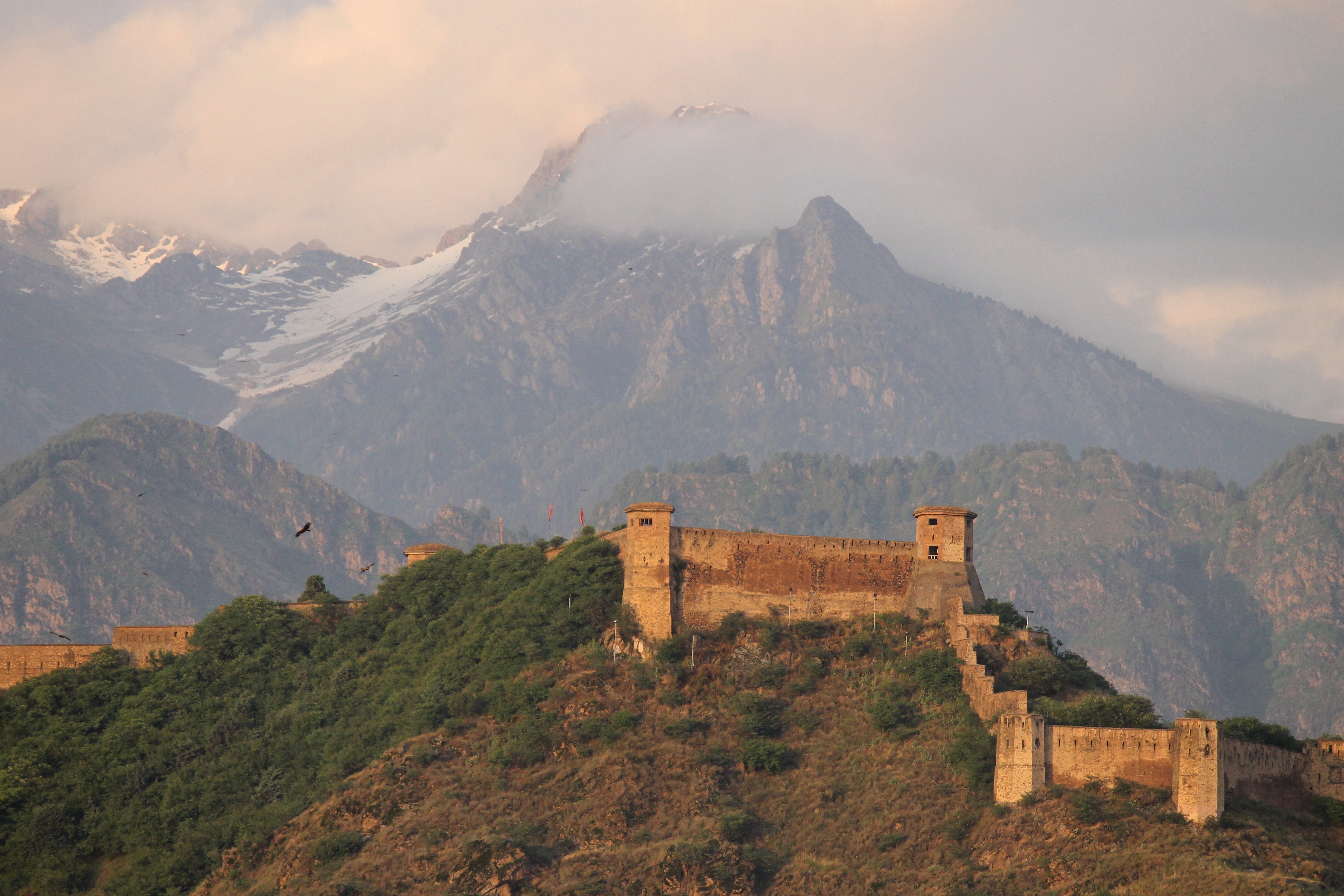
Hari Parbat Fort
Stonemasonry was foreign to Kashmir when Akbar decided to build here. The region's builders worked in wood -- intricately carved, earthquake-resistant timber was the architectural language of the valley. So when the Mughal emperor ordered a fortress atop Hari Parbat hill in Srinagar, he imported two hundred stonemasons from outside Kashmir to do it. The gray limestone walls they raised became Nagar Nagar, a walled city that served as the center of Mughal administration in the valley. That was the late 16th century. In the centuries since, Afghans, Sikhs, Dogras, and the Indian state have each claimed this hilltop, building over and within what came before. The fort that stands today, locally called Koh-e-Maran, is less a single building than a geological record of power in Kashmir.
The Garden That Three Emperors Loved
Akbar did not just build fortifications on Hari Parbat -- he planted a garden. It holds a singular distinction: it is the only palace-garden mentioned in the Tuzuk-i-Jahangiri, the memoirs of Akbar's son and successor Jahangir. When Jahangir visited Srinagar in 1620, he ordered renovations to both the garden and the fort's palace buildings, renaming the garden Nur Afza, meaning "light-increasing." The work was carried out by his trusted official Mutamad Khan. Twenty years later, Jahangir's own successor Shah Jahan visited and found the garden worthy of admiration. Three consecutive Mughal emperors, each drawn to the same hilltop, each compelled to tend and improve what their predecessor had planted. The garden itself has not survived, but the fact of its existence says something about what Hari Parbat meant to the Mughals -- not merely a strategic position, but a place worth cultivating.
An Afghan Governor's Ambition
Of Akbar's walled city, only the rampart and two gateways survived into the Afghan period: the Sangeen Darwaza and the Kathi Darwaza. Within these Mughal walls, Atta Mohammad Khan -- the longest-serving governor of Kashmir under the Durrani Empire -- built a new fortification between 1795 and 1806. His motives were not purely defensive. Khan was making a bid for independent rule, and the fort was part of that assertion of autonomy. He used the same construction method as the Mughal ramparts, stone rubble masonry, but the result was notably less durable. The historian Hamdani attributed this to the turbulent and ephemeral nature of Afghan rule in the region, a period when governors came and went and long-term investment in infrastructure was rare. Khan's fort outlasted his ambitions, but only because the walls he built inside were sheltered by the stronger Mughal walls that surrounded them.
Siege and Surrender
The Sikh Empire took the fort next, and then the British reshaped ownership once more. The 1846 Treaty of Lahore, which ended the First Anglo-Sikh War, included a provision that several Sikh holdings -- Hari Parbat among them -- would be ceded to Gulab Singh, the Dogra ruler who had aided the British victory. But possession on paper did not translate to possession on the ground. Sheikh Imamuddin, the Sikh governor of Kashmir, refused to surrender. He besieged Gulab Singh's forces inside the fort they had come to claim. The standoff lasted weeks before Imamuddin finally lifted the siege and surrendered on October 23, 1846. Gulab Singh took full control of the fort and, with it, the province of Kashmir. A fortress built by Mughals, expanded by Afghans, and contested between Sikhs and Dogras -- each transition of power written into the same stone walls.
A Hilltop Still Claimed
Today Hari Parbat Fort is maintained by the Archaeological Survey of India, though as of 2021 it was occupied by the Central Reserve Police Force. The hill rises prominently above Srinagar's old city, visible from Dal Lake and the surrounding neighborhoods. In 2021, the Indian flag was hoisted at the fort to mark India's 75th anniversary of Independence Day. From the air, Hari Parbat is unmistakable -- a steep, roughly conical hill punctuating the flat expanse of the Kashmir Valley floor, its summit crowned by walls that have watched empires arrive, build, fight, and depart for more than four centuries.
From the Air
Located at 34.106°N, 74.816°E on a prominent hill in central Srinagar, Jammu and Kashmir. Hari Parbat hill is clearly visible from the air, rising above the city with fortification walls along the summit. Dal Lake lies to the east. The nearest airport is Sheikh ul-Alam International Airport (ICAO: VISR), approximately 12 km south of the fort. Best viewed between 5,000 and 12,000 feet for detail of the hilltop fortifications and their relationship to Srinagar's urban fabric.