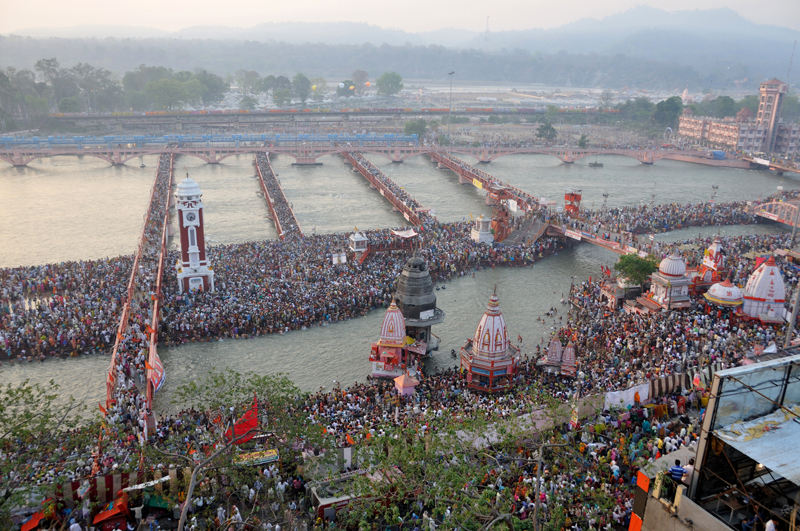
Haridwar Kumbh Mela
Ten million people bathed in the Ganges on a single day in April 2010. Not over the course of a festival or a season -- on one day, in one city, at one stretch of river. The Indian Space Research Organisation took satellite photographs of the crowd, and even from orbit the density of human devotion was unmistakable. This is the Haridwar Kumbh Mela, a pilgrimage that has drawn the faithful to these banks for at least four centuries, and likely much longer. Held every twelve years when Jupiter enters Aquarius and the Sun crosses into Aries, the gathering is timed not by calendar but by celestial mechanics -- an alignment of planets triggering an alignment of people.
The Original Kumbh
Haridwar appears to be where the Kumbh Mela began. The name itself derives from Kumbha, the Sanskrit word for Aquarius, and the twelve-year cycle tied to Jupiter's orbit is documented here earlier than at any of the three other sites -- Prayag, Trimbak, and Ujjain. The earliest texts to use the phrase "Kumbh Mela" -- the Khulasat-ut-Tawarikh of 1695 and the Chahar Gulshan of 1759 -- apply it exclusively to Haridwar's gathering, even while noting similar festivals at Allahabad and Nashik. The Melas at those cities appear to be adaptations of the Haridwar original, grafted onto pre-existing local traditions. By the mid-eighteenth century, the Haridwar Kumbh had grown into a major commercial event for northwestern India, drawing merchants from as far as Arabia alongside the pilgrims and ascetics.
Warriors at the Water's Edge
For centuries, the Kumbh Mela was governed not by any state but by the akharas -- orders of Hindu ascetics who were simultaneously monks, merchants, and soldiers. The Shaivite Gosains carried swords and shields, collected taxes, settled disputes, and ran the entire festival. In 1760, they clashed violently with the Vaishnavite Bairagis, and afterward barred Vaishnavites from bathing at Haridwar for years. The violence ran in both directions. When Captain Thomas Hardwicke attended the 1796 Mela, he estimated the crowd at two to two-and-a-half million. He also witnessed a Sikh army of twelve to fourteen thousand cavalrymen attack the Gosains on the festival's final day, killing some five hundred people, including one of the chief mahants. The British Captain Murray had to deploy sepoys to halt the Sikh advance. By 3 p.m. the cavalry had withdrawn. The next morning, the surviving pilgrims offered prayers for the English soldiers who had intervened.
Cholera and the Cost of Devotion
The 1783 Kumbh Mela brought between one and two million visitors to Haridwar. More than twenty thousand of them died of cholera within the first eight days. The epidemic was eerily contained: the neighboring village of Jwalapur, just eight miles away, recorded no cases at all. Over the next century and a half, cholera shadowed every gathering. Mass bathing contaminated the Ganges, and pilgrims carried the sacred water home for relatives to sip -- transmitting the disease far beyond Haridwar. The death tolls were staggering: nearly 170,000 at the 1891 Kumbh, almost 150,000 at the 1921 Ardh Kumbh. Although Waldemar Haffkine had developed a cholera vaccine, the British Indian government resisted compulsory vaccination for decades, fearing political backlash. It was not until 1945, after yet another outbreak, that authorities finally mandated vaccinations at the Mela.
Multitudes of Every Religious Order
What makes the Kumbh Mela extraordinary is not just its scale but its porousness. Baptist missionary John Chamberlain preached at the 1814 Ardh Kumbh and was astonished to find that Sikhs outnumbered Hindus. He drew crowds of eight thousand listeners by his tenth day. Europeans rode in on elephants for the novelty. Begum Samru of Sardhana arrived with a retinue of a thousand cavalry and fifteen hundred infantry. Hindu rajas, Muslim nawabs, Sikh royals, and Christian missionaries distributing Bibles translated into "the various dialects of the East" all jostled for space along the same ghats. The Kumbh Mela has always been a place where the boundaries between sacred and commercial, devotion and spectacle, blur until they are almost indistinguishable -- a quality that persists today.
Faith in the Modern Age
Modern Kumbh Melas are exercises in logistics on a nearly inconceivable scale. In 2010, roughly forty million people bathed in the Ganges over the course of the festival. Indian Railways ran special trains to accommodate the flow. The 1998 Mela featured luxury tent facilities, badminton courts, whitewater rafting, and -- somewhat inexplicably -- a Tyrannosaurus rex display. But tragedy still attends the crush. Forty-seven people died in a stampede in 1986, and at least five more in 2010. The 2021 Kumbh Mela, held during the COVID-19 pandemic, drew nearly a million bathers on a single April day despite rising case counts. Within ten days, sixty-eight seers had tested positive, and one akhada leader, Mahamandaleshwar Kapil Dev Das, died of the virus. The Niranjani Akhara withdrew from the Shahi Snan. The gathering that had survived conquest, cholera, and colonial rule found itself confronting a new kind of threat -- one that could not be washed away.
From the Air
Located at 29.96°N, 78.17°E in the state of Uttarakhand, where the Ganges emerges from the Shivalik Hills onto the Indo-Gangetic Plain. The Har Ki Pauri ghat complex is visible along the river's western bank. Nearest major airport is Jolly Grant Airport (VIDN) in Dehradun, approximately 35 km to the northwest. From cruising altitude, the vast temporary city of tents erected during Kumbh Mela years can be spotted stretching along both banks of the river.