Harley-Davidson
The first one couldn't make it up a hill. In 1903, twenty-one-year-old William S. Harley and his childhood friend Arthur Davidson finished their motor-bicycle in a Milwaukee machine shop, took it outside, and discovered it couldn't climb the hills around the city without pedal assistance. They called it a 'valuable learning experiment' and went back to the shed - literally, a ten-by-fifteen-foot wooden structure in the Davidson family backyard - to build something better. The next prototype had a bigger engine, help from outboard motor pioneer Ole Evinrude, and enough power to compete in a race at State Fair Park by September 1904. From that backyard shed, Harley-Davidson would grow into the largest motorcycle manufacturer in the world, survive every catastrophe the twentieth century could throw at it, and become synonymous with a particular American idea of freedom on two wheels.
The Shed on Juneau Avenue
William Harley drew up plans for his first small engine in 1901 - a 116cc unit with four-inch flywheels, designed for a pedal-bicycle frame. He and Arthur Davidson worked on it in their friend Henry Melk's machine shop, and Arthur's brother Walter joined to help finish the job. The oldest Davidson brother, William A., was a toolroom foreman at the West Milwaukee railshops and likely fabricated some of the prototype's major parts there. By 1907, all four men were working full-time for the company. Production jumped from 450 motorcycles in 1908 to 1,149 in 1909. Their early V-Twin engine, introduced in prototype form at the 1907 Chicago Automobile Show with its distinctive 45-degree cylinder angle, would become the defining feature of the brand. By 1913, the original shed had been replaced by a five-story factory stretching two blocks along Juneau Avenue. By 1920, Harley-Davidson was the largest motorcycle manufacturer in the world, with 28,189 machines produced and dealers in 67 countries.
War Machines and Survival
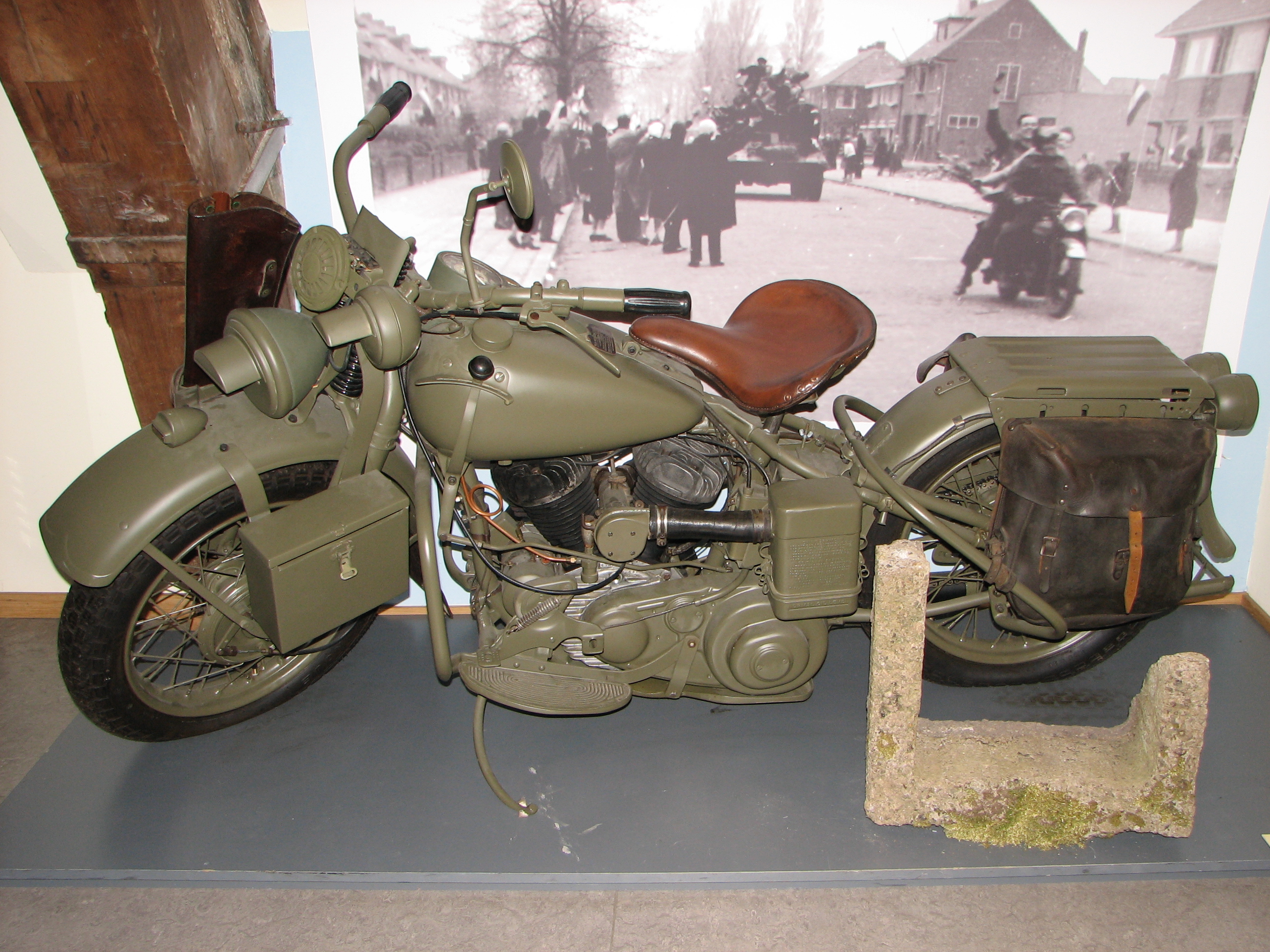
Harley-Davidson has been a military supplier since the Pancho Villa Expedition, but the world wars defined the company's relationship with the American armed forces. The U.S. military purchased over 20,000 motorcycles from Harley-Davidson during World War I. In World War II, the scale was staggering: some 90,000 military motorcycles, mostly the WLA and its Canadian variant the WLC, rolled out of Milwaukee's factories. At least 30,000 went to the Soviet Union under Lend-Lease. Harley-Davidson received two Army-Navy 'E' Awards for production excellence, in 1943 and 1945. The Army even asked Harley to copy a BMW flat-twin design, resulting in the shaft-driven XA - an engineering departure so radical it shared nothing with any prior Harley engine. Only about 1,000 were built before the Jeep made military motorcycles largely obsolete. The Depression had nearly killed the company - sales collapsed from 21,000 in 1929 to just 3,703 in 1933 - but war production pulled it through and funded the postwar civilian boom.
The Dark Years and the Buyback
In 1969, American Machine and Foundry bought Harley-Davidson, slashed the workforce, and streamlined production. Quality plummeted. Japanese manufacturers, led by Honda with its reliable, affordable machines, were revolutionizing the North American market. Harley-Davidson's bikes were expensive and inferior in performance, handling, and build quality. The nickname 'Hog' became an insult. The company teetered toward bankruptcy. In 1981, a group of thirteen investors led by Vaughn Beals and Willie G. Davidson - grandson of co-founder William A. Davidson - bought the company back from AMF for $80 million. Rather than trying to out-engineer Japan, the new management made a brilliant strategic decision: they leaned into Harley's 'retro' appeal, building machines that deliberately evoked the look and feel of the company's golden age. They improved quality by adopting just-in-time manufacturing and won tariff protections from the Reagan administration in 1983 to buy time. The 1984 Softail, with its hidden rear suspension mimicking the hardtail choppers of the 1960s, became a symbol of the revival.
The Sound You Can't Trademark
In 1994, Harley-Davidson tried to trademark a sound. The company filed an application describing 'the exhaust sound of applicant's motorcycles, produced by V-twin, common crankpin motorcycle engines when the goods are in use.' That distinctive potato-potato-potato idle comes from the 45-degree V-twin's uneven firing interval - a quirk of physics that no amount of engineering refinement has ever eliminated, and that no Harley rider would want eliminated. Nine competitors objected, pointing out that any single-crankpin V-twin engine produces a similar rumble. After six years of litigation, Harley-Davidson dropped the effort in 2000. The sound remains unregistered but unmistakable. Earlier, in 1991, the company had joined the Sound Quality Working Group to study motorcycle acoustics at Talladega Superspeedway, trying to lower noise levels for European standards while preserving the character that riders loved. The resulting bikes met EU regulations for 1998 without losing their voice.
Milwaukee's Museum on Two Wheels
The $75 million Harley-Davidson Museum opened in 2008 in Milwaukee's Menomonee Valley, a 130,000-square-foot shrine to the company's history. Inside are hundreds of historic motorcycles, from the earliest singles to wartime WLAs to the bikes that defined American motorcycle culture. The corporate headquarters remains in Milwaukee at the site where those first motorcycles were built over a century ago. Harley-Davidson today manufactures at factories in York, Pennsylvania; Menomonee Falls and Tomahawk, Wisconsin; Manaus, Brazil; and Rayong, Thailand. The company celebrated its centennial in 2003 with a concert featuring Elton John, the Doobie Brothers, Kid Rock, and Tim McGraw. From the air, the Menomonee Valley museum complex sits along the river south of downtown Milwaukee, its parking lot often packed with the gleaming machines of visiting riders making a pilgrimage to the place where it all started - in a shed that could barely fit a motorcycle.
From the Air
Coordinates: 43.0461N, 87.9600W. Harley-Davidson's corporate headquarters is located in Milwaukee, Wisconsin, along Juneau Avenue on the city's west side. The Harley-Davidson Museum sits in the Menomonee Valley, south of downtown Milwaukee along the Menomonee River at approximately 43.031N, 87.916W. Both sites are visible from 2,000-4,000 feet AGL. The museum's large complex with its distinctive parking areas full of motorcycles is identifiable from the air. Nearest major airport: Milwaukee Mitchell International (KMKE), approximately 6nm south. Lawrence J. Timmerman Airport (KMWC) is roughly 5nm northwest. Lake Michigan's western shoreline and the Milwaukee River system provide clear orientation. The Menomonee Valley industrial corridor runs east-west south of downtown.