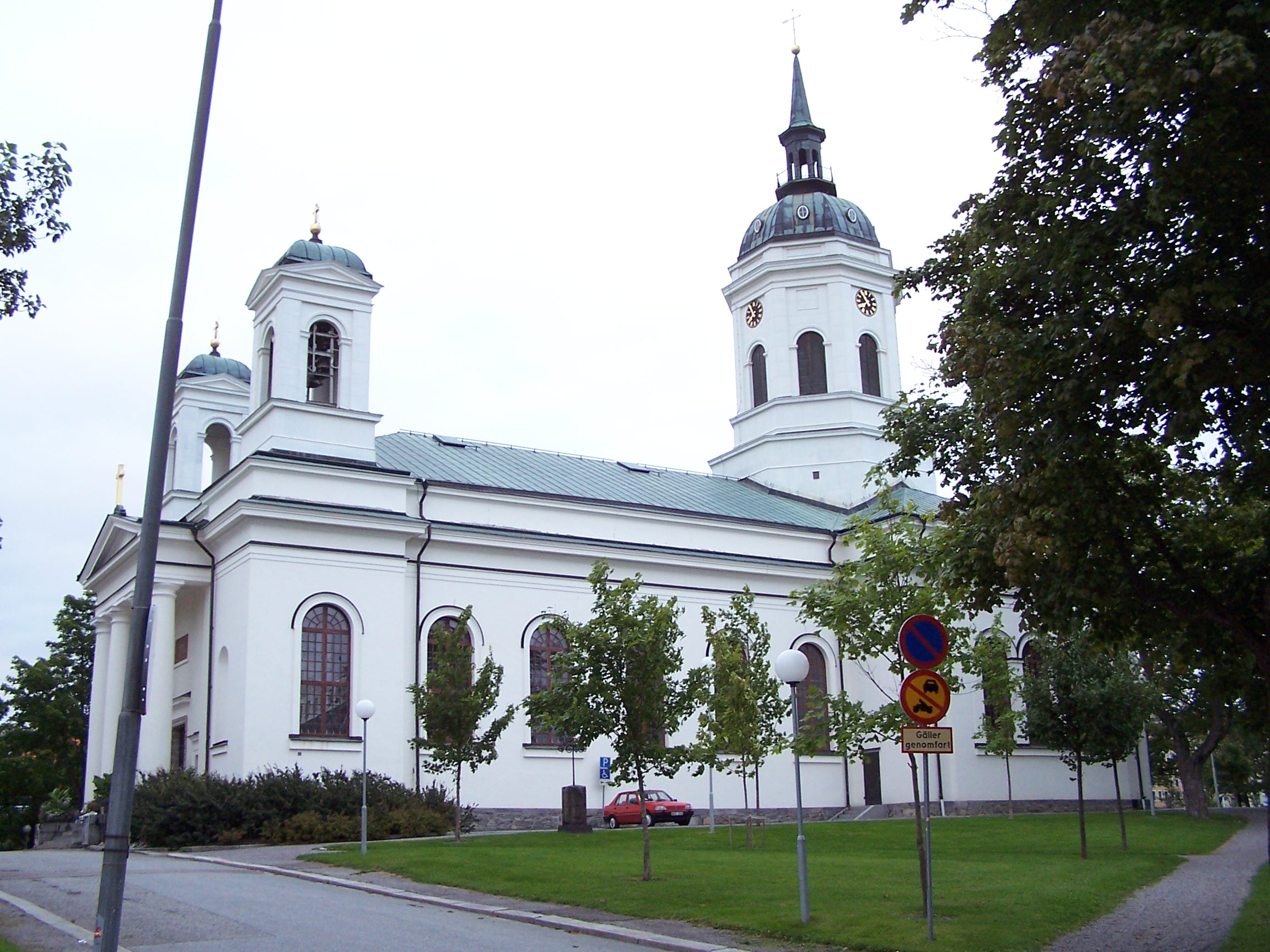
Härnösand Cathedral
Sweden's smallest cathedral holds centuries of survival inside its modest walls. Härnösand Cathedral sits in the coastal town of Härnösand in Västernorrland County, serving the Diocese of Härnösand of the Church of Sweden. From the top of its 46-meter tower, the entire town is visible—a panorama that encompasses harbor, hills, and the northern Swedish coastline. What the view does not immediately reveal is the layered history beneath: a site where churches have stood since 1593, where fire and war have destroyed what faith rebuilt, and where the present structure, inaugurated on June 28, 1846, carries within it artifacts rescued from the flames of earlier sanctuaries.
Burned by Invaders, Rebuilt by Believers
Härnösand's first church went up in 1593, in the decades when Sweden was consolidating its presence along the northern coast. For over a century it served the growing community, accumulating the kind of sacred objects that small northern congregations treasured—including four chandeliers from the seventeenth century that somehow survived everything that followed. In 1721, Russian troops burned the church to the ground during the Great Northern War's campaigns along the Swedish coast. A replacement was erected, but that building too was eventually destroyed. The present cathedral, designed by architect Johan Adolf Hawerman and inaugurated in 1846, stands on the same ground as the original. It is the third church on this site, and it carries forward what could be saved from its predecessors—including those four chandeliers, still hanging, still lit, more than three hundred years after they were first installed.
Treasures Gathered Over Centuries
What makes Härnösand Cathedral remarkable is not its size but its collection. The altar painting is by David von Coln, a German-Swedish artist who lived from 1689 to 1763, and it anchors the sanctuary with a work that predates the current building by nearly a century. The baptismal font is a Spanish rococo piece, crafted in silver in 1777—an object whose journey from Iberian workshops to an Arctic Swedish diocese hints at the trade networks that connected even remote Scandinavian towns to the wider European world. The organ, built in 1975 by the Danish firm Bruno Christensen & Sønner Orgelbyggeri, has 57 stops and fills the nave with a sound disproportionate to the building's intimate scale. Its facade, however, is older than the cathedral itself: it comes from the original Cahman organ saved from the church that stood here before the Russian burning. Old facade, new mechanism—a fitting metaphor for the building it inhabits.
Bells Over the Harbor
In 1981, the cathedral received a 37-bell carillon, making it one of the northernmost carillon installations in the world. A carillon is not a simple set of bells; it is a musical instrument requiring a trained carillonneur to play, with each bell tuned to a specific pitch and controlled by a keyboard of wooden batons and foot pedals. The sound carries across Härnösand's compact townscape—over the harbor, through the narrow streets, up the hillsides—in a way that connects the cathedral to the daily life of the community rather than confining its presence to Sunday services. The Nordic Society for Campanology and Carillons recognizes the Härnösand instrument as part of Sweden's carillon heritage, a tradition that remains small but deeply valued in the Scandinavian countries. For a building that calls itself Sweden's smallest cathedral, the voice it projects through those 37 bells is anything but small.
Small Cathedral, Long Reach
The Diocese of Härnösand extends across a vast stretch of northern Sweden, and this modest cathedral is its spiritual center. There is something fitting about that contrast—a diocese covering thousands of square kilometers of forest, mountain, and coast, governed from a church you can walk around in under a minute. Härnösand itself is a town shaped by its position on the Gulf of Bothnia, where the Swedish coast bends northward toward the Arctic. The cathedral's 46-meter tower serves as both landmark and lookout, a vertical anchor in a horizontal landscape of water and sky. Visitors who climb to the top find a view that explains why this spot was chosen for a church more than four centuries ago: it is a place where you can see everything, and where everything can see you. The cathedral has been destroyed twice and rebuilt twice, and each time the community chose the same ground. Some locations demand a church.
From the Air
Härnösand Cathedral is located at 62.63°N, 17.94°E in the town of Härnösand on the coast of Västernorrland County, Sweden. From the air, the cathedral's 46-meter tower is visible as the tallest structure in the compact town center, situated on the western shore of the Gulf of Bothnia. The town sits on a peninsula and nearby islands, with the Ångerman River estuary to the south. Best viewed at 2,000–5,000 ft. Nearest airport: Härnösand/Sundsvall-Härnösand Airport (ESNN) is nearby, though Sundsvall-Timrå Airport (ESNN) approximately 50 km south is the main regional airport. Mid Sweden Airport (ESNS, Sundsvall-Timrå) serves the region.