Harrow and Wealdstone: Britain's Worst Peacetime Rail Disaster
The guard was walking back toward his brake van when the world ended. At 8:19 on the morning of 8 October 1952, just as the 7:31 local train from Tring sat at platform 4 of Harrow and Wealdstone station with approximately 800 passengers aboard, an overnight express from Perth smashed into its rear at roughly 50 miles per hour. Before anyone could react, the wreckage from the first collision spread across the adjacent track, and seconds later a double-headed express bound for Liverpool and Manchester plowed through it at 60 miles per hour from the opposite direction. Three trains, carrying over a thousand people, collapsed into a mountain of twisted steel 45 yards long, 18 yards wide, and 6 yards high. The Perth locomotive was completely buried. One hundred and twelve people would die.
Three Trains, Thirty Seconds
The Perth express had been running 80 minutes late because of fog. Its driver, described in the subsequent inquiry as 'a methodical young man' in good health, had passed a caution signal and two danger signals without slowing. The reason was never established -- both the driver and his fireman died in the collision. The inquiry speculated that a patch of dense fog at the distant signal, which at 50 miles per hour would have been visible for only four seconds or less, may have caused him to miss it. Having missed the first warning, he may have continued forward expecting different signals than the ones ahead of him. The local train, seven minutes late itself, was busier than usual because the next Tring service had been cancelled. When the Perth express struck, the rear three coaches were destroyed, the wooden bodies of the last two shattered entirely and telescoped with the next steel-bodied coach into the space of a single carriage.
The Angel of Platform Six
Emergency services arrived within three minutes. The fire brigade, ambulance, and police were joined by an unexpected force: a medical unit from the United States Air Force, stationed at nearby RAF South Ruislip. Among them was Abbie Sweetwine, an African American nurse who worked with such dedication amid the carnage that the press named her 'The Angel of Platform Six.' The Salvation Army and Women's Voluntary Service arrived. Local residents brought blankets and tea. The first ambulance left at 8:27, and by 12:15 most of the injured had been evacuated. The search for survivors continued until 1:30 the following morning. Of the 112 who died, 102 perished at the scene. At least 64 of the dead were passengers on the local train, the crowded commuter service that bore the brunt of both impacts.
What the Wreckage Taught
The Ministry of Transport inquiry, published in June 1953, could not determine why the driver of the Perth express had failed to respond to signals. But it could measure the consequences. The report noted that coaches built to the new British Railways standard -- all-steel construction with buck-eye couplings and welded bodies -- had performed significantly better than older wooden stock. Only eight people died in the leading seven coaches of the Liverpool train, which included newer carriages. The rear coaches of the local train, built to older standards, had disintegrated. The disparity pointed directly to a future of better-designed rolling stock, but the more immediate lesson concerned signaling.
A System That Remembers
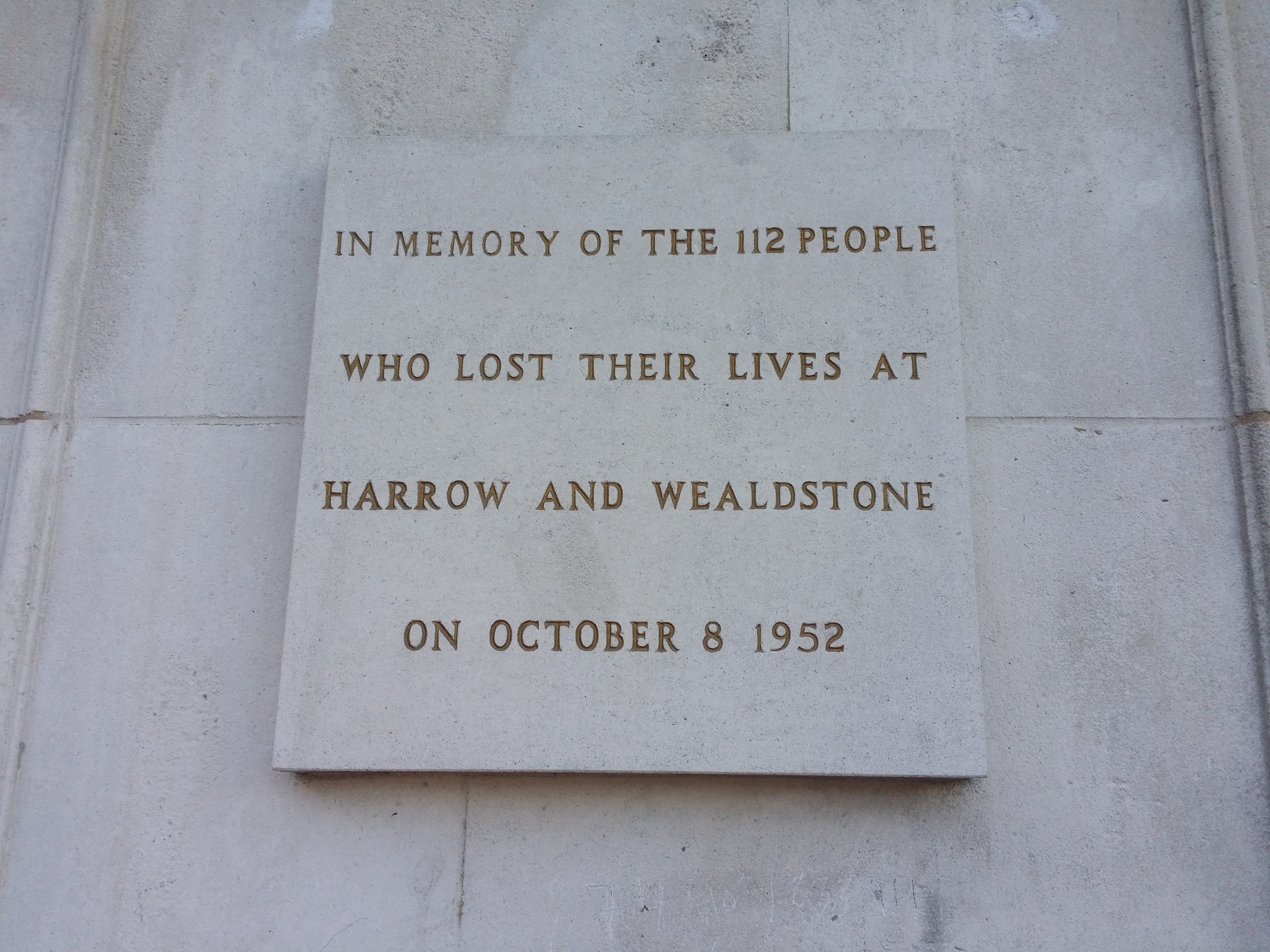
British Railways had been developing the Automatic Warning System, which would give drivers an audible and visual warning when approaching a signal at caution, automatically applying the brakes unless the driver actively acknowledged the alert. The inquiry calculated that such a system could have prevented ten percent of all railway accidents in the previous forty-one years, saving 399 lives. The Harrow disaster ended the debate. By the time the report was published, British Railways had agreed to a five-year plan to install AWS magnets on 1,332 miles of track. The report's final words were pointed: 'At this late stage there should be no reservations on the rate of progress.' A memorial plaque was unveiled at the station in 2002, marking the fiftieth anniversary. A mural painted by children from local schools commemorates the victims along the bordering road. The station itself, rebuilt and modernized, remains on the West Coast Main Line, 11 miles from Euston. Trains pass through every few minutes. The system that now watches over them was born from the wreckage of that October morning.
From the Air
Harrow and Wealdstone station is located in Wealdstone, northwest London (51.592N, 0.335W), on the West Coast Main Line approximately 11 miles from Euston. The station is visible from the air where the railway lines pass through the suburban streets, with the Bakerloo Line terminus adjacent. Nearest airports are RAF Northolt (EGWU) 6km southwest and London Heathrow (EGLL) 18km south. From altitude, look for the railway corridor running north-south through the terraced streets of Harrow.