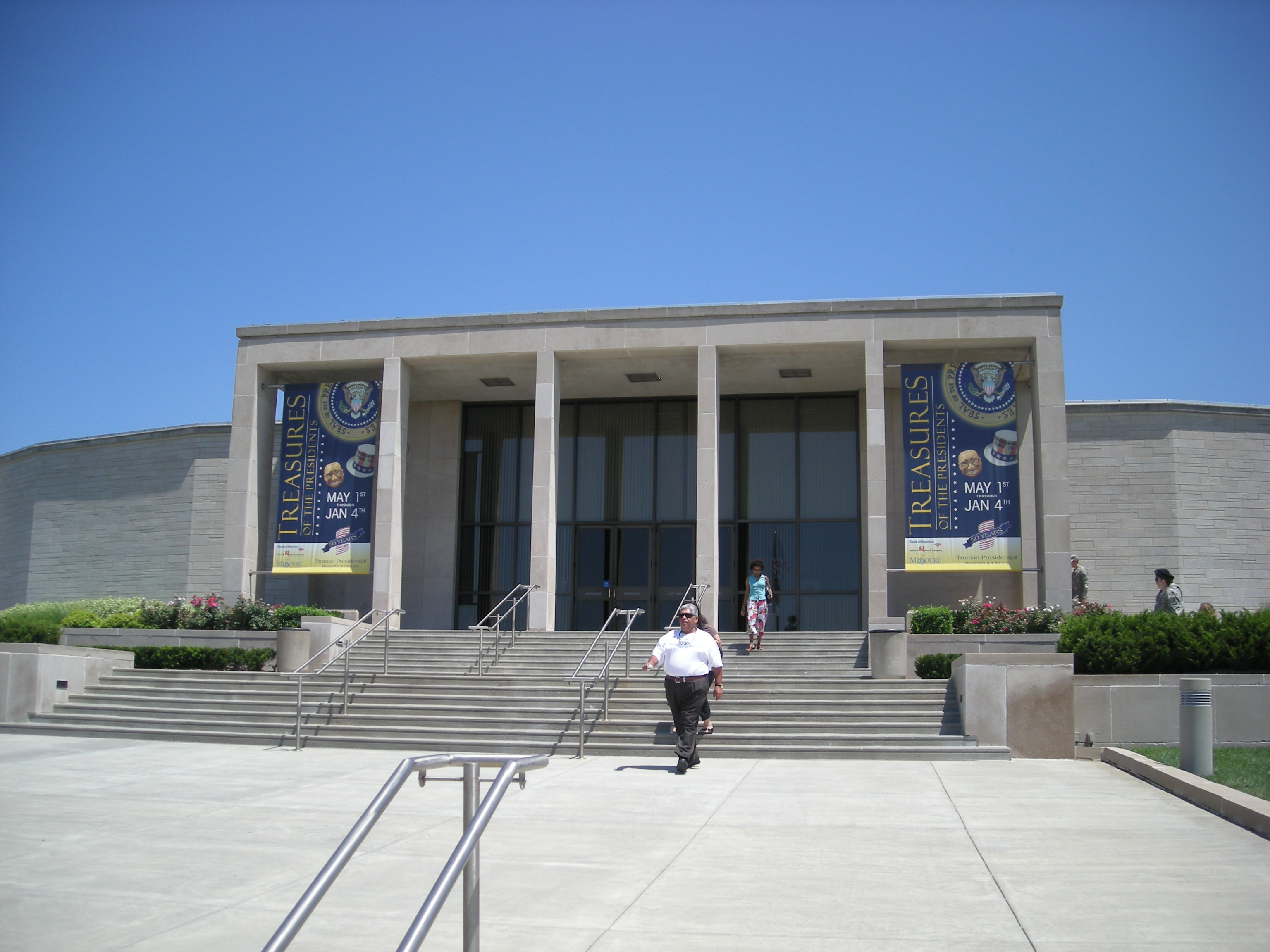
Harry S. Truman Presidential Library and Museum
The phone rang at the Harry S. Truman Presidential Library and Museum. A caller wanted directions. The voice on the other end told them how to get there, then added cheerfully that he was 'the man himself.' It was not a joke. After his presidency ended in 1953, Harry Truman worked at the library five or six days a week, personally training docents, holding impromptu press conferences for visiting schoolchildren, and occasionally answering the telephone. He arrived before the staff most mornings. The library was his creation -- the first presidential library built under the provisions of the 1955 Presidential Libraries Act -- and he treated it with the pride and attention of a man who had spent years fundraising for it by attending dinners, making speeches, and writing thousands of personal letters.
A Hilltop Dedication
Built on a hill overlooking the Kansas City skyline, on land donated by the City of Independence, the library was dedicated on July 6, 1957. The ceremony included Masonic Rites of Dedication and was attended by former president Herbert Hoover -- then the only living former president besides Truman -- as well as Chief Justice Earl Warren and former first lady Eleanor Roosevelt. The building itself has a complicated design history. Truman originally wanted it to resemble his maternal grandfather Solomon Young's farmhouse in Grandview. The architect, Edward Neild, died on July 6, 1955, while working on the design, and the project was completed by Alonzo H. Gentry. When the New York Times detected Frank Lloyd Wright influences in the horizontal design, Truman reportedly quipped, 'It's got too much of that fellow in it to suit me.' The lobby walls carry Independence and the Opening of the West, a mural painted on site over three years by Thomas Hart Benton, completed in 1961.
Where Medicare Was Born
The library became a stage for presidential history beyond Truman's own story. On July 30, 1965, President Lyndon B. Johnson chose this building -- not the White House -- to sign the Medicare Act, honoring Truman as an early champion of national health insurance. Visitors after Truman's active years included incumbent presidents Ford, Carter, and Clinton, as well as presidential nominees John Kerry and John McCain. During Truman's lifetime, his guest list ranged from presidents Eisenhower, Kennedy, Johnson, and Nixon to Jack Benny, Ginger Rogers, Robert F. Kennedy, Thomas Hart Benton, and Dean Acheson. The library's full-sized replica of the Oval Office pioneered a feature that has since been copied by every subsequent presidential library from Kennedy's through George W. Bush's.
The Million-Dollar Mystery
The museum has been victimized by two significant burglaries. In March 1962, Treasury Secretary John Wesley Snyder donated 450 rare coins to the museum. That November, burglars stole the entire collection. None were recovered. Snyder coordinated 147 coin collectors to reconstruct the collection, which went back on display in 1967. The second theft was more dramatic. While serving as president, Truman had received jewel-encrusted ceremonial swords and daggers from Crown Prince Saud of Saudi Arabia and the Shah of Iran. According to the museum curator, the weapons 'had embedded diamonds and rubies and sapphires, a number of precious stones in their hilts and in their scabbards.' In March 1978, burglars broke through the front door, smashed showcases, and stole three swords and two daggers valued at $1 million. None have been recovered. In 2021, the FBI posted a reward of up to $1 million for the items' return.
The Office That Time Forgot
When Truman left the White House in 1953, he set up an office in Room 1107 of the Federal Reserve Bank of Kansas City. He transferred it to the library when the building opened in 1957. In the office, he wrote articles, letters, and his book Mr. Citizen. A $1.6 million preservation project completed in 2009 enclosed the office in a limestone pavilion with updated climate control. The office appears today exactly as it did when Harry Truman died on December 26, 1972 -- the desk, the papers, the personal effects frozen in place. Funeral services were held in the library's auditorium, and burial took place in the courtyard. Bess was buried beside him in 1982. Their daughter Margaret and her husband Clifton Daniel were later interred there as well. The courtyard has become a family resting place as much as a presidential memorial -- intimate, personal, and very much in keeping with Truman's unpretentious character.
From the Air
Located at 39.1033°N, 94.4208°W on U.S. Highway 24 in Independence, Missouri. The library sits on a hilltop overlooking the Kansas City skyline to the west, which makes the general area identifiable from altitude. Kansas City International (KMCI) is approximately 30 miles northwest. Lee's Summit Municipal Airport (KLXT) is roughly 12 miles south. Charles B. Wheeler Downtown Airport (KMKC) is about 12 miles west. The Harry S. Truman National Historic Site (the Truman Home) is nearby at 219 North Delaware Street. From 3,000-5,000 feet, the library grounds and the adjacent residential streets of Independence's historic district are visible, though the building itself is modest in footprint.