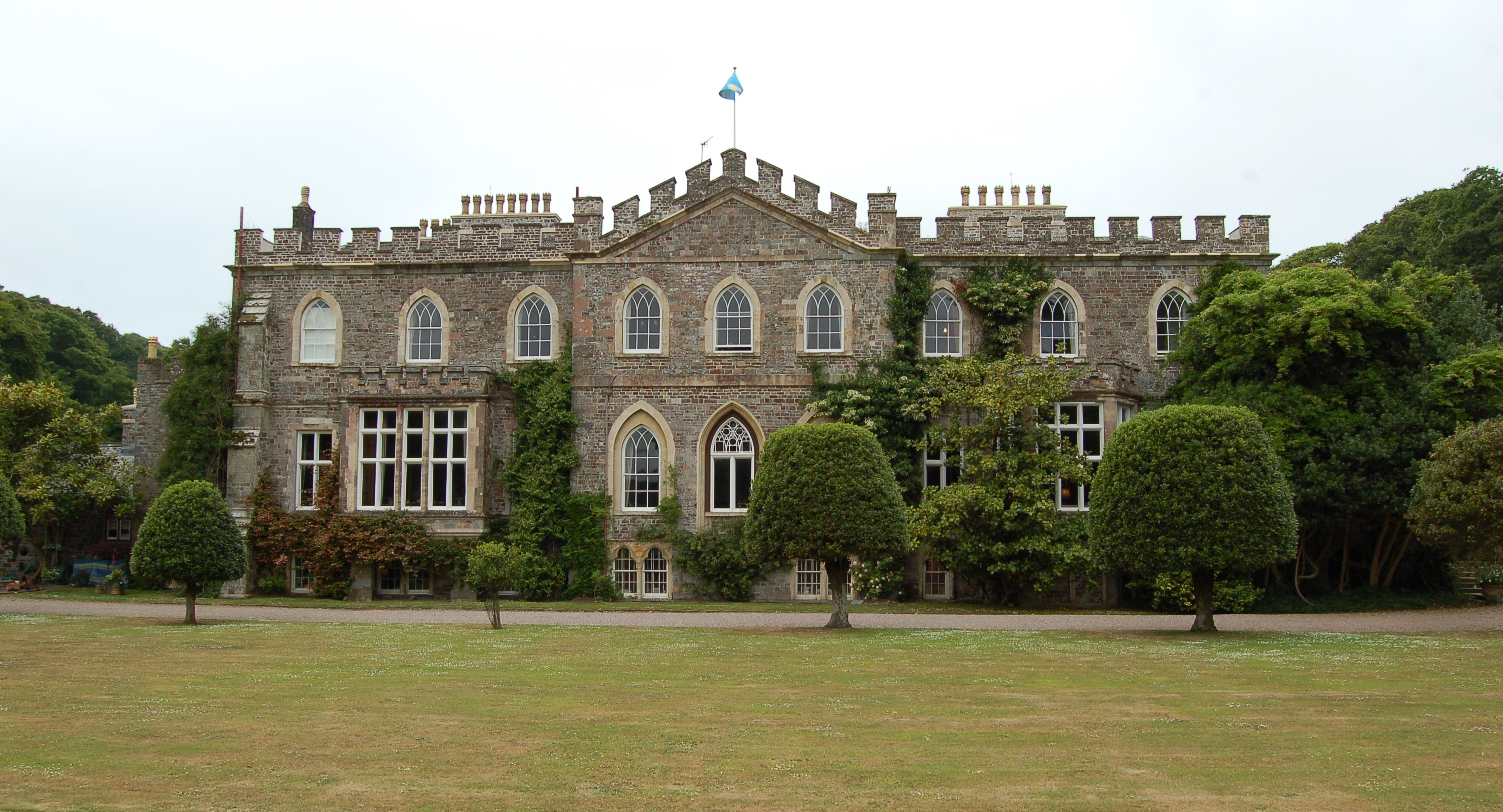
Hartland Abbey
When Henry VIII dissolved Hartland Abbey in 1539, he did not hand it to a nobleman or a military commander. He gave it to William Abbot, his Sergeant of the Wine Cellar at Hampton Court. The building that Augustinian canons had occupied since 1157 -- consecrated by the future Bishop of Exeter, Bartholomew Iscanus, patronized by the Botreaux family of Boscastle -- passed into the hands of the man who kept the king's claret flowing. It is a detail that says everything about the Dissolution: pragmatic, arbitrary, and occasionally absurd. Nearly five centuries later, Hartland Abbey is still a private family home, owned by the Stucleys, and the layers of its reinvention are visible in every room.
The Augustinian Centuries
The abbey was built in 1157 in the Blackpool Valley, a sheltered fold in the wild coast of North Devon near Hartland Point. Bartholomew Iscanus consecrated it in 1160, a year before his appointment as Bishop of Exeter. The foundation followed the Augustinian order, and its most generous patrons were the Botreaux family of nearby Boscastle in Cornwall, whose male heirs were apparently all named William until the line died out with the 3rd Baron Botreaux in 1462. In 1187 a William de Botreaux donated the advowsons of churches in his manors of Molland and Knowstone in Devon, and of Forrabury in his Cornish manor of Boscastle. King Richard I confirmed these grants by charter, and the property was officially converted into an Augustinian abbey in 1189. For 350 years, the canons lived, worked, and prayed in their remote valley, sustained by the agricultural produce of the surrounding parish and the generosity of their noble benefactors.
Centuries of Reinvention
The present house is a palimpsest. Tudor wainscoting survives from the earliest post-Dissolution conversion. In 1705, the architect John Meadows added two wings -- one of his last commissions before his death. The interior preserves examples of Batty Langley's 'Gothik' work, and at some point the main ranges were taken down to cloister level and rebuilt in the Strawberry Hill Gothic style popularized by Lord Walpole. The most dramatic transformation came in the mid-1800s when Sir George Stucley engaged George Gilbert Scott to remodel the building. Scott gave it a formal entrance with a new porch on the north end and installed bay windows on the east frontage. The drawing room and dining room were finished in a style reminiscent of the Palace of Westminster, with fine wall paneling -- Elizabethan in the dining room, linenfold in the drawing room. Both rooms feature painted murals by Alfred Beer of Exeter, depicting events in English and Irish history in which Stucley believed his ancestors had participated. The main passage was decorated in the style and colors of the Alhambra Palace, which Sir George had recently visited. Even the gardens bear a famous signature: they were laid out by Gertrude Jekyll.
Where the Cameras Roll
Hartland Abbey's remoteness, which once isolated its monks, now makes it irresistible to filmmakers seeking landscapes untouched by modernity. The Hartland Quay Hotel, part of the estate, has hosted crews since Disney's 1950 adaptation of Treasure Island. The Blackpool cottage on the estate served as Mrs Dashwood's home in the 2008 BBC adaptation of Sense and Sensibility and later appeared in the 2016 BBC/AMC series The Night Manager. The estate has provided settings for a screen version of Rosamunde Pilcher's novel The Shell Seekers, an edition of the BBC's Antiques Roadshow in 2012, a sequence for Top Gear, and the CBBC children's series Malory Towers, broadcast in 2020. The North Devon coast around the estate offers dramatic cliff scenery, rock formations, and crashing surf -- visual drama that no set designer could improve.
An Abbey in the Landscape
What strikes you about Hartland Abbey is its setting as much as its architecture. The Blackpool Valley runs down to the coast near Hartland Point, where the Bristol Channel meets the Atlantic. The cliffs here are among the most exposed in England, battered by prevailing westerly winds and winter storms. That the Augustinian canons chose this valley in 1157 speaks to the monastic preference for remote, self-sufficient locations -- places where the rhythms of prayer and agriculture could proceed without worldly interruption. That the Stucleys have maintained it as a family home for centuries speaks to something else: the stubborn English attachment to houses that are beautiful but impractical, historic but expensive, beloved but beleaguered. The abbey that began as a place of contemplation has survived the Dissolution, multiple architectural transformations, and the economics of maintaining a Grade II-listed country estate. It endures, like the valley itself, by adapting to whatever each century demands.
From the Air
Located at 51.00N, 4.51W in the Blackpool Valley near Hartland Point on the North Devon coast. The abbey buildings sit in a sheltered valley running down toward dramatic cliffs where the Bristol Channel meets the Atlantic. Nearest airports: Exeter (EGTE) 50 miles east, Barnstaple/Chivenor area. Best viewed at 1,500-2,500 feet to see the contrast between the sheltered valley and the exposed coastline.