Hartley Colliery disaster
The beam weighed forty tons. When it snapped at ten minutes past ten on the morning of 16 January 1862, half of it -- roughly twenty tons of cast iron -- plunged into the only shaft at Hartley Colliery, carrying with it a cascade of masonry, timber, and iron that sealed the passage completely. Below ground, 199 men and boys heard the crash and felt the ventilation stop. Above, the pit village began a frantic effort to reach them. It would take days to clear the shaft, and by then every one of them would be dead -- not from the falling beam, but from the slow, invisible suffocation of carbon dioxide accumulating in the sealed mine.
One Shaft, One Way Out
Hartley's Hester Pit had been sunk in the 1840s to work coal seams at depth, replacing an older pit that had been abandoned because of severe flooding. Like many collieries of the era, it had only a single shaft, divided by a wooden partition called a brattice into an upcast and a downcast side. A massive beam engine pumped water from the workings, its cast-iron beam rocking back and forth above the shaft mouth. At 10:10 am on that Thursday morning, the beam fractured and half of it plunged downward, destroying the brattice and filling the shaft with debris. The single shaft had been both the source of ventilation and the only means of escape. With both sealed, the men below were trapped in a space that was slowly filling with unbreathable air.
The Rescue That Came Too Late
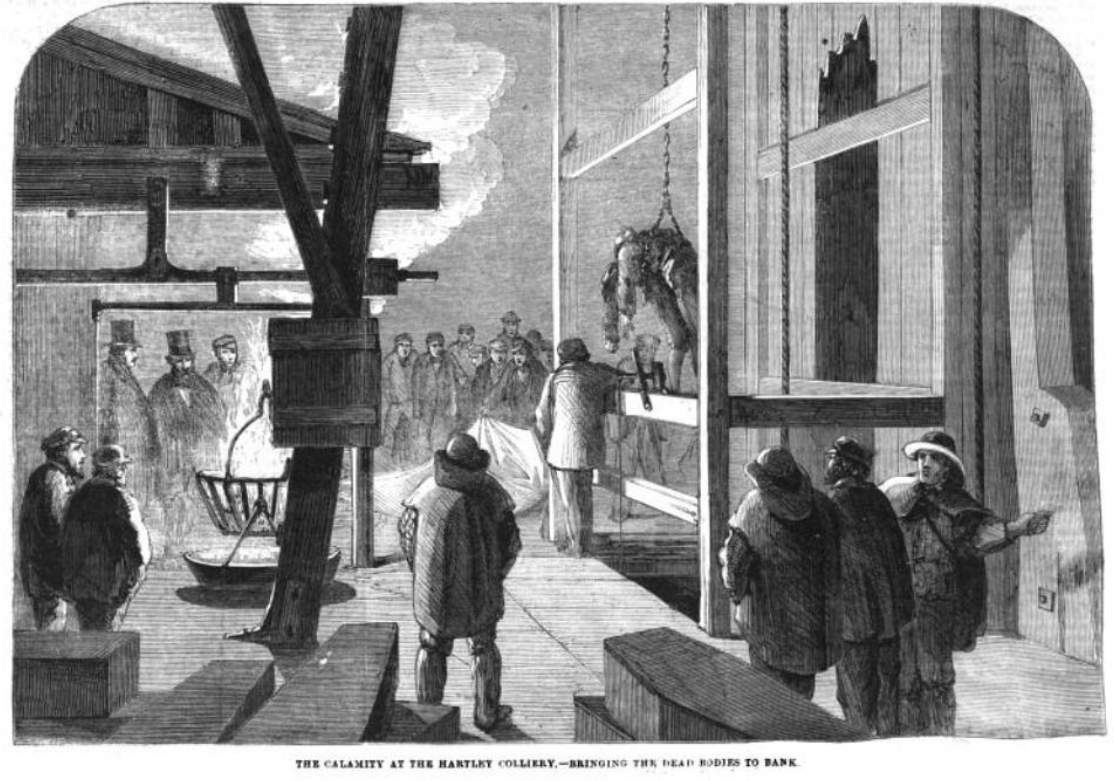
Rescue teams worked without pause for days to clear the obstruction. The task was enormous -- the fallen beam and surrounding debris had to be cut apart and lifted piece by piece from a shaft choked with wreckage. Crowds gathered at the pithead in freezing January weather, families waiting for news. When rescuers finally broke through after nearly a week of work, on around 22 January, they found the miners dead. Many had gathered near the shaft bottom in groups, some with their arms around each other, fathers holding their sons. Evidence showed they had tried to build barriers to keep the bad air at bay, using whatever materials they could find. Some had scrawled messages on surfaces near where they sat. The lack of violence or panic in the arrangement of the bodies suggested they had understood what was happening and faced it together.
A Nation Mourns
The disaster struck a chord across Britain in a way that previous mining tragedies had not. The idea that 204 people -- including boys as young as ten -- could die not from an explosion or a collapse but simply because there was no second way out provoked widespread outrage. Queen Victoria sent a message of condolence. Public subscriptions raised substantial sums for the families. The funeral procession through the village drew enormous crowds, and newspapers across the country covered the story in detail. What made Hartley different was not the scale of the death toll, though it was devastating, but the terrible simplicity of the cause. Everyone could understand that a mine with only one exit was a deathtrap.
The Law That Followed
The coroner's inquest returned a verdict of accidental death but added a recommendation that would reshape the industry. Within months, Parliament passed the Coal Mines Regulation Act of 1862, which required every colliery in Britain to have at least two independent means of access and escape. The law was not merely administrative. It acknowledged a principle that had been resisted by mine owners for decades: that the lives of the men underground were worth the considerable expense of sinking a second shaft. The Act also required proper ventilation equipment and gave inspectors greater powers of enforcement. It was one of the first pieces of legislation in British history to put worker safety ahead of the economic interests of employers.
Remembered at New Hartley
A memorial to the victims stands in the churchyard of St Alban's in Earsdon, near New Hartley, where the men and boys were buried. The monument lists their names and ages. The youngest victims were children who worked underground as trappers, opening and closing ventilation doors in the dark. Their deaths were part of a broader pattern of child labour in the mining industry that would take further decades to abolish. But the legacy of Hartley extends beyond its own dead. The two-shaft requirement that their deaths demanded became standard practice worldwide, and the principle that mines must have independent escape routes remains fundamental to mining regulation today. Every second shaft sunk in a British coalfield after 1862 was, in some measure, sunk because of what happened at Hartley.
From the Air
Hartley Colliery (Hester Pit) was located near the coastal village of New Hartley, Northumberland, at approximately 55.083N, 1.535W. The colliery site is no longer visible above ground. The memorial is in St Alban's Churchyard, Earsdon, approximately 2nm south. The area is now part of the Blyth-Seaton Sluice coastal conurbation. Best viewed at 1,500-3,000 ft AGL. Nearest ICAO: EGNT (Newcastle) approximately 8nm southwest.