Hase-dera
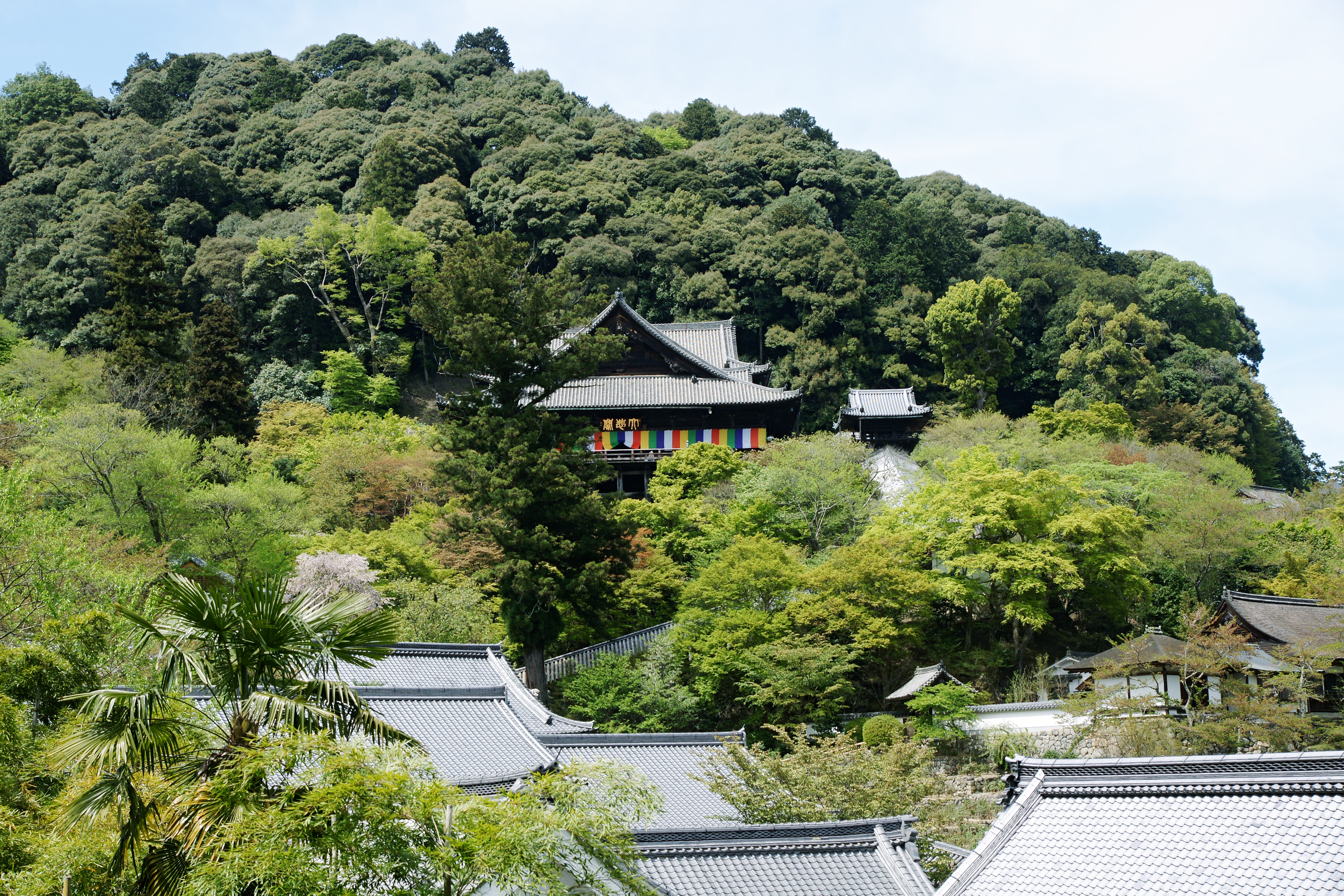
Three hundred and ninety-nine stone steps. That is the price of admission to Hase-dera, and pilgrims have been paying it since the 7th century. The covered wooden staircase climbs 200 meters up a wooded hillside in Sakurai, Nara Prefecture, each step worn smooth by fourteen centuries of feet. Buddhist tradition holds that climbing these steps purifies the walker of the 108 earthly illusions that cause human suffering -- and whether or not the math works out, the ascent does something unmistakable. By the time you reach the Main Hall at the top, perched on its wooden stilts above the valley, the noise of the world has fallen away entirely.
Born from Imperial Sickness
Hase-dera traces its origins to 686, when it was founded as a prayer for the recovery of Emperor Tenmu, who was gravely ill. A bronze plaque depicting the Hokke Sesso-zu -- a hexagonal three-story pagoda surrounded by panels of Buddhas on lotus seats, ringed by deities and monks, with 27 lines of inscription guarded by two protector figures -- was enshrined at the site. That plaque, measuring 75 centimeters wide by 84 centimeters tall, survives today as a National Treasure of Japan. Forty-one years later, in 727, Emperor Shomu ordered the temple expanded and commissioned a towering statue of Juichimen Kannon -- the eleven-headed Bodhisattva of Mercy -- to be placed near the original shrine. The temple had found its identity: a place where imperial power met Buddhist devotion on a forested mountainside.
Ten Fires, Ten Resurrections
Since the 10th century, Hase-dera has burned to the ground and been rebuilt no fewer than ten times. Fire was the great enemy of Japanese wooden temples, and Hase-dera's hillside location, exposed to wind and lightning, made it especially vulnerable. Yet each time the temple was reduced to ash, patrons rebuilt it. The current Main Hall dates to 1650, funded by Tokugawa Iemitsu, the third Tokugawa shogun who consolidated his family's grip on Japan. The hall is itself a National Treasure, a broad-eaved structure that juts out from the hillside on wooden supports, offering sweeping views across the Nara countryside. A copy of the Lotus Sutra housed at the temple also holds National Treasure status -- one of several irreplaceable objects that somehow survived the cycles of destruction and rebirth that define this place.
The Goddess Who Sees Everything
Inside the Main Hall stands the reason most pilgrims make the climb: the Eleven-Headed Kannon. At 9.3 meters -- roughly 31 feet -- it is said to be the largest wooden statue in Japan. Tradition holds that it was carved by a priest named Tokodo. The statue's primary face gazes forward with serene composure, but ten secondary faces crown its head, each turned at a different angle. These faces allow Kannon to see in every direction simultaneously, scanning the world for anyone in need of compassion. The statue is classified as an Important Cultural Property, as are the Nio Gate at the temple's entrance -- flanked by two muscular guardian kings whose fierce expressions are meant to repel demons and thieves -- and the bell tower, whose original bell was retired to the treasure hall in 1984 and replaced with a new one that still marks the hours across the valley.
Poets, Nobles, and the Road to Ise
During the Heian period, Hase-dera became a favorite destination of Japan's aristocracy. The temple sat along the ancient route to Ise Shrine, the most sacred site in Shinto, and travelers made a point of stopping here. Two of the most celebrated diaries of the period -- the Kagero Nikki and the Sarashina Nikki -- mention visits to Hase-dera, recording the impressions of noblewomen who found spiritual refuge in its halls. This literary connection gave the temple a cultural prestige that outlasted political shifts. In 1588, priest Sen'yo arrived from Negoro-ji and established Hase-dera as a center of the reformed Buzan sect of Shingon Buddhism, the role it serves to this day as the sect's main temple. The layers of history here run deep: imperial foundation, aristocratic patronage, literary fame, and sectarian leadership, all compressed into a single hillside compound.
Peonies and Maples
Hase-dera is a temple that changes its costume with the seasons. In spring, 700 Chinese peonies burst into bloom along the staircase, transforming the long ascent into a corridor of pink, white, and crimson. The flowers are dense enough to scent the air, and their display draws thousands of visitors who come as much for the botany as the Buddhism. In autumn, the script flips: the temple's maple trees ignite in shades of red, orange, and gold, and the covered staircase becomes a tunnel through fire-colored canopy. Between these peak seasons, the temple offers the quieter pleasures of green moss on stone, the sound of water in the valley below, and the particular stillness that fills a Buddhist compound in the middle of a weekday afternoon.
From the Air
Located at 34.536N, 135.907E in the hills east of the Nara Basin, Sakurai, Nara Prefecture, Japan. The temple sits on a wooded hillside in the Hase River valley, visible from the air as a cluster of traditional rooflines amid dense forest canopy. Look for the long covered staircase climbing the hillside and the distinctive five-story pagoda rising above the treeline. Nearest airports: Kansai International Airport (RJBB) approximately 60km to the west, Osaka Itami Airport (RJOO) approximately 45km to the northwest. The Yamato highlands surrounding the site create scenic terrain. Best visibility outside the June-July rainy season.