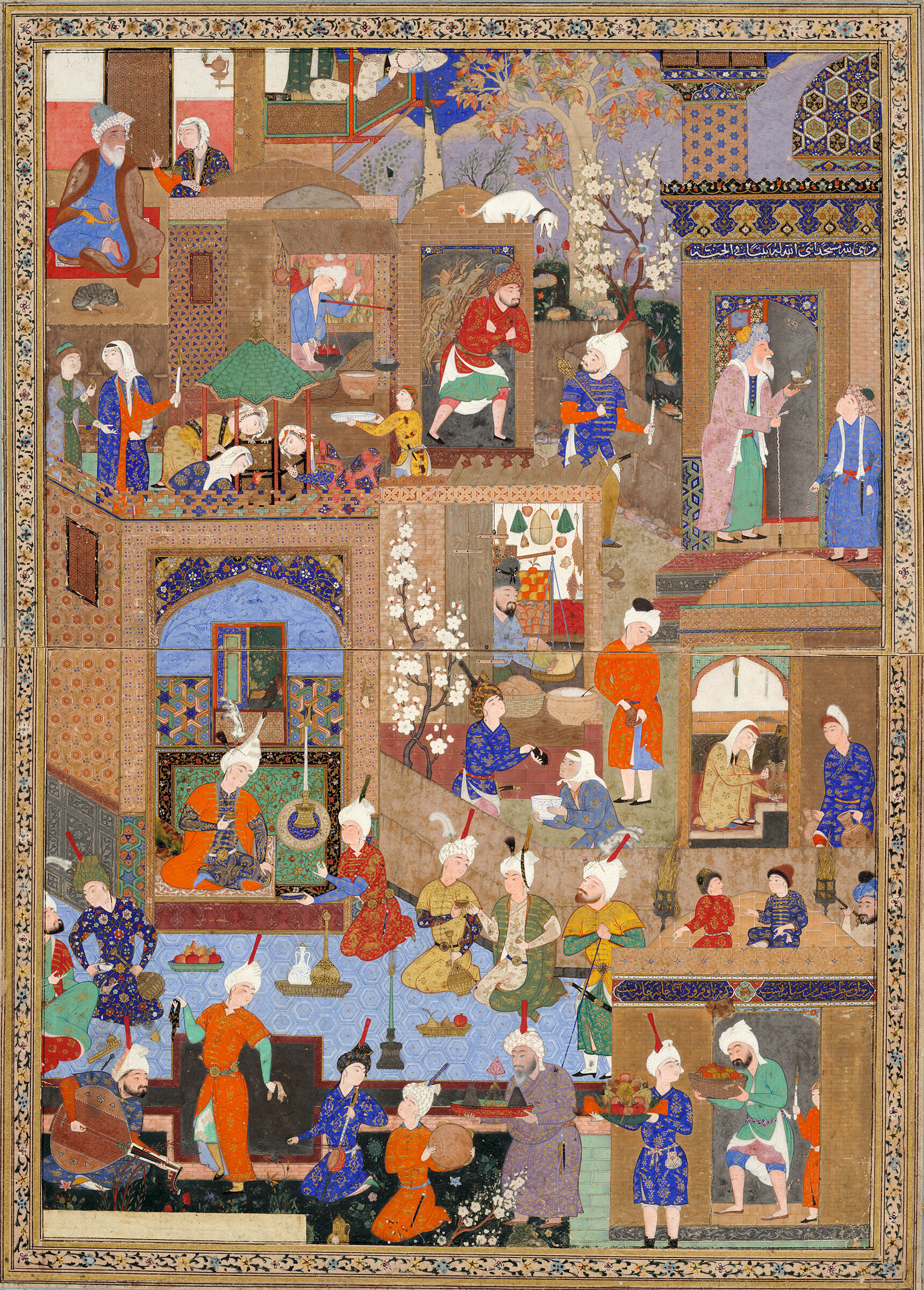
Hasht Behesht: The Palace of Eight Paradises
A Venetian merchant named Domenico Romano visited Tabriz around 1510 and struggled with language. The palace before him -- an octagon roughly 20 to 23 meters in diameter, two stories tall, crowned by a dome, containing a central hall surrounded by thirty-two chambers with multiple terraces -- was, he wrote, "so beautiful that I can hardly find words to express it." The walls were enameled and gilt, painted with scenes of Ottoman ambassadors visiting the ruler Uzun Hasan, of royal hunting expeditions, all rendered in gold, silver, and ultramarine blue. This was the Hasht Behesht Palace, the Palace of Eight Paradises, and it no longer exists.
The Aq Qoyunlu's Crown Jewel
The palace was begun by Uzun Hasan, ruler of the Aq Qoyunlu dynasty from 1452 to 1478, and completed by his son Yaqub Beg between 1483 and 1486. It stood at the center of the Sahebabad Garden in the northern part of Tabriz, probably built on the foundations of an earlier structure by Jahan Shah. The garden and its palace became the dynastic center of the Aq Qoyunlu capital. The building's octagonal form, its lavish decoration, and its function as the seat of power made it one of the most significant architectural achievements of 15th-century Iran. The Ottoman polymath Matrakci Nasuh included it in his 1537–1538 map of Tabriz, and early Safavid painters depicted it in works like Nighttime in a City, dated around 1540.
Looted After Chaldiran
In 1514, the Ottoman Sultan Selim I defeated Shah Ismail I at the Battle of Chaldiran and advanced on Tabriz. The Hasht Behesht Palace was briefly occupied and systematically looted. Precious goods were stripped from the halls and sent to Istanbul. Artists from the Tabriz court were taken as well, forcibly relocating the creative talent that had made the palace's decoration possible. Shah Ismail's personal items, captured at the palace, ended up in Istanbul's Topkapi Museum, where they remain to this day. The looting was thorough but the building survived -- for another seventy years.
Destruction and Legacy
In 1585, the Ottoman general Jafar Pasha demolished the Hasht Behesht Palace and replaced it with a massive defensive fortification, the Castle of Jafar Pasha. The decision was military pragmatism over architectural preservation -- a palace was a symbol of the enemy's dynasty, and a fortress was a tool of occupation. Nothing of the original structure survives above ground today. Yet the palace's influence outlived its physical existence. The Hasht Behesht in Isfahan, built more than a century later, drew directly on the Tabriz original. The palace contributed to the broader Hasht Bihisht architectural model -- the eight-paradise layout -- that became a defining pattern in Iranian palace design.
What Romano Saw
Domenico Romano's description remains one of the most detailed accounts of the palace. Four entrances on the ground floor, apartments decorated beyond what he could articulate, realistic paintings of diplomatic scenes and hunts covering the walls. The color palette alone -- gold, silver, ultramarine -- suggests a building designed to overwhelm visitors with the wealth and sophistication of the Aq Qoyunlu court. Manuscripts commissioned by Yaqub Beg, including the celebrated Khamsa of Nizami from 1481, were produced in connection with this court. The palace was not just a residence; it was a statement of cultural ambition. That statement now survives only in travelers' accounts, Ottoman maps, and Persian miniature paintings.
From the Air
Located at 38.09N, 46.29E in the northern part of Tabriz, East Azerbaijan Province, Iran. The palace site lies within the urban area of modern Tabriz, though no above-ground remains survive. Tabriz International Airport (OITT) is approximately 15 km northwest. From altitude, the city fills a broad valley at roughly 1,350 meters elevation, with Mount Eynali rising to the north and the volcanic peak of Mount Sahand (3,707 m) to the south.