Hassan Tower
The muezzin was supposed to ride a horse to the top. That is how tall the Hassan Tower was meant to be -- so high that instead of stairs, the builders installed ramps spiraling upward through six floors, each centered on a vaulted chamber lit by horseshoe-shaped windows. The tower was intended to reach at least 64 meters, possibly 80, which would have made it the tallest minaret in the world. When Almohad caliph Abu Yusuf Yaqub al-Mansur died in 1199, construction stopped at 44 meters. It has stayed there ever since.
A Caliph's Ambition in Red Sandstone
Construction began around 1191, commissioned by al-Mansur, the third caliph of the Almohad Caliphate, whose empire stretched from Spain to Tunisia. The tower was designed as the minaret for a mosque that, if completed, would have surpassed the Great Mosque of Cordoba as the largest in the western Islamic world. The mosque was strategically sited on the high south bank of the Bou Regreg river, where it would be visible for miles around -- an imposing statement of Almohad power. Historians believe the mosque was intended to serve the Almohad troops who gathered in Rabat before setting off on military campaigns, possibly functioning as both a place of worship and a fortress. Al-Mansur also built new city walls, gates, and additions to the nearby Kasbah of the Udayas during this period.
Three Minarets, One Vision
The Hassan Tower was the third in a trio of monumental minarets commissioned by the Almohad caliphs. It was modeled on the minaret of the Koutoubia Mosque in Marrakesh, and it shares its architectural DNA with the Giralda of Seville. All three towers have square floor plans in the Moroccan tradition, but the Hassan Tower was intended to be the grandest of them all. Its sandstone exterior is decorated with panels of sebka patterning -- an interlocking geometric lattice -- along with engaged columns and capitals carved directly from the same stone. One marble capital of Andalusi origin survives as spolia, a fragment of Al-Andalus transplanted to Morocco. Over the centuries, the sandstone has turned a distinctive red ochre, giving the tower its warm, weathered appearance against the Rabat sky.
The Mosque That Never Was
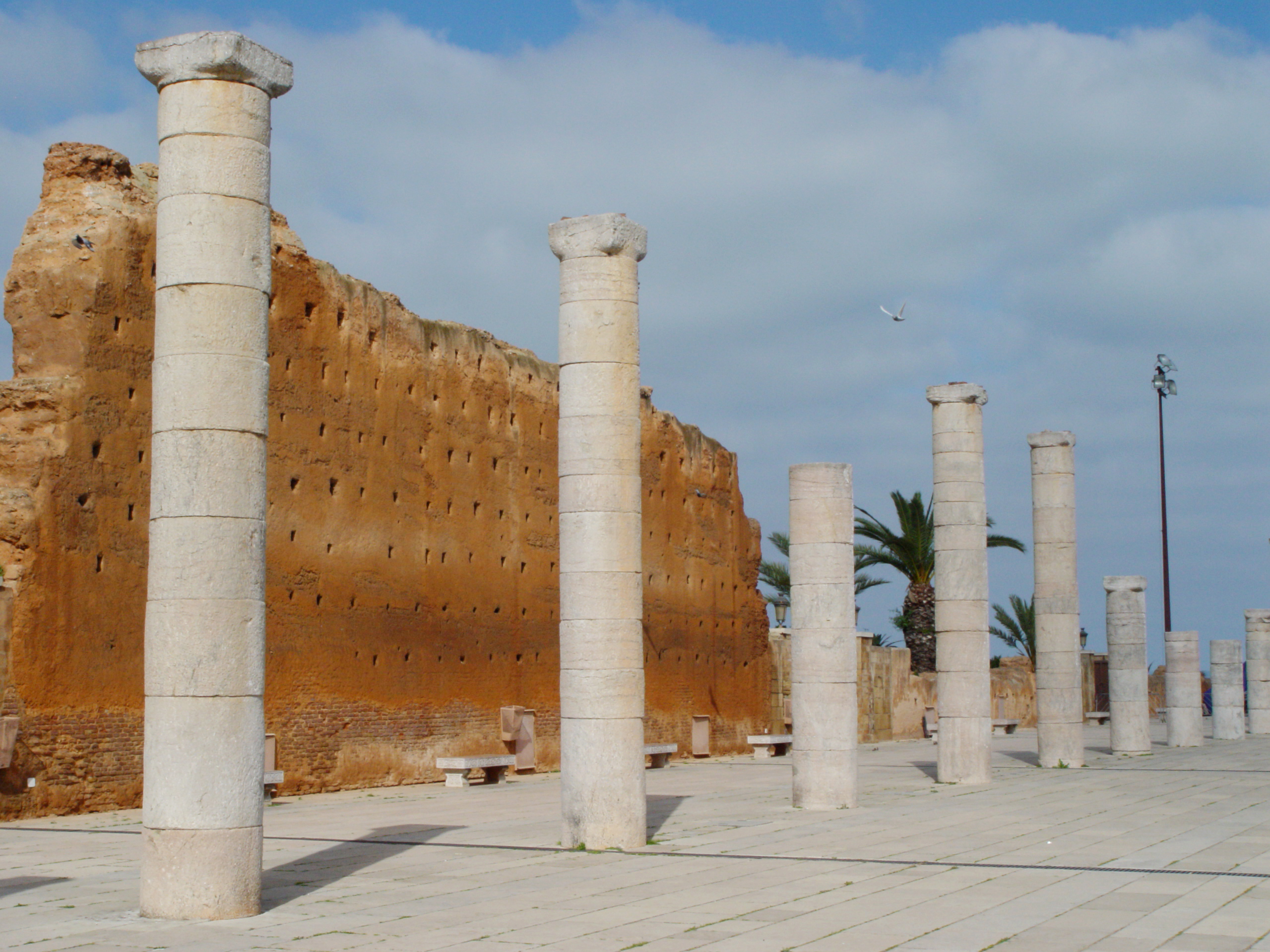
Around the base of the tower, 348 stone columns stand in rows like a petrified forest. These are the remnants of the mosque's hypostyle prayer hall, which was never roofed. The columns mark out what would have been a vast interior -- the floor plan suggests a building of enormous scale, with multiple naves extending from the tower. The area surrounding the mosque site was suburban in the 12th century, lacking the population to regularly fill such an immense space, which reinforces the theory that it was designed more for military assembly than for daily worship. Today the columns cast long shadows across a broad esplanade that leads to the modern Mausoleum of Mohammed V, creating a dialogue between the 12th-century ambitions of al-Mansur and the 20th-century legacy of Moroccan independence.
Standing at Forty-Four Meters
The Hassan Tower measures 16 meters on each side and rises to its unfinished height of 44 meters. At its full intended scale, it would have been slightly taller than the original Giralda in Seville. The tower's six interior floors, each with a ramp wide enough for a horse, were designed so the muezzin could ride to the summit to issue the call to prayer -- a practical solution for a structure of such height. The horseshoe-arch windows that punctuate each level would have illuminated the vaulted chambers at the center of each floor. Eight centuries of standing unfinished have given the tower an unexpected quality: it reads not as a failure but as a monument to ambition itself. The forest of columns below and the mausoleum beside it make the Hassan Tower the centerpiece of Rabat's most important historic complex, recognized as part of the city's UNESCO World Heritage designation in 2012.
From the Air
Coordinates: 34.024N, 6.823W. The Hassan Tower is one of Rabat's most visible landmarks from the air, standing on the south bank of the Bou Regreg river. The red-ochre tower and the orderly rows of columns are identifiable at moderate altitudes. The white Mausoleum of Mohammed V sits adjacent. Nearest airport: GMME (Rabat-Sale, 4 km northeast). The Kasbah of the Udayas is visible at the river mouth to the northwest.