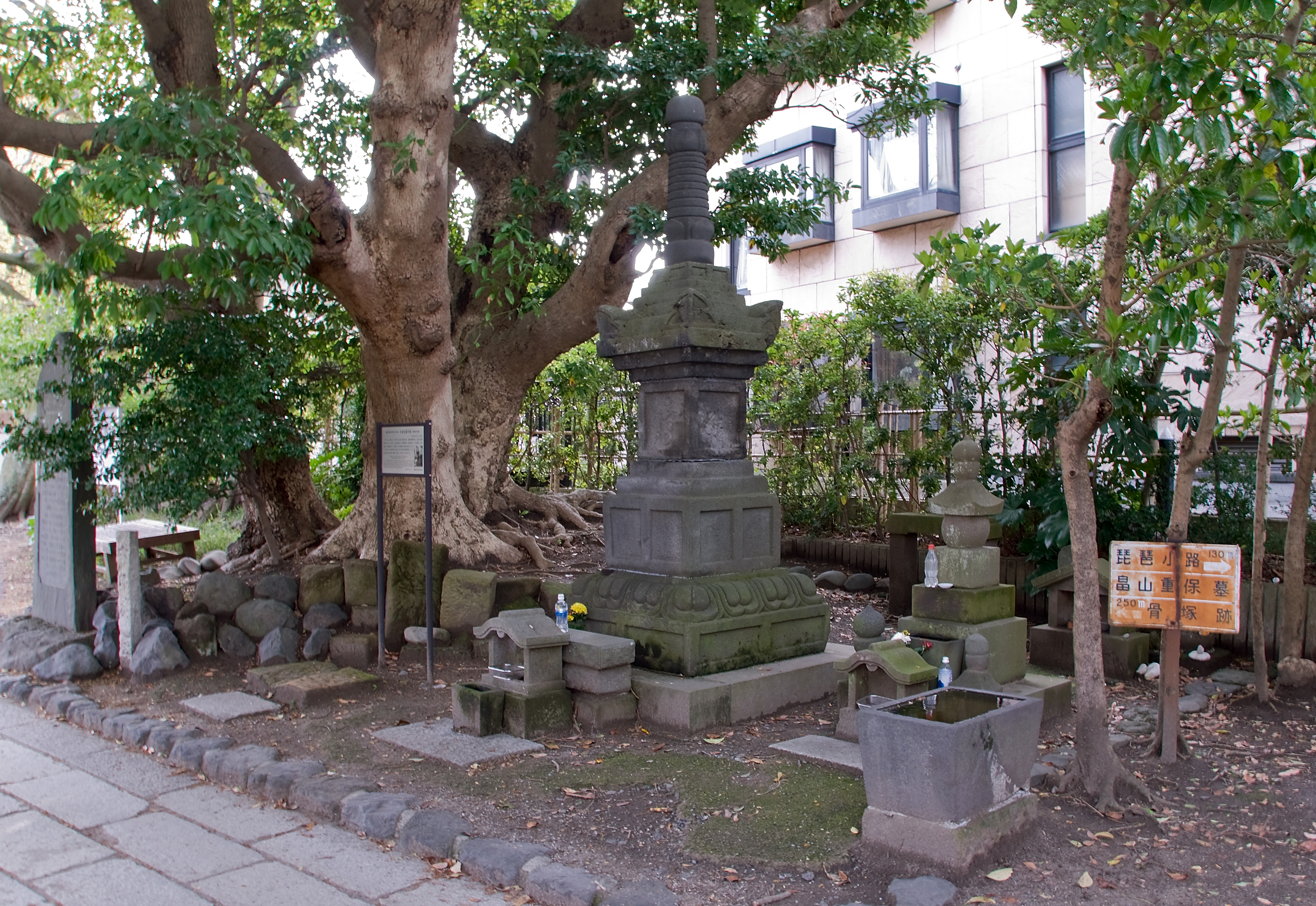
Hatakeyama Shigeyasu's Grave
The warrior was gasping for breath when they came for him. Hatakeyama Shigeyasu, eldest son of the renowned general Hatakeyama Shigetada, suffered from asthma, and on June 22, 1205, he was in the grip of an attack when Hojo soldiers surrounded his residence near Yuigahama beach in Kamakura. He fought anyway. By all accounts he fought well. But the outcome was never in doubt -- the men sent to kill him had orders from the shogun himself, and political grudges in Kamakura's warrior government were settled with swords, not words. Shigeyasu died that day, and his father was lured to his own death the very next morning. Eight centuries later, a stone pagoda stands under a tabu no ki tree near the Yuigahama end of Wakamiya Oji Avenue, close to the first torii gate of the great Tsurugaoka Hachimangu shrine. It is traditionally held to be Shigeyasu's grave, and locals have given it a gentler name: Rokuro-sama, the healer of coughs and colds.
A Quarrel with the Wrong Family
The politics that killed Hatakeyama Shigeyasu were tangled even by the standards of Kamakura-era intrigue. Shigeyasu had quarreled with Hiraga Tomomasa, who happened to be the son-in-law of Hojo Tokimasa -- the most powerful man in Kamakura after the shogun. Tomomasa nursed the grudge and whispered against both Shigeyasu and his father Shigetada to his father-in-law. Tokimasa, for his part, already had his own reasons for wanting the Hatakeyama eliminated. The elder Shigetada had followed the will of the late Minamoto no Yoritomo, the founding shogun, and tried to protect Yoritomo's son and heir Yoriie from Hojo manipulation. For a regent building a dynasty through the puppet shoguns he controlled, that kind of loyalty to the wrong bloodline was unforgivable. When Shogun Sanetomo -- himself a Hojo puppet -- issued the order, the trap snapped shut on both father and son within twenty-four hours.
The Stone That Heals
The hokyointo that marks Shigeyasu's traditional burial site is no ordinary grave marker. Standing 3.45 meters tall and carved from andesite, it is designated an Important Cultural Property of Japan and is considered one of the finest examples of the hokyointo form -- a type of stone pagoda with a distinctive tiered shape that became popular as memorial monuments during the Kamakura period. The craftsmanship is exceptional, with clean proportions and precise stonework that have survived eight centuries of salt air and earthquakes. A plaque erected in March 1922 by the Kamakuracho Seinendan, a local civic youth group, marks the site. The attribution to Shigeyasu rests on two facts: the grave lies within the boundaries of the former Hatakeyama estate, and historical records confirm that Shigeyasu was killed in battle by Hojo soldiers in the Yuigahama area.
Rokuro-sama's Remedy
Of all the ways a medieval warrior might be remembered, being transformed into a folk cure for the common cold is among the more unexpected. But that is precisely what happened to Shigeyasu. Because he suffered from asthma and was reportedly in the throes of an attack when he was killed, local tradition holds that his spirit has a special sympathy for those who suffer from respiratory ailments. The hokyointo became popularly known as Rokuro-sama -- Rokuro being an alternate reading of characters associated with the Hatakeyama -- and people with colds, coughs, and breathing troubles began visiting the grave to pray for relief. The practice endures. In a city crowded with the tombs of shoguns and the ruins of great temples, Shigeyasu's grave offers something more intimate: a personal story of a man who fought through his own failing body, and whose suffering was redeemed by the compassion of those who came after.
Kamakura's Layered Ground
The grave stands near the Yuigahama end of Wakamiya Oji, the grand boulevard that runs from the sea straight to the entrance of Tsurugaoka Hachimangu, Kamakura's most important shrine. The first torii gate of the shrine complex rises nearby. This stretch of avenue sits at the seam between Kamakura's sacred geography and its secular waterfront -- Yuigahama beach, where surfers paddle out today, was once the site of executions and military engagements. Walking from the beach toward the shrine, you pass from one world to another in the space of a few blocks. Shigeyasu's grave is a reminder that the ground beneath Kamakura holds centuries of stories, and that the boundaries between the sacred, the historical, and the everyday have never been firmly drawn. A warrior died here in 1205. Someone carved a beautiful monument. And eight hundred years later, people still stop to ask his spirit for help with a stubborn cough.
From the Air
Located at 35.31N, 139.55E on Wakamiya Oji Avenue in Kamakura, near Yuigahama beach on Sagami Bay. From the air, the site is identifiable by its position along the broad tree-lined avenue running from the coast to Tsurugaoka Hachimangu shrine. The beach and coastline are clearly visible. Kamakura's hills and temple-dotted valleys spread inland. Nearest airports: Tokyo Haneda (RJTT) approximately 25nm northeast, Atsugi Naval Air Facility (RJTA) approximately 15nm north. Enoshima island is visible to the southwest along the coast. The site itself is not individually distinguishable from altitude, but the Wakamiya Oji boulevard and the Tsurugaoka Hachimangu shrine complex provide clear reference points.