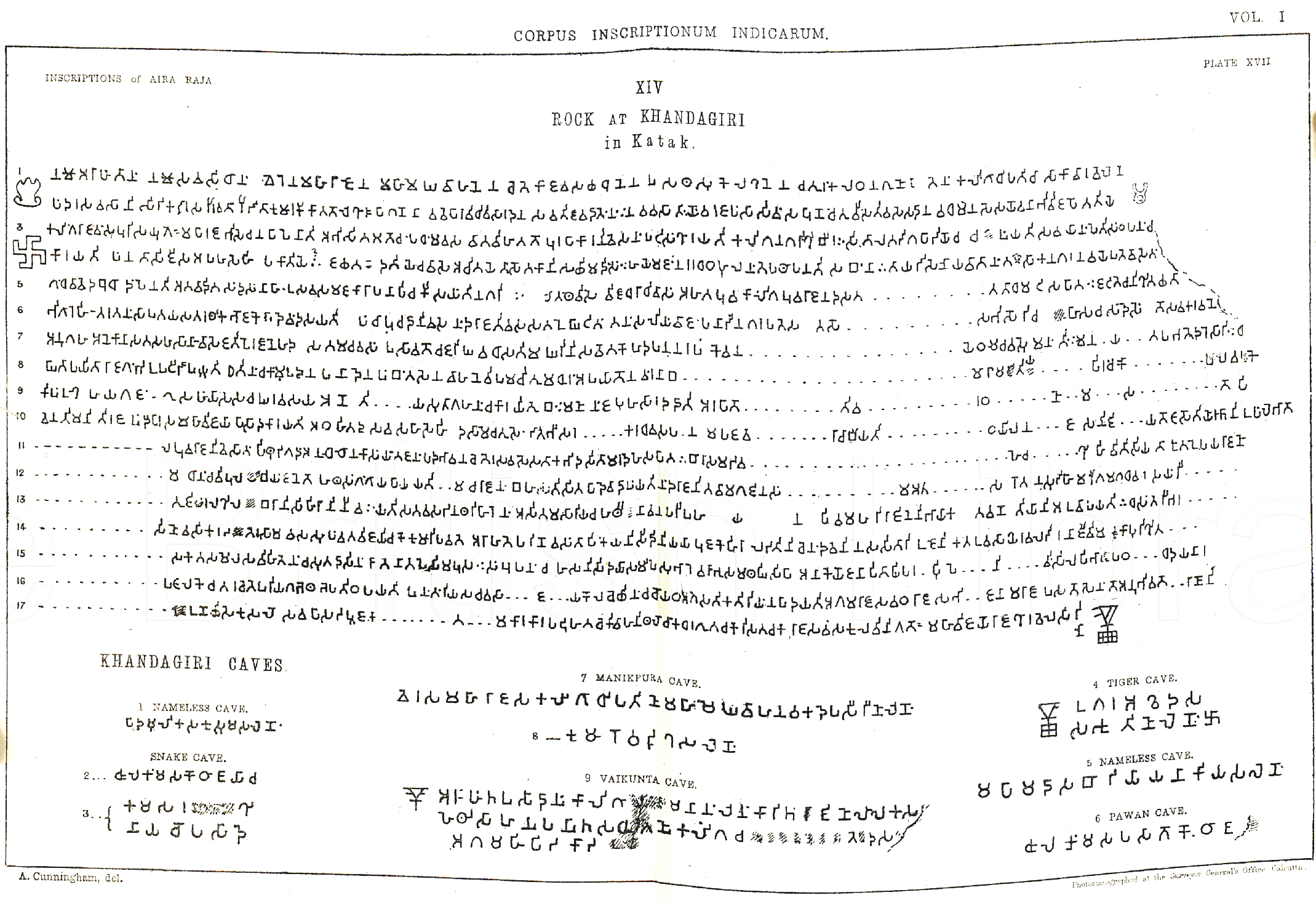
Hathigumpha Inscription
Three different hands carved the inscription. Handwriting analysis confirms it -- three scribes, working together on the same rock face, chiseling seventeen lines of Prakrit text into the overhang of a cave called Hathigumpha, the Elephant Cave, in the Udayagiri hills near Bhubaneswar. The inscription dates to the second half of the 1st century BCE, possibly spilling into the first decades of the 1st century CE, and it tells the story of a king named Kharavela. Since its discovery in 1825, those seventeen lines have been translated, retranslated, disputed, revised, and fought over by scholars for two centuries -- because getting Kharavela's dates right means getting the dates of half of ancient India right.
A King Who Kept Score
The inscription reads like a royal resume, year by year. In his early reign, Kharavela entertained his capital with music, dancing, singing, and festivals -- the text specifically mentions the science of the Gandharvas, the celestial musicians. By year four, he was restoring a building called the Abode of Vidyadharas, originally built by former Kalingan kings. By year ten, he had constructed a royal residence called the Palace of Great Victory at a cost of thirty-eight hundred thousand units, and was sending military expeditions following what the inscription calls the threefold policy of chastisement, alliance, and conciliation. He claimed conquests, jewels, and precious things from defeated kings. Later lines record the construction of carved towers, the establishment of a settlement of one hundred masons exempt from land revenue, and the acquisition of pearls, horses, elephants, and rubies from the Pandya king in the south.
The Nanda Connection
Among the most debated passages is a reference to a Nanda king who, centuries before Kharavela, built a water canal that Kharavela later extended to the Kalinga capital. The same Nanda king allegedly took away something described as Kalingajinam -- a word that has divided scholars ever since. Some interpret it as a Jaina image or idol seized from Kalinga, which Kharavela then triumphantly recovered. Others, including the scholar Sonya Quintanilla, argue this interpretation cannot be correct: archaeological evidence from Jain sites like Kankali Tila at Mathura shows that anthropomorphic idol worship did not exist in Jainism during those centuries. What the Nanda king took, and what Kharavela brought back, remains unresolved. The uncertainty matters because it shapes how we understand the development of religious image worship across the entire subcontinent.
A Ripple Through Centuries of Scholarship
The Hathigumpha inscription did not merely record one king's achievements -- it scrambled the dating of monuments across central India. The inscription mentions a war against the Satavahana king Satakarni. Early scholars dated the inscription to between the 3rd and 2nd centuries BCE and treated Satakarni as Kharavela's contemporary. That assumption cascaded outward. According to the art historian Walter Spink, it led to the widely repeated belief that the earliest Andhra dynasties started in the late 3rd to early 2nd century BCE, and that these rulers built the Chaitya halls at Bhaja, Nasik, and Kondane between 300 and 100 BCE. The error compounded as other inscriptions, coins, and monuments were dated relative to this flawed anchor point. Spink argues that many of these monuments should be shifted forward by 200 to 300 years, to the 1st and early 2nd centuries CE. A single misread inscription had rewritten the chronology of Indian art.
Words in Stone, Questions in Air
The inscription sits where it has always sat, on the rock face of the Elephant Cave in the Udayagiri hills, exposed to the humid Odisha air for more than two thousand years. Portions of the text have been lost to weathering -- the translations are punctuated with notations reading "lost" where the rock has surrendered its message. The translation published by Jayaswal and Banerji in Epigraphia Indica Volume 20 remains a foundational text, though nearly every line has generated alternate readings by subsequent scholars. The inscription represents an early prototype of the prashasti style -- the royal eulogy that would become standard in Indian epigraphy. It records infrastructure projects, charitable donations to monks and Brahmins, festivals, arts patronage, and military campaigns. What makes it extraordinary is not just its content but its consequences: seventeen lines carved by three scribes on a cave wall in Odisha reshaped the way an entire civilization understands its own past.
From the Air
Located at 20.263N, 85.786E in the Udayagiri hills, approximately 6 km west of central Bhubaneswar. The nearest airport is Biju Patnaik Airport (VEBS), just a few kilometers to the east. The Udayagiri and Khandagiri cave complex is visible from low altitude as a rocky hillside with carved cave openings amid otherwise flat terrain. The hills rise modestly from the surrounding plain -- look for exposed rock faces with vegetation on the slopes. The inscription itself is not visible from the air, but the cave complex is a recognizable geological feature.