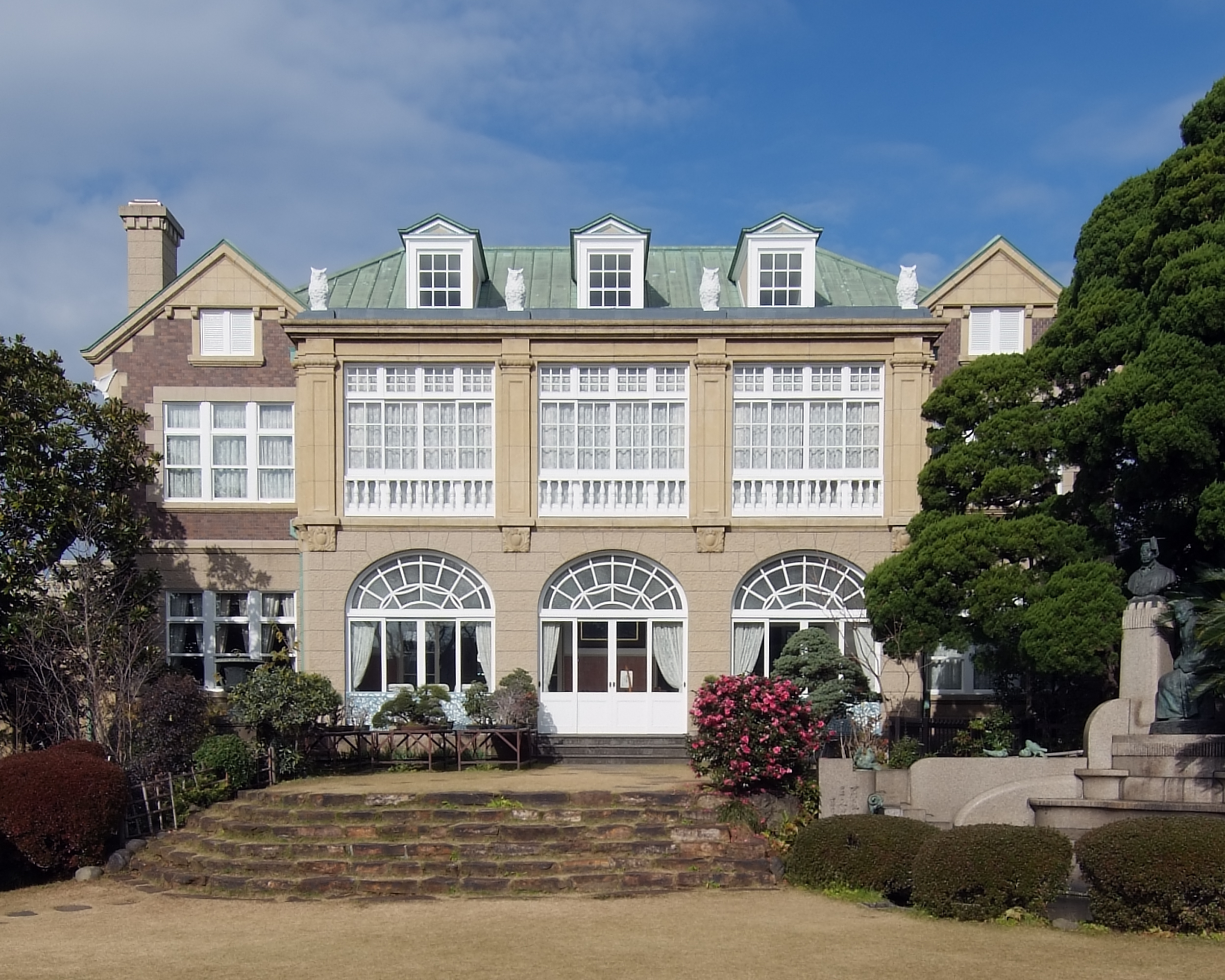
Hatoyama Hall: Five Generations Under One Roof
In November 1955, a group of men gathered in the salon of a Western-style mansion on a quiet hill in Bunkyo, Tokyo. Flashbulbs popped as Prime Minister Ichiro Hatoyama, flanked by party leaders Tanzan Ishibashi and Bukichi Miki, posed for a photograph that would mark one of the defining moments in postwar Japanese politics: the founding of the Liberal Democratic Party. The house where they stood -- a three-bay stone facade with tall French windows and narrow wrought-iron balconies -- had been commissioned by that same Ichiro Hatoyama in 1924, designed by the architect Shinichiro Okada, who also gave Tokyo its famed Kabuki-za theatre. The mansion was called the Otowa Mansion then, named for the Bunkyo neighborhood where it sits. Today it is Hatoyama Hall, and the political dynasty it sheltered across five generations makes it less a house than a living archive of modern Japanese governance.
The Patriarch and the Pioneer
The Hatoyama story at this address begins with the first generation. Kazuo Hatoyama, born in 1856, served as Vice-Foreign Minister, Speaker of the House of Representatives from 1896 to 1897, professor at the University of Tokyo, and principal of Waseda University from 1890 to 1907. His wife Haruko, born in 1863, was a pioneering educator who co-founded what is today Kyoritsu Women's University. Together, they established a family culture in which public service and education were not just careers but obligations. The garden still holds bronze sculptures of Kazuo and Haruko, watching over the estate they began. It was their son, Ichiro, who would commission the house itself and turn the Hatoyama name from distinguished into dynastic.
A Prime Minister's Drawing Room
Ichiro Hatoyama, born in 1883, rose through the ranks of Japanese politics as Secretary of the Cabinet and Minister of Education before reaching the pinnacle: he served as the 52nd, 53rd, and 54th Prime Minister of Japan. It was inside the Otowa Mansion that he orchestrated the merger of conservative parties into the Liberal Democratic Party, the political force that would dominate Japanese governance for decades. His wife Kaoru, who served as schoolmaster of Kyoritsu Women's University, raised their son Iichiro in these rooms. Today, three memorial rooms stand open to the public inside the hall, one dedicated to Ichiro, one to Kaoru, and one to Iichiro, each preserving the personal effects and political memorabilia of their respective occupant. The salon where that famous 1955 photograph was taken remains much as it was -- a room where the architecture of postwar Japan was literally sketched out.
Diplomats, Ministers, and a Second Prime Minister
Iichiro Hatoyama, the third generation, served as Japan's Foreign Minister from 1976 to 1977. His son Yukio Hatoyama, born in 1947, became Prime Minister himself as leader of the Democratic Party of Japan -- making the Hatoyamas one of a very small number of families to produce two prime ministers. Yukio's brother Kunio, born in 1948 and who died in 2016, served as Minister of Internal Affairs and Communications, Minister of Education, Minister of Labour, and Minister of Justice. The fifth generation has continued in public service: Taro Hatoyama, Kunio's son, served in the Tokyo Metropolitan Assembly. Five generations of the same family, from the Meiji era into the twenty-first century, all tied to a single address in Bunkyo.
Stone, Glass, and Memory
The building itself deserves attention beyond the family it housed. Architect Shinichiro Okada designed the facade in natural stone, composed of three symmetrical bays. The ground floor features large French windows that flood the interior with light. On the first floor, the windows and doors span the full width of the building, with doors that open inward onto narrow, French-style balconies. The style is Western, a deliberate choice in the 1920s when Japan's elite were absorbing European architectural influences at a rapid pace. Today, the house and its gardens are gradually evolving into a museum commemorating the Hatoyama family's contributions to politics and education. Visitors walk through rooms that feel suspended between eras -- European architecture housing Japanese political memory, private domestic space converted into public heritage.
From the Air
Located at 35.714°N, 139.731°E in the Bunkyo ward of central Tokyo. The mansion sits in a residential neighborhood on a hillside and is not easily distinguished from altitude, but the surrounding Bunkyo area is identifiable by its proximity to Tokyo Dome (to the southwest) and the University of Tokyo campus (to the east). Best viewed at low altitude in clear weather. Tokyo International Airport/Haneda (RJTT) is approximately 10 nautical miles to the south. Narita International Airport (RJAA) is approximately 35 nautical miles to the east-northeast.