Hawaiian Kingdom
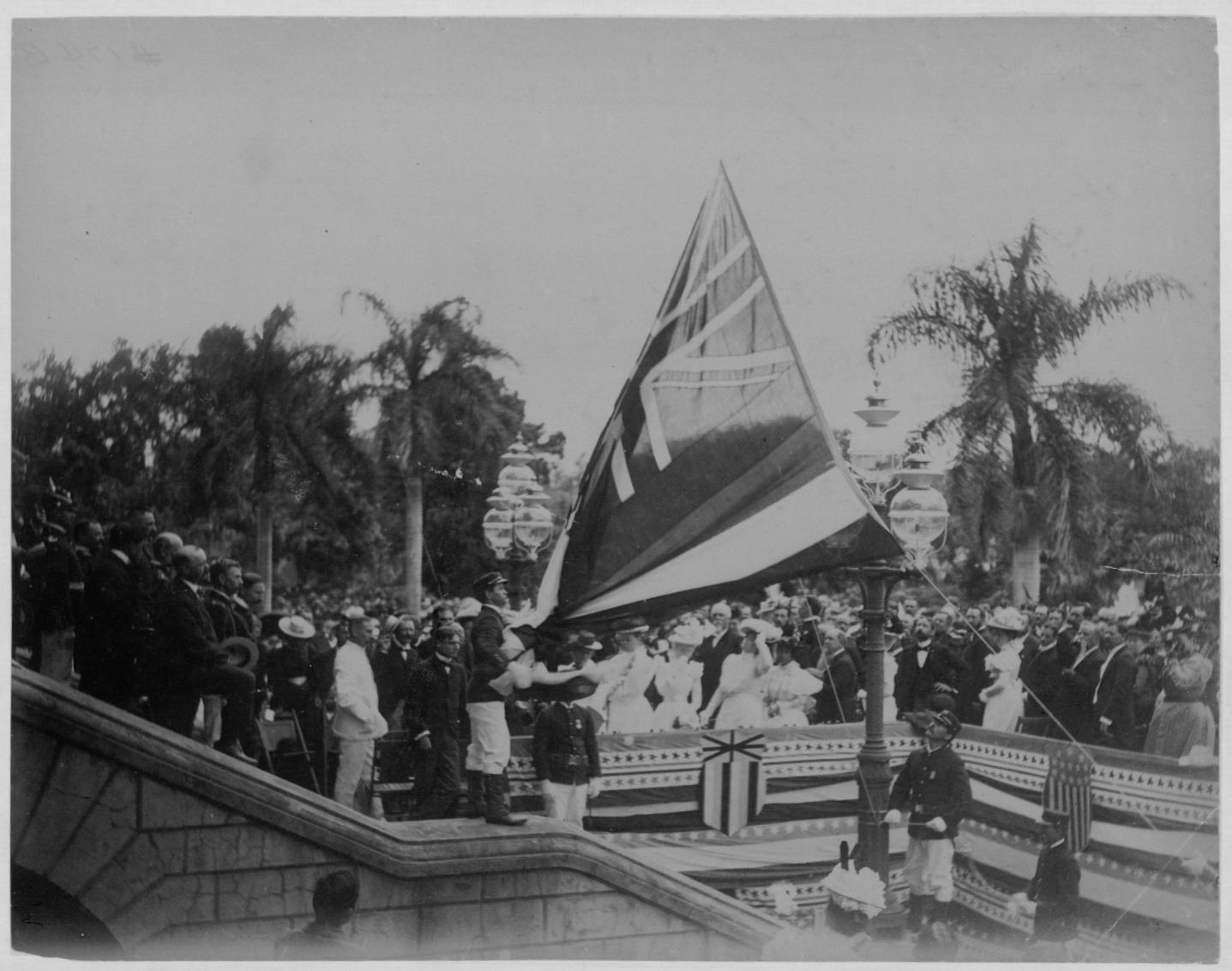
In January 1893, Queen Lili'uokalani of Hawai'i looked out from 'Iolani Palace and saw armed men in the streets of Honolulu. A group of American and European businessmen, backed by 162 U.S. sailors and marines landed from the USS Boston, had declared a provisional government. The queen yielded her authority -- not to the conspirators, she carefully stated, but to the superior force of the United States. She expected the American government to investigate and restore her throne. It never did. A kingdom that had governed these islands for nearly a century, that had been recognized by the major powers of the world, ceased to exist.
Conquest and Unification
The Hawaiian Kingdom began with Kamehameha I. In 1795, the ali'i nui of Hawai'i Island conquered O'ahu, Maui, Moloka'i, and Lana'i through a series of military campaigns that combined traditional Hawaiian warfare with Western weapons acquired from European traders. The pivotal Battle of Nu'uanu drove the defenders of O'ahu up the cliffs of the Ko'olau Range, where many were forced over the precipice. Kaua'i and Ni'ihau, the westernmost inhabited islands, remained independent under their own chief, Kaumuali'i, until 1810, when he voluntarily acknowledged Kamehameha's sovereignty rather than face invasion. With that agreement, the Hawaiian Islands were unified under a single ruler for the first time. Kamehameha established his capital at Lahaina on Maui and later at Honolulu, building a government that blended Hawaiian traditions of land management and chiefly authority with the administrative structures he observed among the Westerners arriving in growing numbers.
A Kingdom Among Nations
What distinguished the Hawaiian Kingdom from many indigenous polities that encountered Western expansion was how quickly and deliberately it engaged the international system on its own terms. Kamehameha III promulgated the kingdom's first constitution in 1840, establishing a constitutional monarchy with a legislature, a judiciary, and a bill of rights. The Great Mahele of 1848 transformed the traditional land tenure system, creating private property rights -- a change that had profound and not always beneficial consequences for Native Hawaiians, as it opened the door for foreign land acquisition. The kingdom established diplomatic relations with the United States, Britain, France, and other major powers. Hawaiian ambassadors served in Washington, London, and Paris. Foreign nations maintained consulates in Honolulu. Treaties of friendship and commerce were signed. The kingdom operated its own postal system, issued its own currency, and maintained a small but functional military.
Sugar, Power, and the Erosion of Sovereignty
Sugar transformed Hawai'i and ultimately destroyed its independence. American and European planters established vast sugar plantations across the islands, importing contract laborers from China, Japan, Portugal, and the Philippines to work the fields. The planters accumulated enormous economic power and chafed under a monarchy they could not fully control. The Reciprocity Treaty of 1875 gave Hawaiian sugar duty-free access to the American market, binding the kingdom's economy to the United States. An 1887 renewal of the treaty granted the U.S. exclusive rights to a naval coaling station at Pearl Harbor. That same year, a group of mostly American businessmen and lawyers forced King Kalakaua to sign what became known as the Bayonet Constitution -- a document that stripped the monarchy of most of its power, disenfranchised most Native Hawaiians and Asian immigrants through property and income requirements, and concentrated political control in the hands of the foreign planter class.
Overthrow
When Lili'uokalani succeeded her brother Kalakaua in 1891, she attempted to restore the monarchy's authority by promulgating a new constitution. The response was swift. On January 17, 1893, a Committee of Safety composed largely of American citizens organized a coup. John L. Stevens, the U.S. Minister to Hawai'i, ordered 162 sailors and marines from the USS Boston ashore, ostensibly to protect American lives and property. Their presence made armed resistance futile. The queen surrendered her authority under protest, expecting -- as she wrote in her formal statement -- that the United States would undo the actions of its representatives. President Grover Cleveland did investigate and concluded the overthrow was illegal, but Congress refused to act. A Republic of Hawai'i was declared in 1894 under Sanford Dole, and in 1898, amid the fervor of the Spanish-American War, the United States annexed the islands.
What Remains
'Iolani Palace still stands in downtown Honolulu, the only royal palace on American soil. It was built by King Kalakaua in 1882 in an American Florentine style, with electric lights installed before the White House had them. Today it operates as a museum. In 1993, a century after the overthrow, the United States Congress passed the Apology Resolution, acknowledging that the overthrow was illegal and that the Native Hawaiian people never directly relinquished their sovereignty. The resolution did not, however, provide for any form of restoration. The Hawaiian sovereignty movement remains active, with various groups advocating positions ranging from federal recognition as an indigenous nation to full independence. The question of what was taken in 1893 -- and whether it can ever be returned -- is not settled history in Hawai'i. It is a living argument, carried on in courtrooms, in the state legislature, and in the ceremonies held every January 17 at 'Iolani Palace.
From the Air
The Hawaiian Kingdom was centered on the island of O'ahu, with its capital at Honolulu (approximately 21.31N, 157.86W). 'Iolani Palace, the seat of the monarchy, is located in downtown Honolulu near the modern state capitol. The nearest major airport is Daniel K. Inouye International Airport (PHNL). From the air, the palace grounds are visible as a green rectangle in central Honolulu, flanked by government buildings. The kingdom encompassed all the main Hawaiian Islands, stretching from Hawai'i Island (Hilo, PHTO) in the southeast to Ni'ihau in the northwest, a span of roughly 350 miles.