Hawks Nest Tunnel Disaster
Shirley Jones was eighteen years old, engaged to be married, and thrilled to have found work. "Think of it, honey. A job! Twenty-five cents an hour, 12 hours a day. That's -- why, that's $3 a day! We'll be marryin' soon, honey." He was the first to die. Beginning in 1930, nearly 3,000 men drilled a 3.8-mile tunnel through Gauley Mountain near the small town of Gauley Bridge, West Virginia, to divert the New River for hydroelectric power. What they drilled through was almost pure silica. Without masks, without wet drilling to suppress the dust, without breaks, they breathed in crystalline particles that shredded their lungs. Within months, workers began dying of acute silicosis -- a disease so aggressive it could kill in under a year. The death toll remains disputed: Union Carbide, the company behind the project, admitted to 109 deaths. A Congressional hearing placed it at 476. A physician who studied the disaster put the number at 764. Whatever the true count, the Hawks Nest Tunnel disaster stands as the worst industrial catastrophe in American history, and a stain that has never been fully acknowledged.
The Promise of Work in Hard Times
The project began in 1927 when Union Carbide created a subsidiary, the New Kanawha Power Company, to harness the fast-flowing New River. The plan was elegant in its engineering: divert water through Gauley Mountain via a tunnel with a 162-foot drop, generating electricity at a plant in Alloy, West Virginia. The contractor, Rinehart and Dennis, won the bid and began work on March 31, 1930. Nearly three-quarters of the workforce were African American men migrating north from the Deep South, desperate for employment during the Great Depression. Workers carved 250 to 300 feet of tunnel per week, laboring ten- to fifteen-hour shifts with drills and dynamite. Their wages were paid in scrip -- company currency usable only at the company store -- and Black workers received lower pay than white workers for the same grueling labor. Despite the inequities, in an era when any job was a lifeline, the men kept drilling.
White Dust, Silent Killer
The rock inside Gauley Mountain was sandstone composed primarily of cemented quartz -- silica in its most dangerous form. When Rinehart and Dennis discovered the vein contained high-quality silica valuable for making ferro-silicon used in steel production, the tunnel became a mine as well. According to testimony from the 1936 Congressional inquiry, the company refused to provide masks or breathing equipment. They rejected wet drilling, a standard technique that suppresses harmful dust. Some reports describe the silica dust turning drinking water white. Black workers testified before Congress that they were denied breaks and forced to work at gunpoint by "shack rousters" who served as company enforcers. The microscopic particles of crystalline silica, once inhaled, lacerated lung tissue beyond repair. Workers developed acute silicosis -- scarring so severe that lungs could no longer exchange oxygen. Men who had arrived healthy began gasping, coughing, wasting away. Many died within a year of exposure.
Justice Denied
The tragedy sparked two major trials and a Congressional investigation, yet accountability remained elusive. In 1932, Cora Jones filed the first lawsuit after her husband and three sons all died. In total, 538 lawsuits were filed seeking $4 million in damages. After hearing nearly 170 witnesses, the jury deadlocked, and victims accepted a settlement of $130,000 -- half of which went to lawyers. The 1936 House Committee on Labor was unsparing in its conclusion: the tunnel was "begun, continued, and completed with grave and inhuman disregard of all consideration for the health, lives and futures of the employees." The committee found that workers had been infected with silicosis, that many had died, and that many still living were "doomed to die." Union Carbide responded with its own report. Neither Rinehart and Dennis nor Union Carbide ever admitted guilt or responsibility.
Buried Under Cover of Darkness
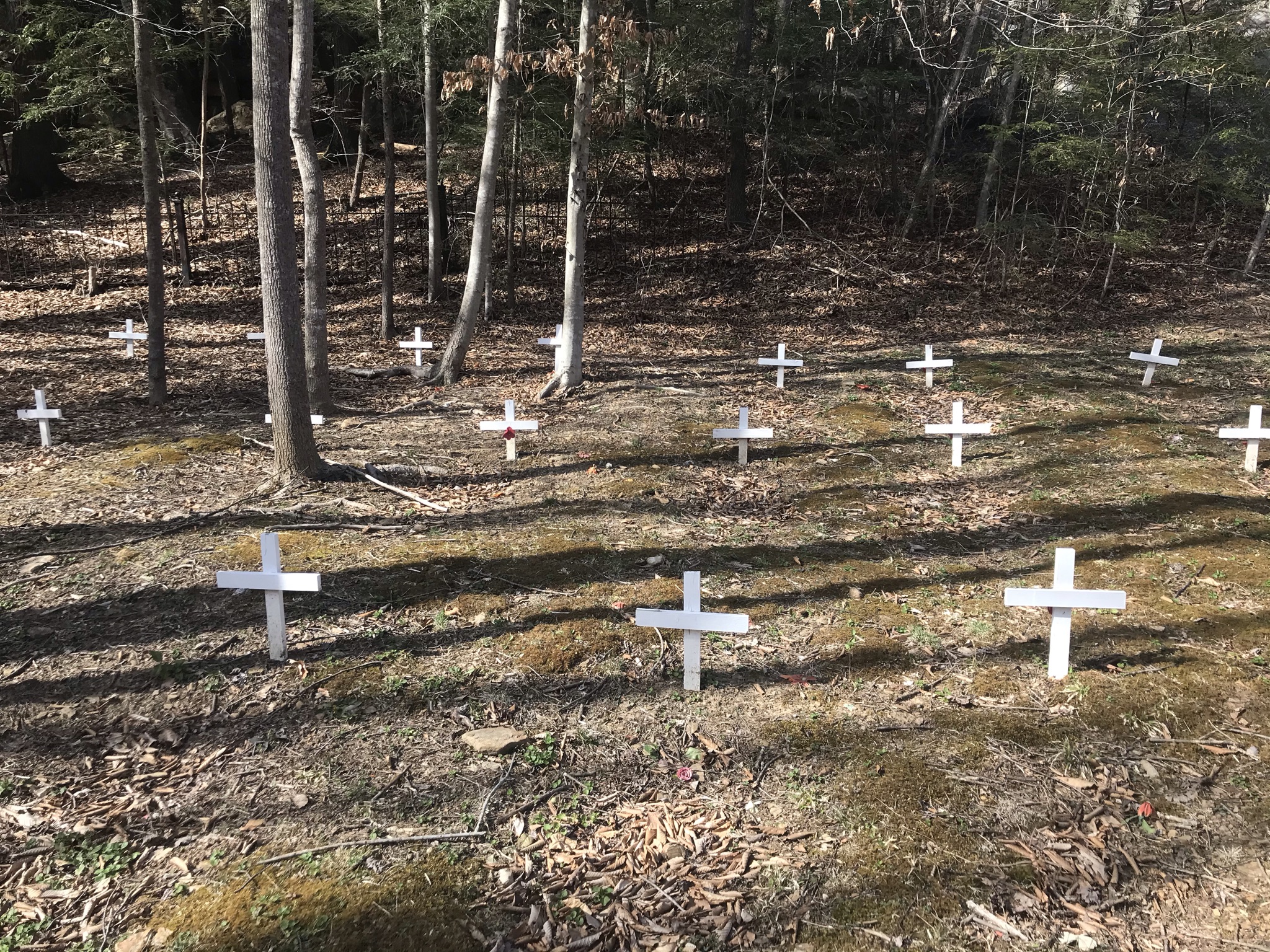
The true scale of the dying was deliberately obscured. Many African American workers, once they fell ill, returned to their homes across the South or were driven out of company camps, making an accurate death toll impossible. Those who died locally faced a final indignity: Black workers could not be buried in the "white" cemeteries near Gauley Bridge. Instead, their bodies were transported at night to a farm near Summersville and buried without ceremony in unmarked graves. In 1972, when the West Virginia Department of Highways widened U.S. Route 19, the remains were disinterred and moved several miles to a new site at 98 Hilltop Drive in Mount Lookout. The decomposed remains were placed in child-sized coffins and reburied, creating the roughly 48 small grave depressions visible there today. West Virginia placed a historical marker at the tunnel site in 1986. A memorial at the gravesite, spearheaded by local couple George and Charlotte Yeager with help from West Virginia State University professor Richard Hartman, was dedicated on September 7, 2012.
Echoes That Would Not Fade
The disaster refused to stay buried. In 1936, blues musician Josh White, recording under the name "Pinewood Tom," released "Silicosis Is Killing Me," giving voice to the miners' suffering. Two years later, poet Muriel Rukeyser published The Book of the Dead, a poetry sequence that wove together Congressional testimony, geological surveys, and the landscape of the New River Gorge into a searing indictment. West Virginian novelist Hubert Skidmore followed in 1941 with Hawk's Nest, drawing on direct sources to fictionalize the workers' lives. The tragedy's legacy extends beyond art. Hawks Nest forced the recognition of acute silicosis as an occupational lung disease, leading to compensation legislation to protect workers. It remains a landmark case in the history of worker safety and environmental justice -- a reminder that the greatest industrial disasters are not always the ones that explode, but the ones that accumulate silently, breath by breath, in the lungs of men who were promised a paycheck and delivered a death sentence.
From the Air
Located at 38.12N, 81.13W near Gauley Bridge in Fayette County, West Virginia. The New River Gorge is a dramatic visual landmark visible from altitude, with the river winding through steep forested canyons. The tunnel runs 3.8 miles through Gauley Mountain. Hawks Nest State Park overlooks the area from the canyon rim. Nearest airports: Yeager Airport (KCRW) in Charleston approximately 35 nm northwest; Greenbrier Valley Airport (KLWB) approximately 50 nm southeast. Best viewed at 3,000-5,000 ft AGL to see the gorge and river diversion. The memorial gravesite is located near Summersville, several miles northeast of the tunnel.