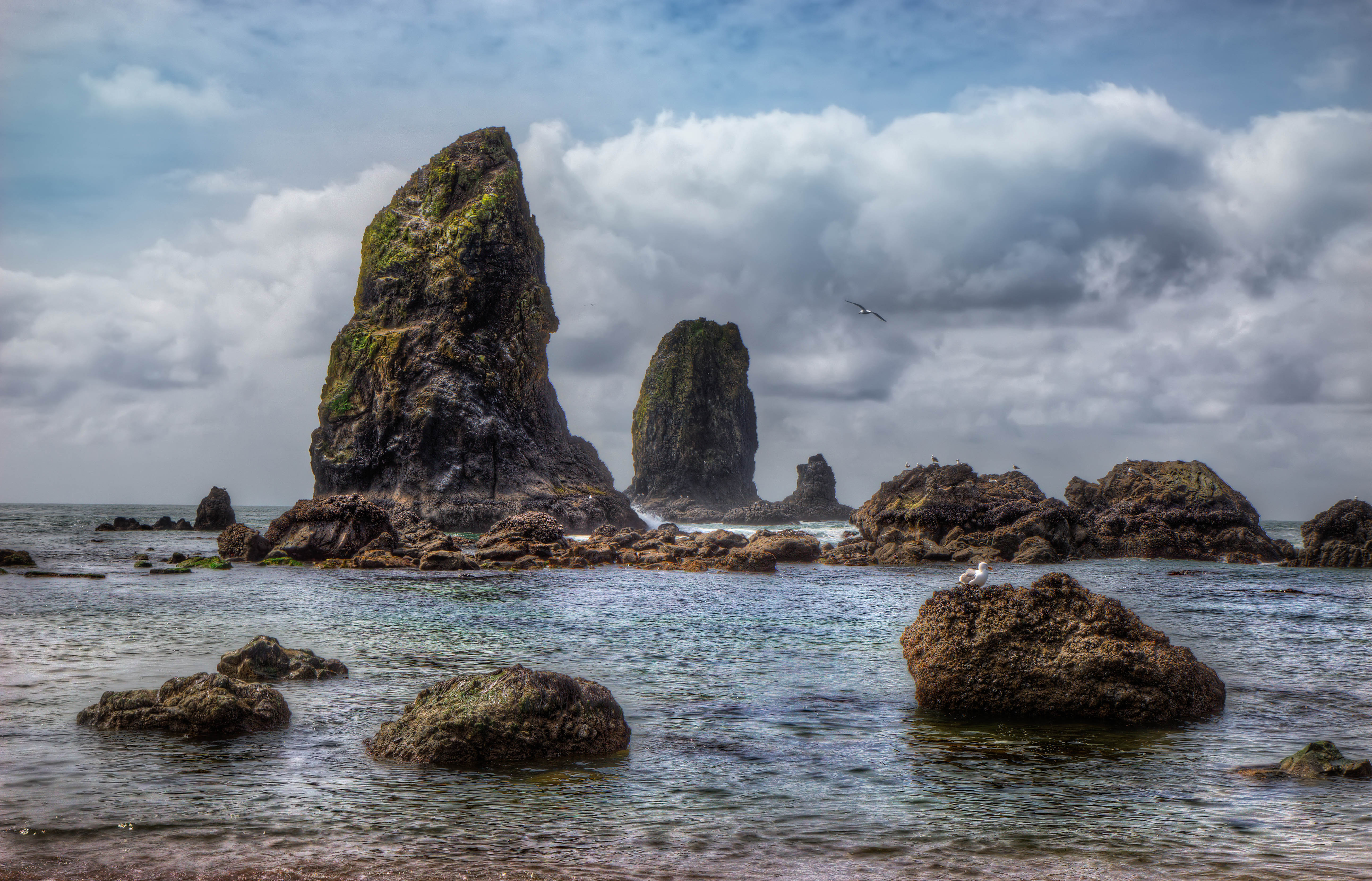
Haystack Rock
Fifteen million years ago, the rock that would become Cannon Beach's most famous resident was molten basalt, pouring westward from eruptions near what is now Yellowstone. The lava traveled hundreds of miles through the ancestral Columbia Basin, reached the coast, and cooled into the headlands and sea stacks that define the Oregon shoreline today. Most of that basalt remains anonymous - dark cliffs and offshore rocks that blend into the coastal scenery. But one piece refused to be ordinary. Haystack Rock rises 235 feet from the sand at Cannon Beach, a monolith so perfectly shaped and so improbably placed that it looks less like geology and more like something deliberately set there. At low tide, you can walk right up to its base and press your hand against stone that remembers a time when this continent's interior was tearing itself apart.
A Slow Separation
Haystack Rock was not always an island. It was once part of the coastline itself, connected to the headlands that frame the beach. Erosion did what erosion does - wave by wave, storm by storm, over thousands of years, the ocean carved away the softer surrounding rock until only the hardest basalt remained. The Needles, three smaller rock formations to the south, mark the same process at an earlier stage. Scientists estimate that the ocean will finish the job in another 2,000 to 3,000 years, grinding Haystack Rock down to nothing. For now, though, it stands - massive, dark, and unmistakable against the grey Pacific sky, its shape shifting with the light and the fog in ways that have made it one of the most photographed landmarks on the West Coast.
The Tidepool World
Twice a day, the tide retreats and reveals a miniature ecosystem clinging to the rock's base. Ochre sea stars grip the basalt in clusters of orange and purple. Sea anemones open their tentacles in the still water of shallow pools. Crabs scuttle beneath overhangs. Chitons, those armored relics of deep evolutionary time, press flat against the rock surface. Limpets and sea slugs navigate a landscape measured in inches rather than miles. The tidepools earned Marine Garden status from the Oregon Department of Fish and Wildlife in 1990, which means collecting anything - a shell, a stone, a living creature - is strictly prohibited. Volunteers from the Friends of Haystack Rock patrol the base during low tides, answering questions and watching for visitors who reach too far or step too carelessly into this fragile, ancient world.
Puffins and Pigeon Guillemots
Every spring, tufted puffins return to Haystack Rock after months spent floating on the open Pacific. They nest in burrows dug into the grassy patches on the rock's upper reaches, raising chicks through the summer before departing again in late July. With their orange bills and tufts of golden feathers swept back from their eyes, they look slightly absurd and entirely compelling. Below the puffin colonies, pigeon guillemots nest in rock crevices, their bright red feet visible against the dark basalt. Common murres crowd the ledges, standing shoulder to shoulder in colonies so dense the rock appears to move. Black oystercatchers probe the lower rocks with their long red bills. Climbing above the mean high-tide barnacle line is forbidden - the birds need the upper rock undisturbed, and the boundary is enforced by both regulation and the barnacles themselves, which make the surface treacherous.
The Rock on Screen
Haystack Rock appears in The Goonies, visible in the background as the kids race toward their pirate-ship adventure along the Cannon Beach shoreline. Point Break used nearby Indian Beach for its climactic scenes. Kindergarten Cop filmed in the area as well. The rock's cinematic appeal is simple: it is enormous, unmistakable, and moody. Morning fog wraps around its base while the top catches the first light. Sunset turns it into a silhouette that looks lifted from a painting. In 1968, authorities dynamited a protruding ledge that daredevil climbers had been using as a foothold - an era when the solution to people doing dangerous things was to blow up the thing they were climbing. The rock survived the blast. It survives everything, for now, patient and indifferent, while the ocean works on its slow, inevitable project.
From the Air
Located at 45.88°N, 123.97°W, Haystack Rock is the prominent 235-foot sea stack on Cannon Beach, approximately 1.5 miles south of downtown. Easily identifiable from altitude as the largest monolith on the beach, with three smaller formations ('The Needles') immediately to its south. Approximately 80 miles west of Portland. Nearest airports: Seaside Municipal Airport (56S) approximately 8nm north, Astoria Regional Airport (KAST) approximately 18nm north-northeast. Best viewed at 1,000-2,500 ft AGL - the rock's scale against the beach is dramatic from lower altitudes. Tidepool areas visible at low tide as dark patches around the base. Oregon Coast fog is common, particularly summer mornings; afternoon clearing typical. U.S. Route 101 parallels the coast and serves as a reliable visual reference.