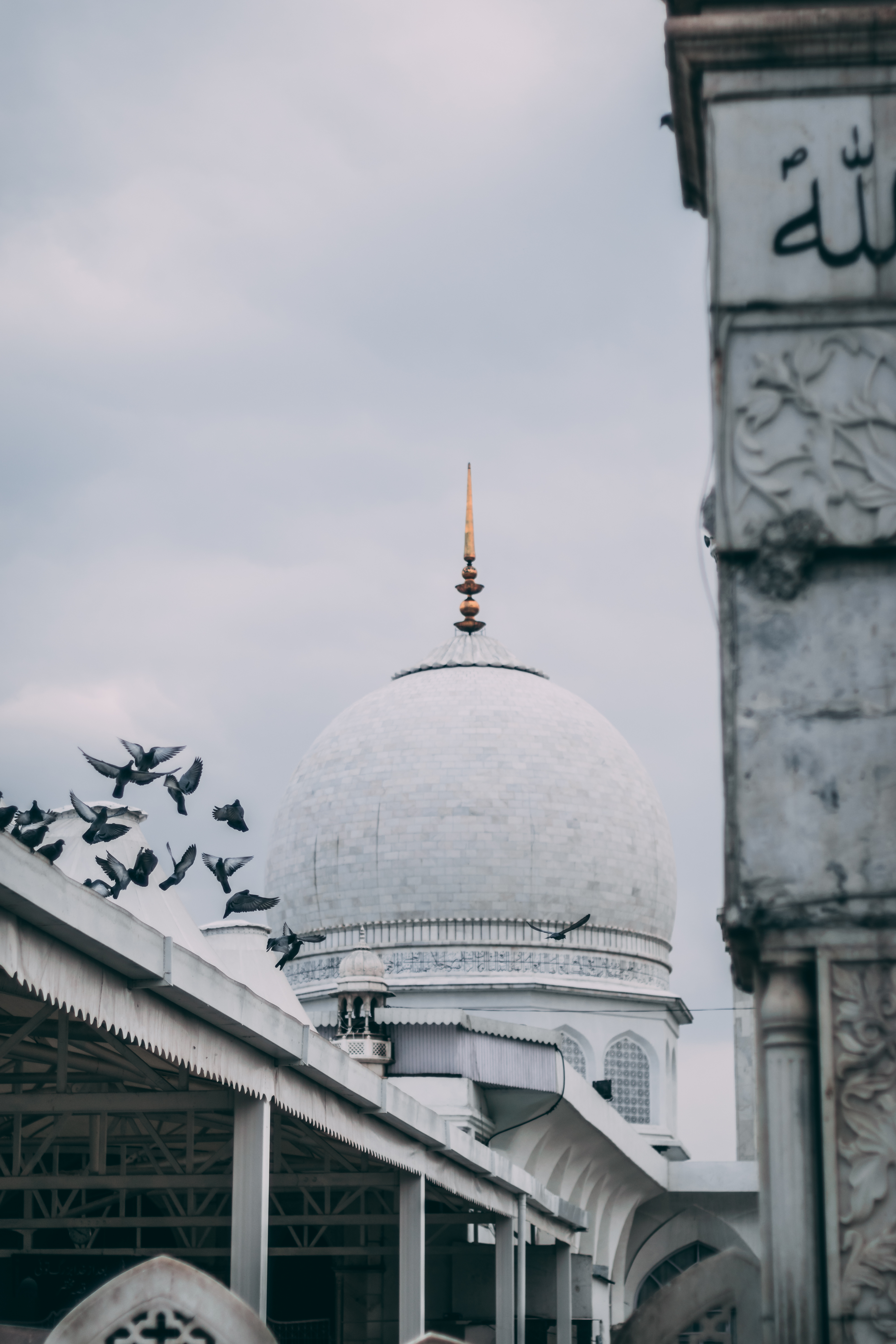
Hazratbal Shrine
A single strand of hair, kept behind glass and displayed only on the holiest days of the Islamic calendar, has shaped the politics of Kashmir for centuries. The Hazratbal Shrine -- its name combining the Arabic hazrat (a title of respect) with the Kashmiri bal (place) -- sits on the northern bank of Dal Lake in Srinagar, its white marble dome and minaret reflected in water that has mirrored prayer for nearly four hundred years. The mosque houses the Moi-e-Muqqadas, a relic believed to be a hair of the Prophet Muhammad. For the Muslims of Kashmir, Hazratbal is the holiest site in the valley. But the shrine's significance has always extended beyond devotion. Empires have fought over its patronage, governments have staked legitimacy on its renovation, and one winter in 1963, the relic's brief disappearance nearly tore the subcontinent apart.
From Medina to the Valley
The relic's journey to Kashmir reads like a picaresque novel spanning centuries and empires. According to tradition, Syed Abdullah Madani -- described as a descendant of the Prophet Muhammad -- left Medina and settled in Bijapur in southern India around 1635, during the period of Mughal expansion. He brought the hair with him. After his death, his son Syed Hameed inherited custody of the relic. But the Mughal conquest upended Hameed's fortunes; he lost his estates and eventually transferred the relic to Khwaja Nur-ud-Din Eshai, a Kashmiri merchant. The earliest structure at the Hazratbal site was built in the 17th century by Mughal subedar Sadiq Khan under the orders of Emperor Shah Jahan. Originally called Ishrat Jahan, the building was converted into a prayer hall in 1634. The relic found its home. And then Emperor Aurangzeb tried to take it away.
An Emperor's Dream
When Aurangzeb learned of the relic's existence in Kashmir, he ordered it seized and transported to Ajmer, to be placed at the shrine of the Sufi saint Mu'in al-Din Chishti. Eshai, the relic's custodian, was imprisoned in Delhi. The story might have ended there -- a powerful emperor claiming a holy object for a shrine of his choosing. But traditional accounts record what happened next: Aurangzeb experienced a dream in which he saw the Prophet Muhammad alongside the four Rashidun caliphs. The dream, according to these accounts, so disturbed the emperor that he reversed his decision and ordered the relic returned to Kashmir. Whether the dream was genuine revelation, political calculation, or a face-saving narrative crafted after the fact, the result was the same. The Moi-e-Muqqadas went back to the valley, where it has remained ever since.
The Winter the Relic Vanished
On December 27, 1963, the Moi-e-Muqqadas was reported missing from the shrine. The reaction was immediate and immense. Protests erupted across Jammu and Kashmir, with large demonstrations in multiple cities. Four days later, Prime Minister Jawaharlal Nehru addressed the nation and dispatched a Central Bureau of Investigation team to probe the theft. The relic was recovered on January 4, 1964, identified by Sayyid Meerak Shah Kashani and others who knew it by sight. But the damage rippled far beyond Kashmir. Communal tensions surged in West Bengal and East Pakistan (present-day Bangladesh), triggering violence that displaced an estimated 200,000 refugees between December 1963 and February 1964. A single missing hair had destabilized regions hundreds of miles from where it was kept -- a testament to the relic's hold on the collective imagination of millions.
Marble Over Thatch
The shrine visitors see today bears little resemblance to its earlier incarnation. Through the 1970s, under the leadership of Sheikh Abdullah, the original structure -- characterized by a thatched roof and traditional Kashmiri architectural style -- was demolished and rebuilt in white marble with Mughal-inspired design elements, including the distinctive dome and minaret. Some scholars have interpreted this reconstruction as a political gesture, an effort by Abdullah's administration to reinforce legitimacy following the Indira-Sheikh Accord. A more recent transformation came through a 45-crore-rupee beautification project funded by the Indian government's PRASAD scheme. Sanctioned in 2014-15 and formally launched in 2017 by Chief Minister Mehbooba Mufti, the project incorporated traditional Kashmiri khatamband woodwork and calligraphy alongside modern amenities. Key components were inaugurated by Prime Minister Narendra Modi in March 2024.
Sacred Ground, Contested Ground
Hazratbal's location is part of its power. The shrine occupies a promontory on Dal Lake's northern shore, its white facade visible from houseboats, shikaras, and the ring of mountains that frame Srinagar. From above, the dome gleams against the dark water -- an unmistakable landmark in a city defined by its relationship to the lake. The relic is still displayed publicly only on special Islamic occasions, including Mawlid, the celebration of the Prophet Muhammad's birth. On those days, the head cleric holds the glass reliquary before crowds of thousands who have gathered to witness what they believe is a physical connection to their prophet. Four centuries after a merchant from Bijapur first brought it to the valley, the Moi-e-Muqqadas continues to draw the faithful to the shore of Dal Lake.
From the Air
Located at 34.129°N, 74.842°E on the northern shore of Dal Lake in Srinagar, Jammu and Kashmir. The white marble dome and minaret are clearly visible from the air, standing out against the dark water of the lake. Dal Lake itself is a major visual landmark, roughly 18 square kilometers in area. The nearest airport is Sheikh ul-Alam International Airport (ICAO: VISR), approximately 14 km to the southwest. The shrine sits at about 1,585 meters elevation. Best viewed between 5,000 and 10,000 feet for detail of the shrine and its lakeside setting.