Heard Museum
The photographs are what stay with you. Young Native American children in identical uniforms, their hair cut short, staring at the camera with expressions ranging from bewilderment to quiet defiance. The Heard Museum's boarding school exhibit captures what the New York Times called 'the little-known experience of thousands of children bused, sometimes forcibly, from their reservations to government schools in order to erase their culture.' But this Phoenix museum is not only about painful history - it stands as the nation's foremost institution dedicated to the advancement and celebration of American Indian art, told from a first-person perspective.
A Personal Collection Becomes a Legacy
Dwight B. and Maie Bartlett Heard founded the museum in 1929 to house their personal art collection. Much of their archaeological material came from La Ciudad Indian ruin, which they had purchased three years earlier at 19th and Polk streets in Phoenix. What began as a wealthy couple's private passion transformed over nine decades into one of America's most important cultural institutions. The main Phoenix location earned designation as a Phoenix Point of Pride. Architect Bennie Gonzales, who also designed Scottsdale City Hall, shaped portions of the Spanish Colonial Revival building. Today the museum sprawls across 130,000 square feet of gallery, classroom, and performance space, drawing 250,000 visitors annually.
Goldwater's Kachinas
Among the Heard's most treasured holdings is the Barry Goldwater Collection: 437 historic Hopi kachina dolls assembled by the Arizona senator and 1964 presidential candidate. These carved wooden figures represent katsinas, spirit beings central to Hopi and Pueblo religious life. Each doll captures intricate ceremonial details - the masks, the body paint, the ritual objects. The Mareen Allen Nichols Collection contributes 260 pieces of contemporary Native American jewelry. Together with 40,000 other items and a library holding 34,000 volumes, these collections make the Heard a Smithsonian Affiliations member and essential resource for understanding American Indian artistic traditions.
Living Traditions
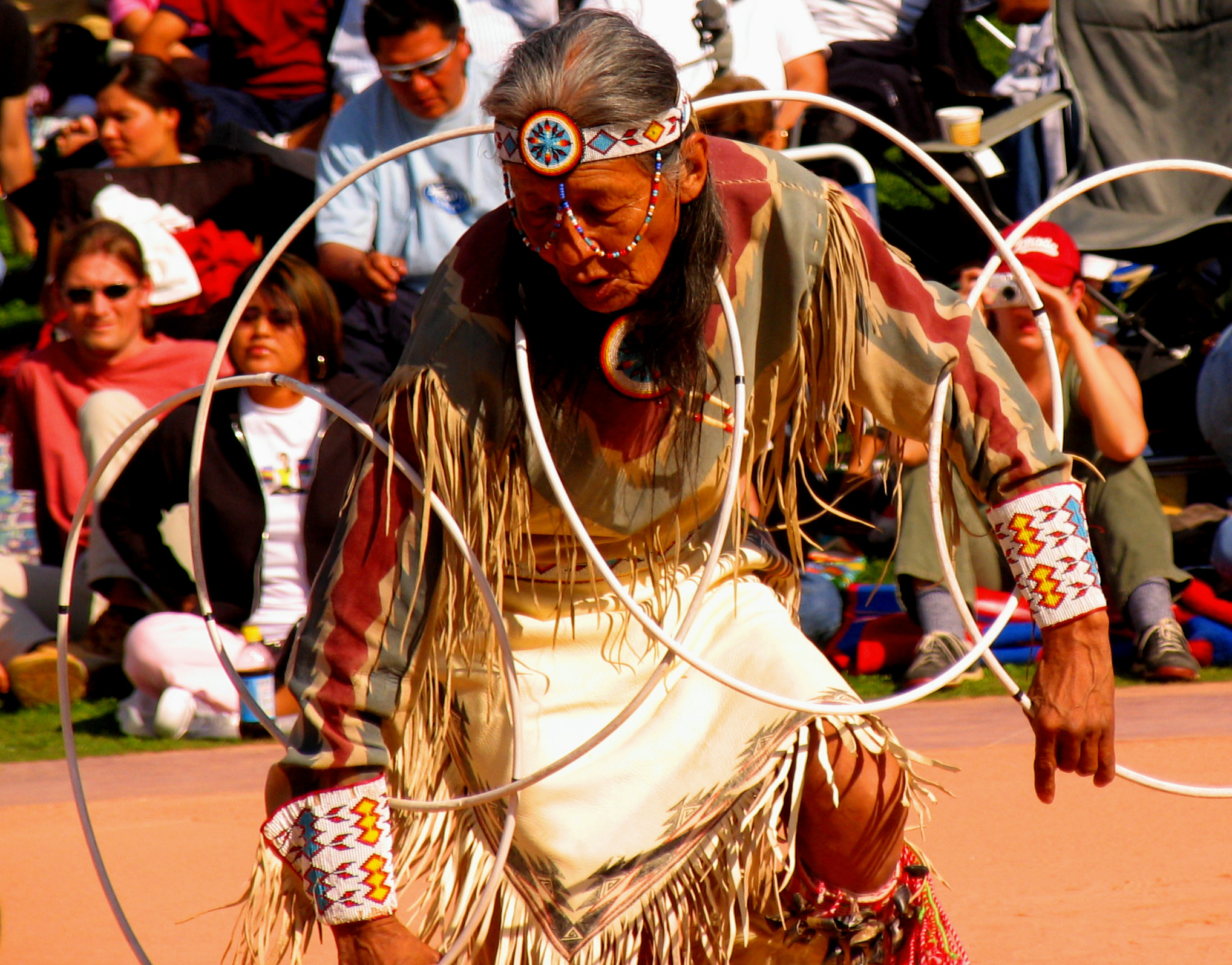
The Heard pulses with contemporary Native American life, not just preserved artifacts. Each March, the Annual Heard Museum Guild Indian Fair and Market - running continuously since 1958 - brings 600 Native American artists before 15,000 visitors. Juried competitions in eight classifications from jewelry to pottery to textiles crown champions, with judges drawn largely from American Indian tribes. November brings El Mercado de Las Artes, featuring Hispanic artists from Arizona and New Mexico creating santos, colcha embroidery, and silver work while mariachis stroll the galleries. In February, the World Championship Hoop Dance Contest transforms the outdoor Libby Amphitheater into an arena of athletic grace and spiritual expression.
Honoring Those Who Served
Adjacent to the Libby Amphitheater stands the American Indian Veterans National Memorial, a powerful acknowledgment of Native American military service that too often goes unrecognized. Four bronze-colored panels honor veterans across conflicts, while three sculptures by master artists add contemplative depth: works by Chiricahua Apache sculptor Allan Houser and Santa Clara Pueblo sculptor Michael Naranjo, including the striking piece titled 'Unconquered II.' The memorial reminds visitors that Native Americans have served in the United States military at higher rates per capita than any other ethnic group - a complex legacy given the history documented elsewhere in the museum.
First-Person Voices
What distinguishes the Heard from other Native American museums is its commitment to first-person perspective. Stories are told by Native people themselves, not about them. The Home: Native Peoples in the Southwest exhibition roots visitors in place, exploring how diverse Indigenous peoples have lived in this landscape for millennia. Dr. Letitia Chambers, who served as director from 2010 to 2012, was the first Heard director of American Indian descent - a milestone that reflected the museum's evolving identity. Under current director David M. Roche, who began in 2016, the institution continues balancing its roles as art museum, cultural center, and keeper of difficult truths.
From the Air
Located at 33.4736°N, 112.0736°W in central Phoenix, Arizona. The museum occupies a campus in the Encanto-Palmcroft historic district, recognizable by its Spanish Colonial Revival architecture with distinctive red tile roofs. Phoenix Sky Harbor International Airport (KPHX) lies just 5 nautical miles to the east - expect Class B airspace restrictions. Phoenix Deer Valley Airport (KDVT) is 12 nautical miles north. The museum sits in the urban grid of central Phoenix, north of downtown. The Libby Amphitheater is visible as an outdoor performance space adjacent to the main buildings. Best viewed at lower altitudes below 3,000 feet AGL in clear conditions.