Hearst Memorial Mining Building
The architect called it "the kind, bluff brother amid a bevy of lovely sisters." John Galen Howard was explaining why his newest building at the University of California looked nothing like the graceful classical halls rising around it. Where those buildings reveled in ornament and proportion, the Hearst Memorial Mining Building -- completed in 1907 at a cost of $1.065 million, every dollar a gift from Phoebe Apperson Hearst -- presented something rougher. Exposed brick. Timber brackets. A deliberate, unapologetic muscularity. Howard believed the profession of mining "has to do with the very body and bone of the earth," and he wanted the architecture to say so. The result is one of Berkeley's strangest and most compelling buildings: a structure that is simultaneously a Beaux-Arts masterpiece and a monument to the raw, Cyclopean work of pulling wealth from the ground.
A Fortune Remembered
Senator George Hearst made his money the old way -- in silver and gold, in copper and lead, in the hard places of the American West. When he died in 1891, his widow Phoebe resolved to transform the Berkeley campus in his memory. She funded an international architectural competition that drew 105 entries from eleven countries, then hired the winning supervising architect, John Galen Howard, to execute the plan. The mining building would be first. It was a deliberate choice. When construction began in 1902, Berkeley's College of Mines enrolled 247 students -- eleven percent of the entire university and the largest mining school in the world. Yet the college had no dedicated building. Phoebe Hearst's gift changed that, and Howard designed a structure that would honor both the senator's profession and the college's ambition. Julia Morgan, then a young Berkeley alumna and one of the few women practicing architecture in America, collaborated with Howard on the design. She would go on to design Hearst Castle, but this was an early proving ground.
Beauty Worked from Within
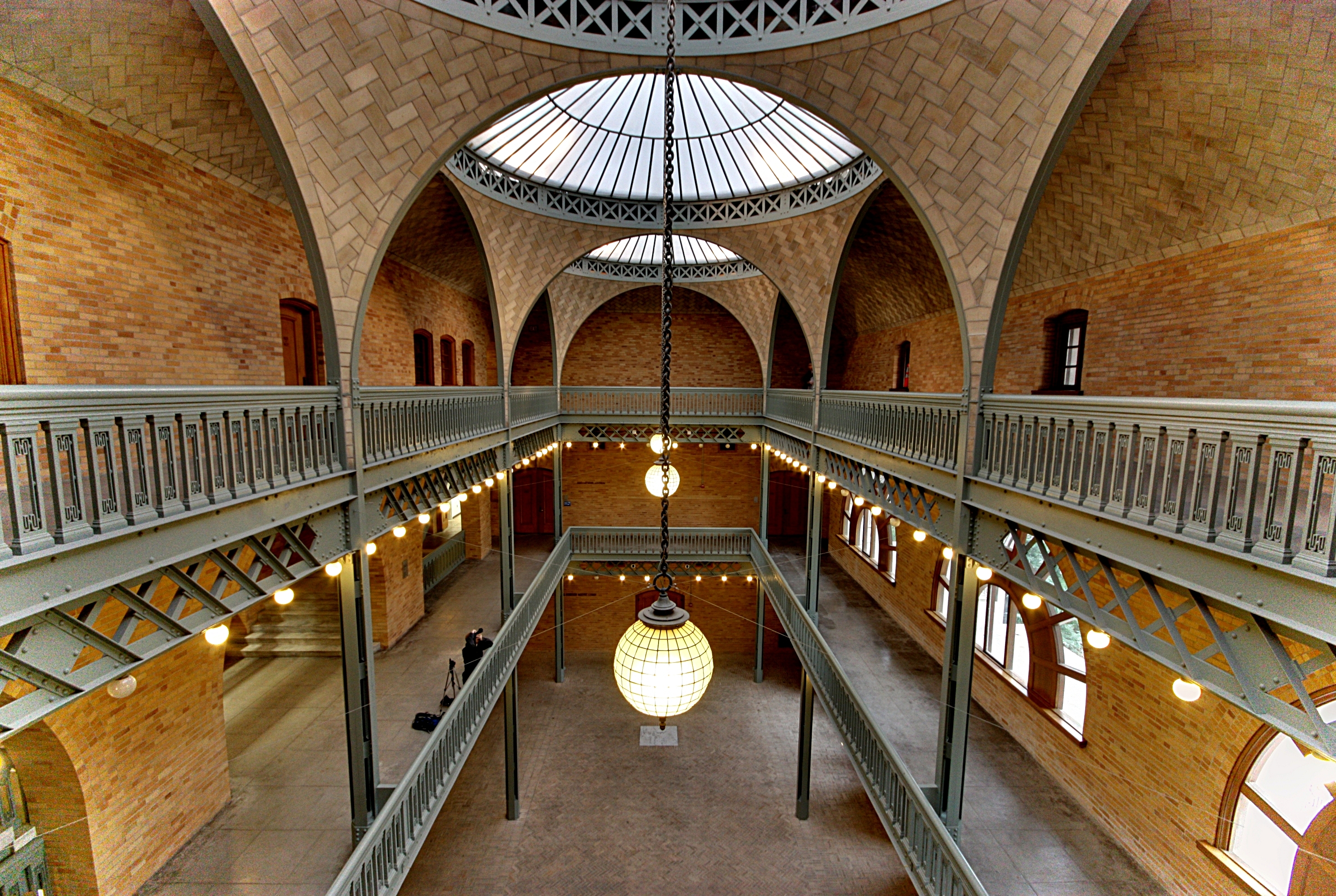
Howard rejected what he called "easy masquerade and putting on of architectural stuff." He wanted the building's beauty to emerge organically from its purpose. The roof tiles echo California mission architecture. Six granite corbel sculptures by Robert Ingersoll Aitken support the wooden brackets -- the western pair representing "primal elements," the eastern pair "eternal forces," and two central female figures embodying "the ideal art, the final flower of life, fresh, mysterious, pure, emerging from the void of chaos." Inside, the effect is more dramatic still. Push through the golden oak doors and you enter a vestibule modeled on Henri Labrouste's Reading Room at the Bibliotheque Nationale de France. Buff-toned Guastavino tiles cover domes fifty feet overhead, installed by workers brought from the studio of the Valencian architect Rafael Guastavino, who had earned fame for his vaulting in the Boston Public Library. Two floors of balconies rise along blue-green cast-iron railings, supported by steel lattice trusses. Bricks are left deliberately exposed -- a reminder that beneath the elegance, this is a building about extraction and force.
The Working Heart
The building was not a showpiece alone. Behind the memorial vestibule lay the functional machinery of a working mining school. A three-story tower at the north end housed the dry ore crushing operation. To the east, a copper and lead smelting laboratory. To the west, a gold and silver mill. The mining laboratory occupied the central court, flanked by metallurgic and research labs, a library, and lecture halls. Students could move from classroom to laboratory to industrial process without leaving the building. A plaque on the north wall of the entryway honored the man whose fortune made it possible: "This building stands as memorial to George Hearst, a plain honest man and good miner. Taking his wealth from the hills he filched from no man's store and lessened no man's opportunity." The Lawson Adit -- an actual horizontal mining tunnel -- sits directly east of the building, a reminder that the earth being studied in the classrooms lay just beyond the walls.
A Building That Floats
By the late twentieth century, the mining building faced a threat George Hearst could never have anticipated. Not economic decline or obsolescence, but the Hayward Fault, which runs directly beneath the Berkeley campus. From 1998 to 2003, the building underwent a five-year renovation that combined seismic retrofitting with modern expansion. Engineers built a platform beneath the entire structure and installed a base isolation system capable of one meter of lateral travel -- meaning the building can now slide more than three feet in any direction during an earthquake while its contents remain stable. To distinguish the new construction from Howard's original design, architects clad the additions in shot-peened aluminum rather than stone, creating a visible dialogue between the nineteenth-century original and its twenty-first-century survival strategy. Today the building houses the Department of Materials Science and Engineering, its research spanning biomaterials, computational materials, and electronic and optical systems. The profession has evolved far beyond picks and smelters, but the building's muscular beauty endures -- still the bluff brother, still standing, now floating on its platform above the restless earth.
From the Air
Located at 37.874°N, 122.256°W on the UC Berkeley campus, the Hearst Memorial Mining Building sits near the northeast edge of the main campus. From the air, look for a large Beaux-Arts structure with a distinctive tiled roof and timber brackets, oriented roughly north-south. The UC Berkeley Campanile (Sather Tower) is a prominent visual reference to the southwest, and California Memorial Stadium lies to the east. Nearest airports: KOAK (Oakland International, 9 nm south), KSFO (San Francisco International, 19 nm southwest). Best viewed at 2,000-3,000 ft in clear conditions.