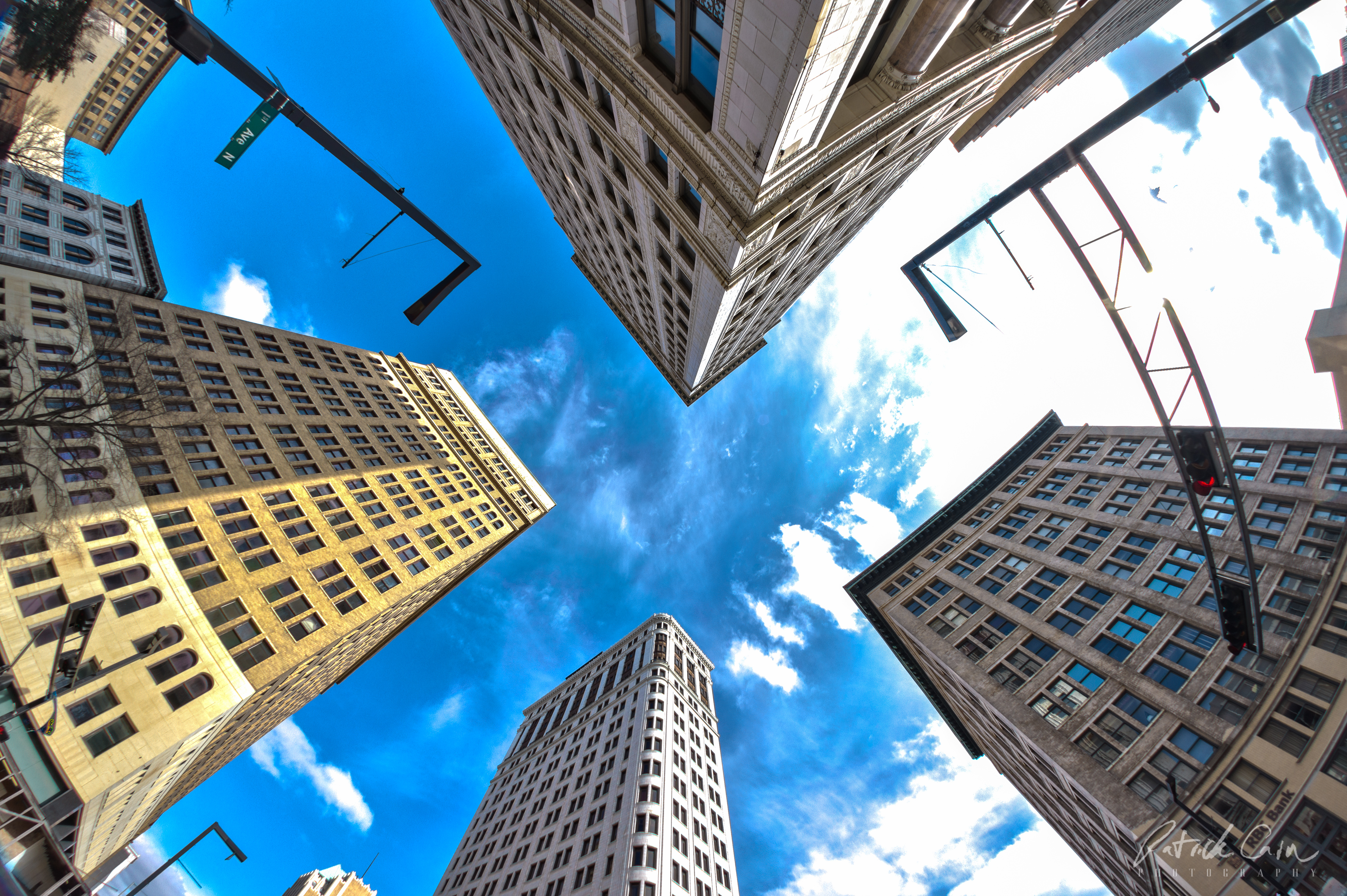
Heaviest Corner on Earth
The boast started modestly enough. In January 1911, the Jemison Magazine ran an article declaring that Birmingham was about to have 'the Heaviest Corner in the South.' Four tall buildings were converging on a single intersection - 20th Street and 1st Avenue North - and the claim seemed reasonable. But Birmingham was not a city built on modesty. Within a few years the nickname had inflated to 'the Heaviest Corner on Earth,' a cheerful exaggeration that said more about the city's self-image than about structural engineering. The four buildings still stand, and the name still sticks.
Four Buildings, Ten Years
The corner assembled itself in a decade. The Woodward Building came first in 1902 - ten stories, 132 feet tall, Birmingham's first Chicago-style steel-frame skyscraper. William Woodward, former owner of the Woodward Iron Company, had sold his business to finance the tower. When it opened, nothing in the city came close. Then the Brown Marx Building rose on the northeast corner in 1906, sixteen stories of lightly colored brick with arched ground-floor windows and marble interiors, named for early tenants Otto Marx and Eugene L. Brown. Three years later, the Empire Building claimed the northwest corner at 247 feet, developed by the Empire Improvement Company and financed by Metropolitan Life Insurance Company in one of the first development deals of its kind by an insurer. It was the tallest building in Alabama. Not for long. In 1912, the American Trust and Savings Bank Building topped out at 284 feet and twenty-one stories, briefly holding the state's height record.
A Young City Reaches Up
Birmingham was barely thirty years old when the Woodward Building went up. The city had been founded in 1871 at the junction of two railroad lines, atop rich deposits of iron ore, coal, and limestone. By the turn of the century it was booming, its furnaces pouring out iron and steel, its population doubling every decade. The four skyscrapers were declarations of permanence: this was not a temporary mining camp but a real city, a Southern rival to Chicago and Pittsburgh. The buildings were designed to impress Eastern investors and attract Northern capital. The corner was Birmingham's calling card, proof that the Magic City - as local boosters had named it - was building upward as fast as it was spreading out.
Survival and Reinvention
The buildings survived what the city's other landmarks often did not. While Birmingham demolished its Terminal Station in 1969 and lost much of its early architecture to urban renewal, the Heaviest Corner endured. Three of the four buildings were individually listed on the National Register of Historic Places in 1982 and 1983, and the group of four was designated a historic district on July 11, 1985. A historical marker, erected on May 23, 1985 by the Birmingham Historical Society, stands on the sidewalk outside the Empire Building. In recent years, the buildings have found new lives: the Empire Building now houses the Elyton Hotel, and the Brown Marx Building was acquired by Ascent Hospitality for renovation. The John Hand Building - as the American Trust and Savings Bank Building is now known - operates as furnished apartments. The Woodward Building has welcomed new commercial tenants.
Standing at the Corner
Stand at 20th and 1st Avenue North today and the four buildings still define the intersection, their early-twentieth-century facades framing the sky. The Woodward's light-brown brick anchors one side; the Empire's 247-foot tower rises opposite. The Brown Marx sits at the northeast, its arched windows catching afternoon light. The John Hand Building, tallest of the four, occupies the southeast. Together they form a kind of urban canyon, a dense cluster of ambition from a time when Birmingham believed it would be one of America's great cities. The name was always a stretch - there were heavier corners in New York and Chicago even in 1912. But the nickname was never really about tonnage. It was about a young industrial city looking up at its own skyline and liking what it saw.
From the Air
Located at 33.514N, 86.806W in downtown Birmingham, Alabama. The four buildings cluster at the intersection of 20th Street and 1st Avenue North, visible from altitude as a distinctive grouping of early-twentieth-century towers in the city's central grid. The tallest, the John Hand Building, reaches 284 feet. Birmingham-Shuttlesworth International Airport (KBHM) is 5 miles northeast. Downtown Birmingham's regular grid pattern makes orientation straightforward. Red Mountain and the Vulcan statue lie to the south.