Hebei Museum
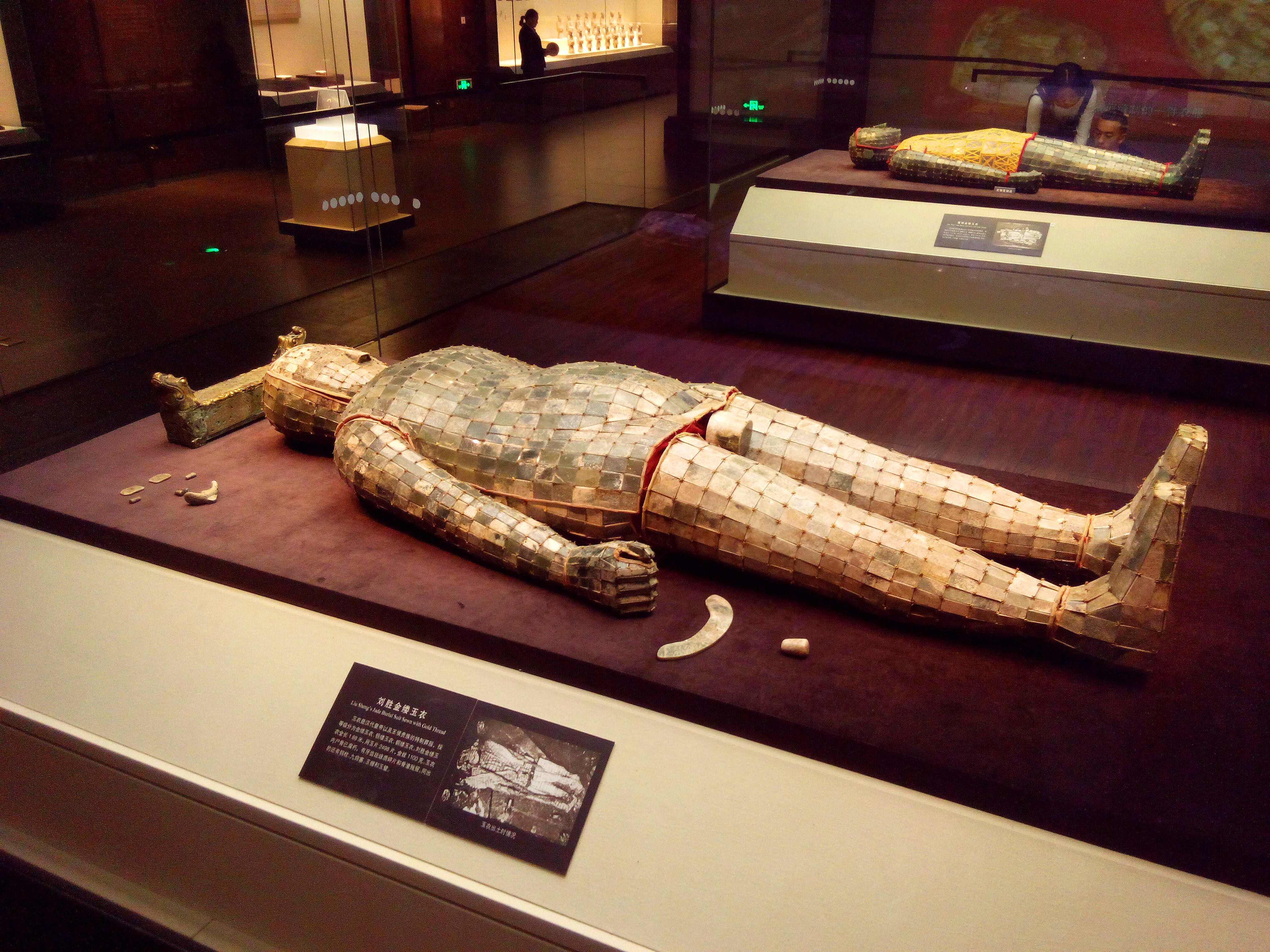
The jade suit weighs roughly two kilograms and is made of 2,498 individual pieces of jade, each one cut, polished, and connected to its neighbors with gold wire. It was not clothing for the living. It was armor for the dead. When Liu Sheng, Prince of Zhongshan, was buried around 113 BCE, his body was encased in this jade shell, a Han dynasty belief that jade could preserve the body for eternity made tangible in meticulous craftsmanship. His suit, and the one made for his wife Dou Wan, are the centerpieces of the Hebei Museum in Shijiazhuang.
A Museum That Moved Twice
The Hebei Museum first opened its doors in April 1953, not in Shijiazhuang but in Baoding, which had served as the provincial capital. As Hebei's administrative center shifted, so did its museum. After relocating twice during the 1980s, it finally settled at its current location on South Zhongshan Street in October 1987. As the only provincial-level museum in Hebei, it carries the responsibility of representing the cultural heritage of a province that stretches from the edge of Beijing to the mountains bordering Shanxi. Its exhibition area covers approximately 20,000 square meters and houses nearly 150,000 cultural relics spanning millennia of Chinese civilization.
Treasures from the Mancheng Tombs
The museum's greatest treasures come from a single archaeological discovery: the Mancheng tombs of Liu Sheng and his wife Dou Wan, who died around 113 BCE during the Western Han dynasty. Liu Sheng was a son of Emperor Jing and served as the Prince of Zhongshan, a regional kingdom in what is now Hebei. His tomb, carved into a hillside, yielded an extraordinary collection of burial goods designed to accompany him into the afterlife. The jade burial suits are the most famous items, but the collection also includes a hill censer inlaid with gold, used for burning incense in a design meant to evoke the mythical peaks of a paradise island, and the Changxin Palace lantern, an elegant bronze lamp in the form of a kneeling palace servant, dated to around 172 BCE and recovered from the tomb of Dou Wan.
Bronze, Porcelain, and Vanished Dynasties
Beyond the Han dynasty treasures, the museum's collection spans the full arc of Chinese artistic achievement. Bronze cups from Dou Wan's tomb feature a vermilion bird holding a jade ring in its mouth, a motif drawn from Chinese cosmology where the vermilion bird represents the south and the element of fire. A Yuan dynasty jar decorated in blue and white pottery displays fretwork floral designs of lotus petals, grasses, and peonies in blue and red glaze, topped with a lion finial. These pieces do not merely illustrate artistic taste; they document the trade networks, religious beliefs, and political structures that produced them. Each object in the collection is a surviving witness to a world that otherwise exists only in written records.
An Open Door
The Hebei Museum is open Tuesday through Sunday, from 9:00 AM to 5:00 PM, and entrance is free with valid identification. This accessibility is intentional. As a first-grade national museum, its mission extends beyond scholarship to public education, making the material culture of Hebei's past available to anyone willing to walk through the door. For visitors arriving in Shijiazhuang by train or air, the museum offers a concentrated introduction to the province's cultural depth, a reminder that Hebei is not merely the geographic wrapper around Beijing and Tianjin but a region with its own profound and distinct history, stretching from the jade-wrapped princes of the Western Han to the present day.
From the Air
The Hebei Museum is located at 38.041N, 114.523E in central Shijiazhuang, the capital of Hebei Province. Shijiazhuang Zhengding International Airport (ZBSJ) is approximately 30 km northeast of the museum. The museum sits on South Zhongshan Street, one of the city's main arterials. From the air, Shijiazhuang presents as a large urban area on the flat North China Plain, with the Taihang Mountains visible to the west.