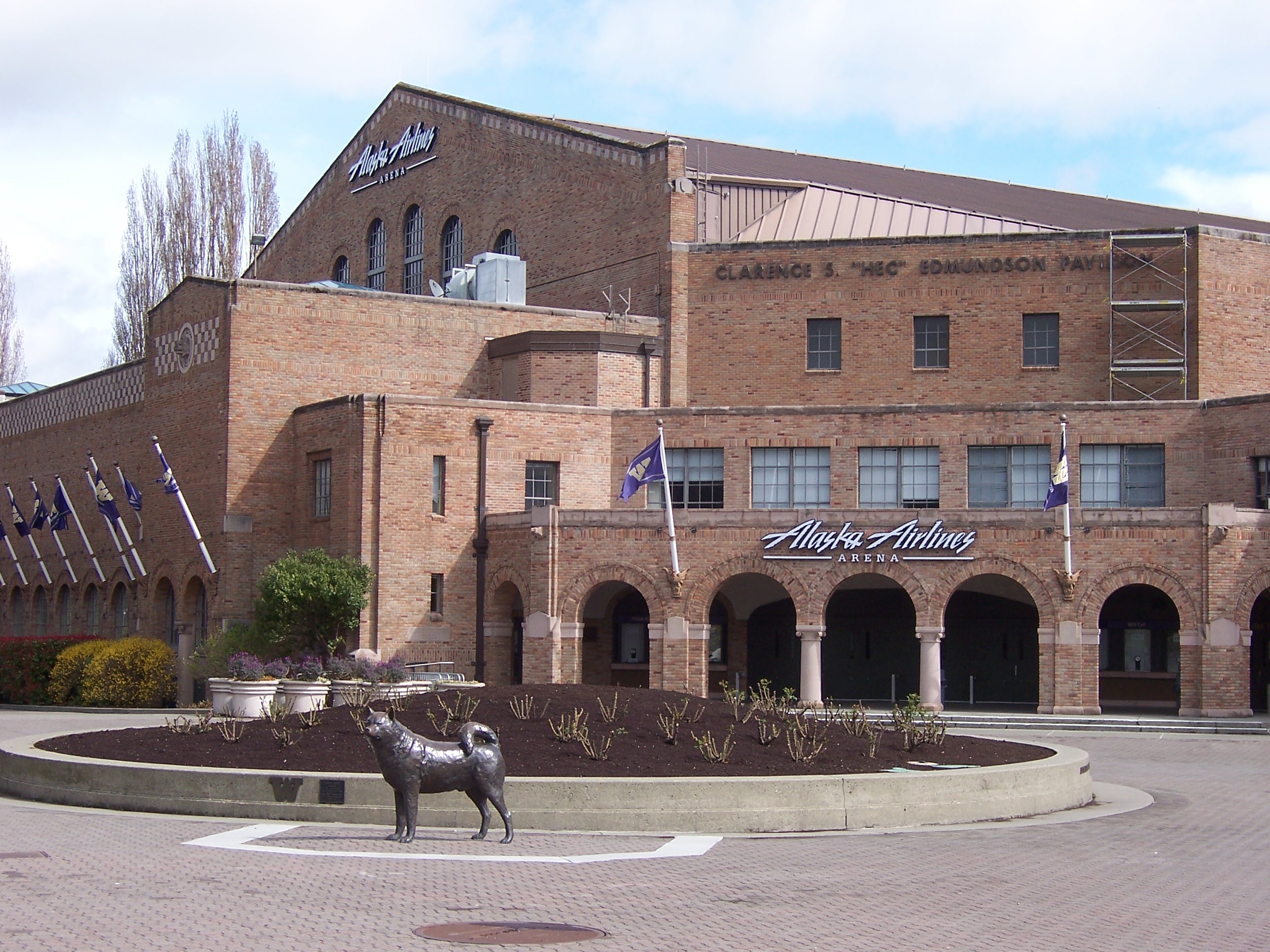
Hec Edmundson
In June 1905, a high school student from Moscow, Idaho lowered the Northwest record for the half mile. Seven years later, Clarence Sinclair "Hec" Edmundson stood in Stockholm's Olympic Stadium for the 800 meters final, the first athlete from Idaho ever to compete in the Olympic Games. What happened between those two moments, and in the decades that followed, would reshape college basketball in the Pacific Northwest. Edmundson's insight was deceptively simple: if a runner's legs could outpace a defender on the track, they could do the same on a hardwood court. He turned that idea into the fast-break offense, a style of play that transformed the Washington Huskies from a regional program into a national contender and earned their arena the nickname that stuck long after its creator was gone.
The Fastest Man in Idaho
Edmundson grew up in Moscow, a small university town in the rolling Palouse hills of northern Idaho. His father Thomas taught horticulture at the University of Idaho, and young Hec enrolled at the university's prep school before joining the college team. He was one of the first standout athletes at what was still a fledgling institution, and he announced himself dramatically. In 1905, he and two teammates traveled to the Lewis and Clark Exposition Games in Portland, competing against the best programs in the Northwest. Newspapers praised his "graceful form and unfaltering determination." By 1908, he had organized the university's cross-country team, laying the groundwork for a program that would eventually win nine Pacific Coast Conference titles. That same year, Edmundson traveled to Stanford for the western U.S. Olympic trials, winning the 800 meters and finishing second in the 400. He did not make the 1908 Olympic team, but he held the title of top half-miler in the country through 1912, when he finally reached the Games in Stockholm. He finished seventh in the 800 meters and sixth in the 400, running against the best middle-distance athletes on Earth.
From Track Spikes to High-Tops
After graduating with a bachelor's degree in agriculture in 1910, Edmundson coached high school for two years, at Coeur d'Alene and then Broadway High School in Seattle, before returning to Moscow to coach the Idaho track team in 1913. A salary dispute eventually pushed him to Whitman College in Walla Walla, where he picked up basketball coaching alongside his track duties. His basketball teams there were among the first at Idaho referred to by what would become the university's permanent athletic nickname. A brief stint coaching track at Texas A&M followed before Edmundson landed in Seattle to coach the Washington Huskies. It was at Washington that his athletic background reshaped how the game was played. Edmundson credited his track training for the fast-break offense he developed, a system built on the simple premise that speed kills. Rather than walking the ball up the court and setting deliberate plays, his teams pushed the pace, outrunning opponents who could not match their conditioning. The approach was revolutionary for its era and became a Huskies trademark.
Three Decades on Montlake
Edmundson coached Washington basketball through March 1947 and continued as track coach for another seven years, a combined tenure of nearly three decades at the university. His influence extended beyond the sidelines. He served on the NCAA Basketball Committee from 1941 to 1946, helping to shape the sport's national governance during the war years. The university hosted the NCAA national basketball finals in both 1949 and 1952 in the arena that had become synonymous with his coaching. That arena, a multi-purpose field house on the Montlake campus, had opened in December 1927 as simply the UW Pavilion. In January 1948, the university renamed it Hec Edmundson Pavilion, recognizing the man who had spent two decades filling its seats. Generations of Seattle sports fans came to know it simply as "Hec Ed," a nickname as informal and affectionate as the coach who inspired it.
A Legacy Buried Close to Home
Edmundson died of a stroke in August 1964, three days after his seventy-eighth birthday. He was buried in Calvary Cemetery in northeast Seattle, roughly a mile north of the pavilion that carries his name. His wife Mary Zona Schultz, their son James, and an infant child who died in 1921 rest beside him. In 1979, Edmundson was posthumously inducted into the Big W Club, the University of Washington's athletics hall of fame, as part of its inaugural class. The pavilion itself underwent a major interior renovation beginning in March 1999, closing for nineteen months before reopening in its modernized form. The building has changed, but the name endures, a reminder that the man who brought Olympic speed to Pacific Northwest basketball still occupies the most prominent address on the Montlake campus. From farm country prep school runner to Stockholm Olympian to the coach who taught the Huskies to run, Edmundson's trajectory was always the same: forward, and fast.
From the Air
Located at 47.667N, 122.294W on the University of Washington campus in Seattle's Montlake neighborhood. Hec Edmundson Pavilion is visible as a large arena structure on the south side of campus, near Husky Stadium and the Montlake Cut waterway connecting Lake Washington to Lake Union. Nearest airports: Boeing Field/King County International (KBFI) 6nm south, Seattle-Tacoma International (KSEA) 14nm south, Kenmore Air Harbor (S60) 8nm north. Best viewed at 1,500-2,500 feet AGL, looking for the cluster of large sports facilities along Montlake Boulevard.