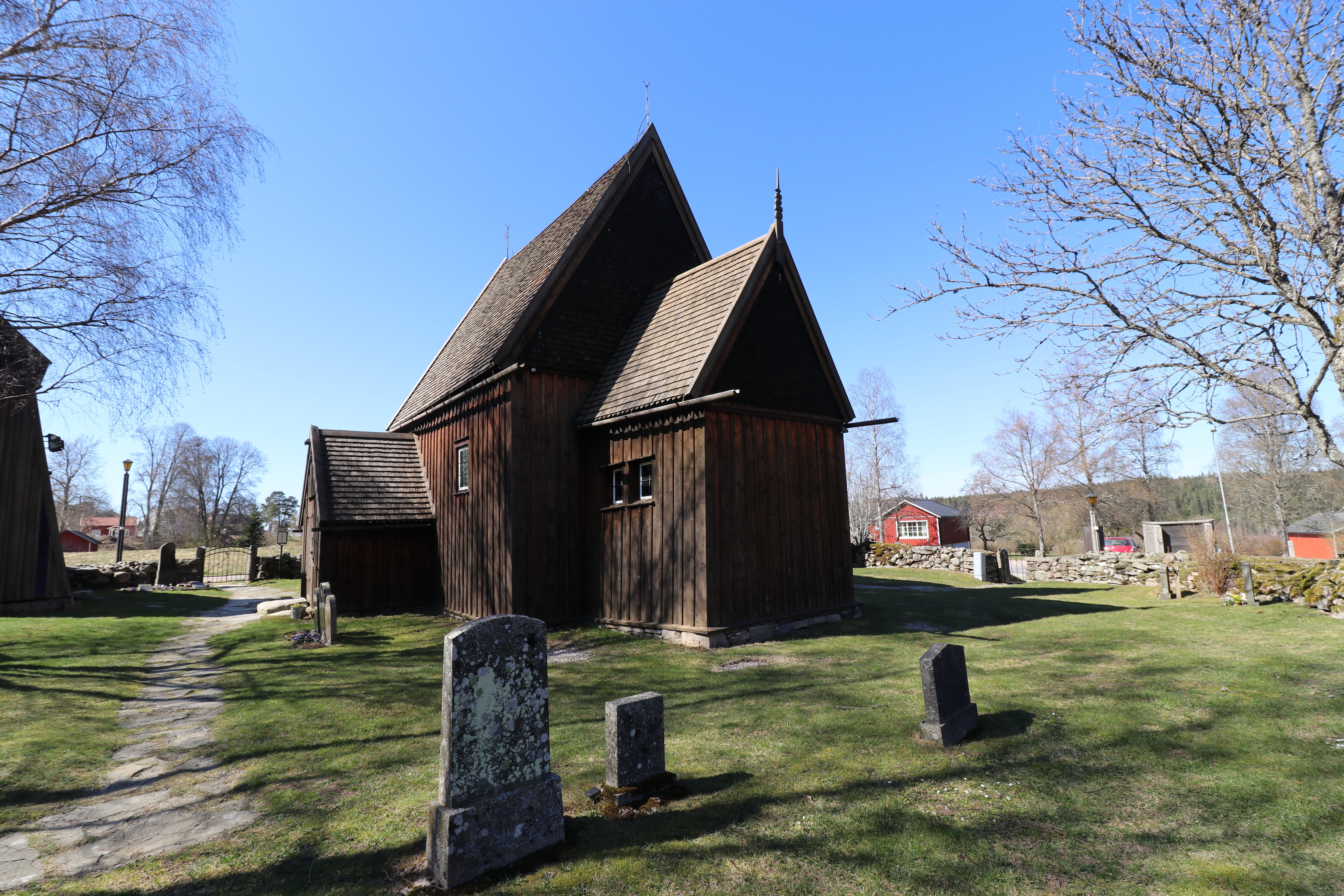
Hedared Stave Church
Norway claims nearly thirty stave churches. Sweden has exactly one. In a quiet clearing between Alingsås and Borås, the Hedared Stave Church stands as the sole medieval survivor of a building tradition that once dotted the Scandinavian landscape. When archaeologist Emil Ekhoff examined the church at the turn of the twentieth century, he suspected it was far younger than anyone assumed. Dendrochronology later proved him right: the logs were felled around 1501, making this not an early medieval relic but a late medieval statement, built when stone churches had already become the norm.
Smaller Than a Studio Apartment
Step inside and you occupy 35 square meters of sacred space - roughly the size of a modern studio apartment. When first constructed, the church offered even less comfort: bare earth floors, no windows, only walls and a steeply pitched roof designed to shed the heavy Swedish snows. Worshippers gathered in darkness, illuminated only by a small lysglugg - a light hole - that admitted the barest suggestion of daylight. This was not architectural poverty but theological intent: a space stripped of distraction, focused entirely on the divine. The wooden floor arrived in 1735, the current windows in 1781, concessions to changing expectations of what worship should feel like.
The Bishop's Letter
A document from 1506 mentions a bishop's involvement in constructing a church in this parish - almost certainly this building. The logs date to 1498-1503, with 1501 the most probable felling year. After cutting, the timber required drying before construction could begin, placing the actual building work in the years immediately following. This dating demolished the romantic notion that stave churches belonged exclusively to the early medieval period, the age of Viking conversion. Hedared demonstrates that communities chose wooden construction centuries later, perhaps from tradition, perhaps from economy, perhaps simply because they preferred the way firelight moved across timber walls.
Layers of Devotion
During a 1934 interior restoration, workers removing later wall coverings discovered an altar painting executed directly on the original timber - a medieval artist's devotion hidden for centuries beneath subsequent improvements. A thirteenth-century altar chalice sits inside, three hundred years older than the building itself, suggesting continuity with an earlier church on this site. Wooden sculptures of the Virgin Mary and Saint Francis share the intimate space, along with later paintings by Johan Ehrenfrid. Each generation left something, and each restoration has tried to preserve what came before while revealing what earlier improvements had concealed.
The 1990s Resurrection
By the late twentieth century, the church needed more than preservation - it needed saving. Restorers raised the entire structure 70 centimeters and replaced the deteriorating ground sills that five centuries of Swedish weather had slowly consumed. The 1901 exterior restoration had stripped away later additions to reveal the original form, though it wisely kept the windows that the congregation had grown to need. Today the church belongs to the Diocese of Skara and remains an active place of worship, not a museum piece but a continuing community gathering place where the twenty-first century meets the sixteenth across a threshold worn smooth by countless feet.
From the Air
Located at 57.81°N, 12.75°E in rural Västra Götaland, between the towns of Alingsås and Borås. The church sits in a forested area and is difficult to spot from altitude due to its small size and dark timber construction. Look for the clearing and adjacent cemetery. Best viewed from low altitude (1,500-2,500 feet) in good visibility. Gothenburg Landvetter Airport (ESGG) lies approximately 40 kilometers west. The surrounding landscape is typical Swedish mixed forest and farmland.