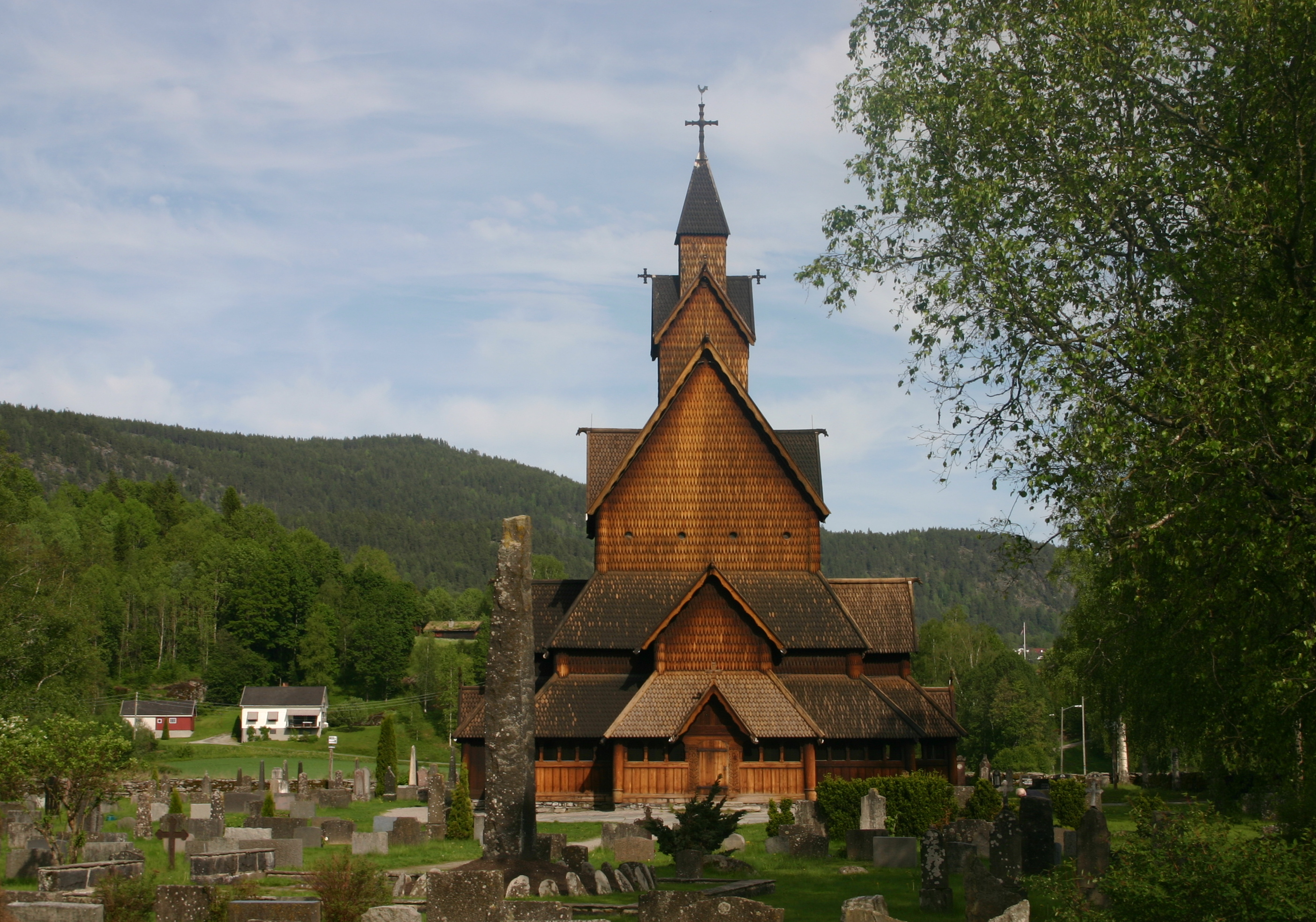
Heddal Stave Church
Five farmers from Heddal wanted a church. According to local legend, they got one in three days. The story does not explain how a building of this scale and complexity could have been raised in a weekend, and history provides no support for the claim. What it provides instead is a church that has survived roughly 800 years through neglect, bad restorations, better restorations, a royal fire sale, and at least one period when it served as a polling station for the election that gave Norway its constitution. Heddal Stave Church, in the village of Heddal in Telemark county, is the largest of Norway's 28 surviving stave churches. Built around the year 1200, dedicated to the Virgin Mary, and constructed entirely from Scots pine on a stone foundation, it seats about 180 people in a space that feels simultaneously cavernous and intimate, its triple nave rising to a height that smaller stave churches can only suggest.
Where Dragons Yield to Crosses
Heddal Stave Church is a hybrid. Its nave borrows from two traditions: the towering central plan of the Borgund type, with its dramatic vertical interior, and the long arcaded nave of the Kaupanger group, which stretches the building lengthwise. The result is a structure that manages to be both tall and deep, its chancel extending through six free-standing masts into a space that feels more like a corridor than a room. But the most telling detail is on the facade. In older stave churches, pagan dragon heads occupy the highest positions on the roof, with Christian symbols placed below. At Heddal, the arrangement is reversed: Christian symbols sit at the more elevated level. The church was built after Christianity's influence had spread throughout Norway, and the decorative hierarchy records that shift. The portals, which in earlier churches served as thematic boundaries between pagan exterior and Christian interior, here lean fully into the new faith. The older ambiguity is gone.
Hidden Paintings and a Sold Church
Beneath 17th-century decorative paint on the walls of Heddal's chancel and nave, restorers in the early 2000s found the remains of medieval wall paintings. Between 2008 and 2010, the distempered paintings were painstakingly refurbished to their original medieval designs, revealing a style similar to the wall paintings at the Torpo Stave Church, evidence of an artistic connection between workshops in different parts of southern Norway. The church's post-medieval history is a study in institutional indifference. After the Reformation reached Norway in 1536-1537, the building fell into serious disrepair. In 1723, during the Norwegian church sale, the King sold it, along with hundreds of other churches across the country, to private owners in order to pay debts from the Great Northern War. The new owner was responsible for upkeep, a responsibility that went largely unmet. By the mid-1800s, the building was in dangerous condition.
The Restoration That Went Wrong
In 1848, the architect Johan Henrik Nebelong began a major rebuilding of Heddal Stave Church. When it was finished in 1851, the interior had been transformed into something closer to the Empire style fashionable in 19th-century Scandinavia, a look completely at odds with a medieval wooden church. The restoration was strongly criticized, and for good reason. This was one of the first major restorations of a medieval building in Norway, and neither Nebelong nor the newly established Society for the Preservation of Ancient Norwegian Monuments had much understanding of stave church construction. The rebuilding introduced moisture problems and fungal damage that would plague the structure for the next century. A second, more sympathetic restoration was carried out in the 1950s, stripping away much of Nebelong's work and attempting to return the interior to something closer to its medieval character. The lesson of Heddal's two restorations became a cautionary example in Norwegian heritage preservation: good intentions without proper knowledge can cause as much damage as neglect.
A Polling Station and a Living Church
In 1814, Norway wrote its constitution. The process required elections, and each church parish served as a constituency. Heddal Stave Church, along with more than 300 other parish churches across the country, became a polling station for the country's first national elections, where locals chose electors who would later select representatives for the constitutional assembly at Eidsvoll. The church has carried this dual identity ever since, serving simultaneously as a place of worship and a site of secular significance. Unlike many surviving stave churches, which have been decommissioned and preserved as museums, Heddal remains an active parish church. Weddings are common. Services are held regularly. The church is open to tourists during the summer season, and its proximity to the town of Notodden makes it one of the more accessible stave churches in Norway. The heating system, which keeps the interior at a steady 5 degrees Celsius through the cold months between October and May, reflects the ongoing challenge of maintaining an 800-year-old wooden building that is still expected to function.
From the Air
Located at 59.58N, 9.18E in Notodden Municipality, Telemark county. The church is in the village of Heddal, west of Notodden town center. From the air, look for a large dark-timbered structure with a distinctive multi-tiered roofline, significantly larger than other stave churches. Nearest airports: Notodden/Tuven (ENNO) approximately 8 km east, Skien/Geiteryggen (ENSN) approximately 40 km south. Best viewed at lower altitudes; the church sits in a broad valley with agricultural land surrounding it.