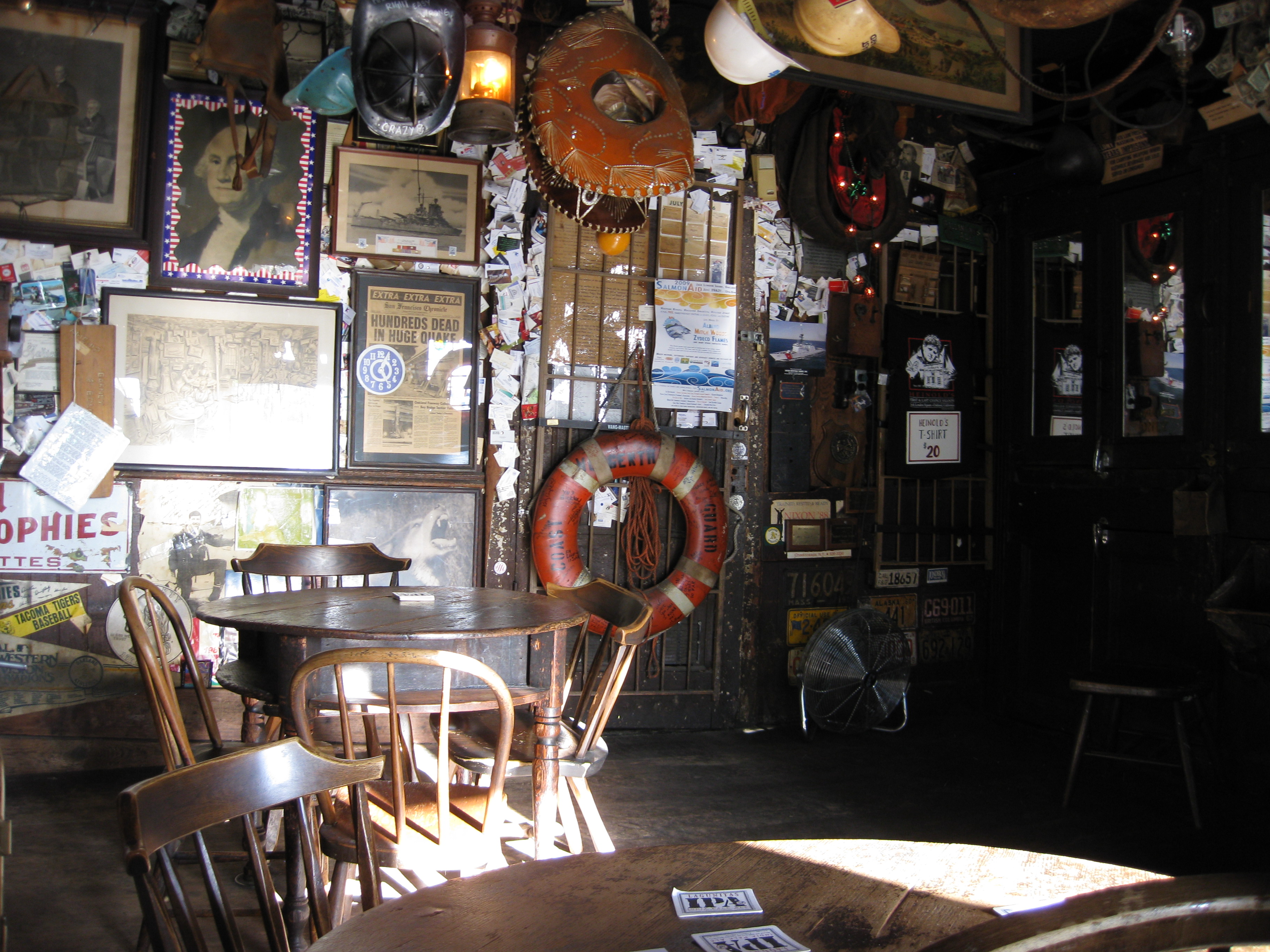
Heinold's First and Last Chance Saloon
The floor slants. It has slanted since the 1906 earthquake, and nobody has ever bothered to fix it. Your drink slides if you set it down carelessly, and first-time visitors grip the bar with mild alarm before they realize the building has been leaning this way for more than a century. Heinold's First and Last Chance sits at the foot of Webster Street on Oakland's waterfront, a tiny wooden box of a saloon that has been serving drinks since 1884 -- the same tables, the same gas lighting, the same tilted floor. It is the last commercial establishment in California still illuminated by its original gas lamps, and somewhere on the ceiling, pinned among thousands of business cards and sailors' hats, there may still be a dollar bill signed by a merchant seaman who never came back to spend it.
Salvaged from a Whale Ship
The building predates the bar. In 1880, workers constructed sleeping quarters from the timbers of the Umatilla, an abandoned stern-wheel paddle steamer, setting the structure at the foot of Webster Street near Oakland's oyster beds. For three years it served as a bunkhouse, housing the men who worked the beds. Then, in 1883, a German-born Philadelphian named Johnny Heinold bought the place for one hundred dollars. With the help of a ship carpenter he converted the bunkhouse into a saloon, calling it J.M. Heinold's Saloon. The location proved inspired. A ferry ran between Oakland and Alameda, where the sale of alcohol was illegal, making Heinold's the first or last chance for a legal drink depending on which direction you were traveling. Sailors departing through the Oakland port on long voyages adopted the same logic -- one last drink before months at sea, or the first upon return. The nickname stuck, and eventually Heinold made it official: Heinold's First and Last Chance.
The Boy at the Bar
Jack London grew up in Oakland. After a restless adolescence spent oyster pirating on San Francisco Bay, riding freight trains, and sailing to Japan, he came back to finish high school. He studied at Heinold's tables -- the same scarred wooden surfaces that remain in the bar today. At seventeen, London confessed to Johnny Heinold that he wanted to attend university and become a writer. Heinold lent him the tuition money, and London enrolled at the University of California, Berkeley. He lasted one semester. But the education that mattered was happening back at the saloon. Heinold's introduced London to the sailors, adventurers, and waterfront characters who would populate his fiction. In his autobiographical novel John Barleycorn, London mentioned the pub seventeen times. It was at Heinold's that he met Alexander McLean, a sea captain notorious for his cruelty, who became the model for Wolf Larsen in The Sea-Wolf. The bar gave London his material, and London gave the bar its legend.
Dollars on the Ceiling
Johnny Heinold ran the saloon for fifty-six years, until 1939. His son George took over and ran it for another thirty years. George's wife Margaret continued the tradition until 1984, when Carol Brookman became proprietor. Through four operators and more than a century, almost nothing inside changed. The gas lamps still burn. The tables, reportedly salvaged from the same paddle steamer that provided the building's timbers, remain in use. The walls and ceiling have become a living archive -- covered in business cards, old photographs, and hats left by patrons over the decades. Sailors heading out on deployment would sign a dollar bill and pin it to the ceiling, ensuring they had money for a drink waiting when they returned. Some of those bills have been waiting a very long time. The floor, tilted by the 1906 earthquake, was never leveled. It has become part of the experience, a physical reminder that this place has been standing -- leaning, really -- since before the great quake.
A Literary Landmark on the Register
On January 12, 1998, the Friends of Libraries U.S.A. added Heinold's to the Literary Landmarks Register, recognizing the bar's role in shaping one of America's most widely read novelists. Two years later, on September 1, 2000, the United States federal government listed Heinold's First and Last Chance on the National Register of Historic Places. The bar sits on what is now Jack London Square, a waterfront district named for its most famous former regular. A sign reading "Jack London's Rendezvous" was added to the roofline years ago, cementing the connection. But the place does not trade solely on nostalgia. Heinold's remains a working bar, still pouring drinks in a room built from a paddle steamer's timbers, still lit by gas, still tilting gently toward the water. The apostrophe on the exterior sign is in the wrong place -- "Heinolds'" instead of "Heinold's" -- and nobody has corrected it. In a bar where the floor has been crooked for over a century, a misplaced apostrophe feels about right.
From the Air
Located at 37.794°N, 122.275°W on the Oakland waterfront at Jack London Square, near the foot of Webster Street. From the air, look for the Jack London Square waterfront development along the Oakland Inner Harbor. The saloon is a tiny wooden structure easily lost among larger buildings, but the surrounding square and marina are distinctive. Nearest airports: KOAK (Oakland International, 5 nm south), KSFO (San Francisco International, 17 nm southwest). The Oakland-Alameda ferry terminal is immediately adjacent. Best viewed at 1,500-2,500 ft in clear conditions.