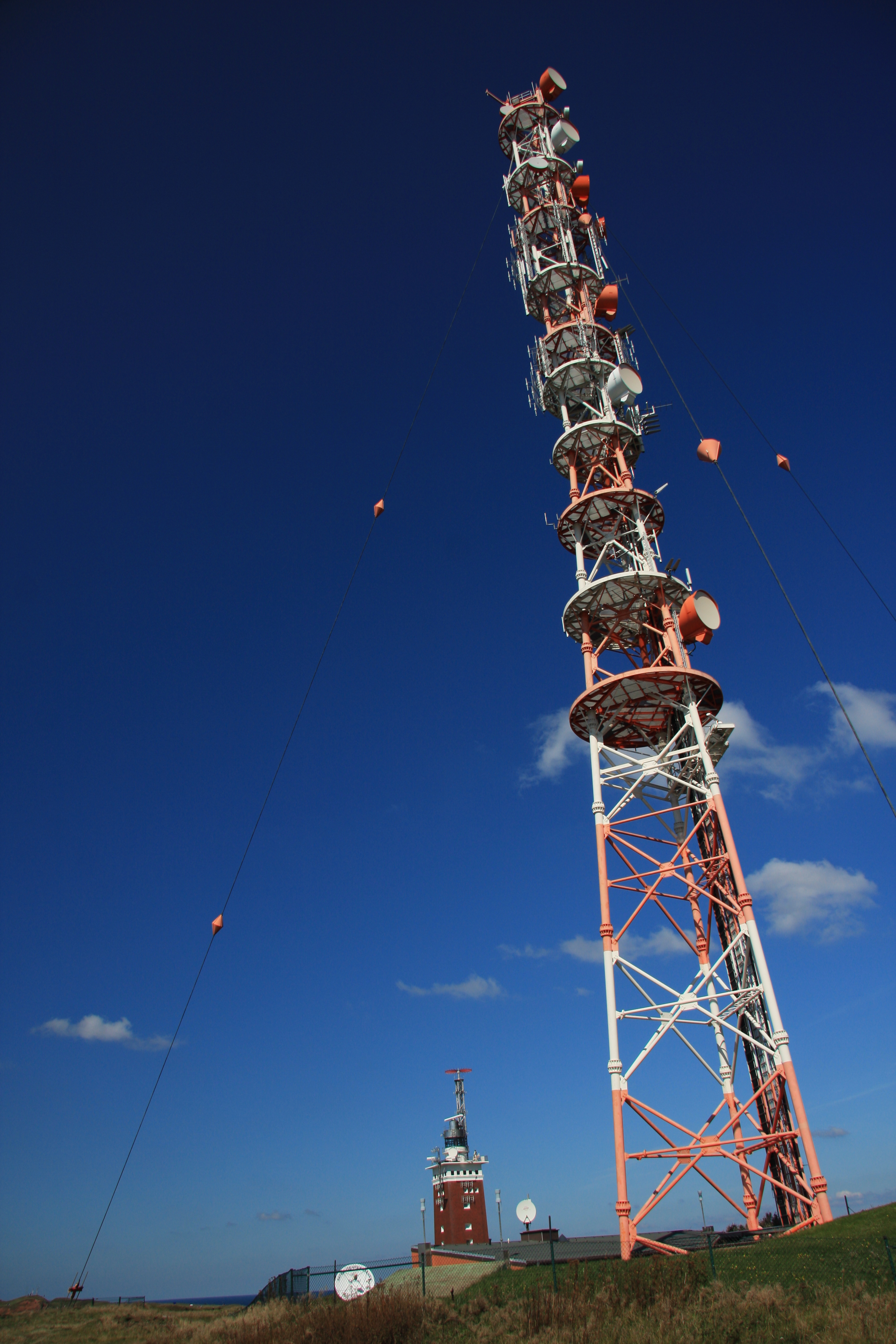
Heligoland Radio Tower
From a passing aircraft, Heligoland looks like three landmarks: the red sandstone cliffs, the Lange Anna sea stack off the northwest corner, and a thin steel needle on the Oberland that does not quite match anything else around it. The radio tower stands 113 metres above the island's central plateau, owned by Deutsche Telekom, and it is engineered in a way that confuses most observers who notice towers for a living. Its base is triangular - that part is unusual but not unique. Its support, however, is the strange detail. The tower is free-standing, designed and rated to hold itself up. It also has guy wires. Both. At once. That is not how communications towers are built almost anywhere else.
Replacing the Predecessor
The current tower went up in 2000, replacing an older, lower mast on the same site that was demolished once the new structure was carrying traffic. The reasoning behind the unusual triangular guyed-and-self-supporting design has never been published in detail, but Heligoland's wind environment is its own special problem - North Sea storms hit the unsheltered Oberland with nothing in the way for hundreds of kilometres, and a 113-metre slender steel structure on a sandstone cliff is more exposed than almost any communications tower on the German mainland. The triangular base provides bracing in three directions; the guy wires add a redundant safety margin. A few months after the installation, local authorities on Heligoland began looking at the sale of municipal land on the Düne side of the island for private building and operations, but the tower itself remained on its original plot.
Everyone's Voice on a Single Mast
The tower's primary role is microwave relay - the link that ties Heligoland's telephones and internet to the mainland, sixty-nine kilometres away across open water. But it also broadcasts every radio and television service the island receives. Wandering up and down the FM dial on a kitchen radio in the Unterland, every signal you can pick up comes off this single mast. NDR 1 Welle Nord at 88.9 MHz, NDR 2 at 93.4, NDR Kultur at 97.0, NDR Info at 92.5, N-Joy at 91.5, Deutschlandfunk at 107.4, Deutschlandradio Kultur at 103.0, regional commercial stations R.SH at 100.0, delta radio at 104.5, Radio NORA at 101.6, and Klassik Radio at 89.8. Digital television runs through it as well - ZDF, NDR, and ARD bouquets on UHF channels 23, 39, and 47, each pushing 250 watts.
A Tower With a Military Air
Heligoland has spent so much of its history as a military installation that even its civilian infrastructure carries echoes. The radio tower is one of three communications structures on the island, and together they retain what one description calls a military air - an architecture of utility and reach rather than aesthetics. The other two structures are smaller, but the cluster matters: in the event of any disruption, redundancy is not optional on an island this isolated. The ferries from Cuxhaven and Hamburg can be cancelled by weather. The Heligoland-Düne airfield closes in poor visibility. The microwave link, when it works, is the only connection the island has that does not depend on the sea state. The 2,500 residents and the day-trippers who triple the population each summer all depend on this 113-metre needle to talk to anyone who is not standing within walking distance.
Standing in the Wind
From the cliff path you can stand directly beneath the tower and look up the spine of its lattice into the grey North Sea sky. The guy wires reach out at sharp angles to their anchor points. Gulls perch on the antennae. The tower hums in the wind - a faint structural resonance that you feel more than hear. In a place where the lighthouse is a converted flak tower and the cliffs were partly blown apart by the largest non-nuclear explosion in pre-1947 history, a quietly engineered Deutsche Telekom mast is almost an act of mercy: a piece of infrastructure that does its job, holds its position through cyclones, and exists only to keep the island connected to the world that, for most of its history, kept trying to take it over.
From the Air
Located at 54.1804°N, 7.8833°E on the Oberland of Heligoland's main island, very close to Heligoland Lighthouse - both structures share the central plateau. The 113-metre tower is a recognisable visual landmark from cruising altitude in clear conditions and especially useful as a waypoint at low level approaching the island. Heligoland-Düne (EDXH) is on the small eastern island; light aircraft only. Cuxhaven (EDHC) on the mainland is the nearest larger field. Watch for offshore wind farm helicopter traffic in the surrounding airspace.