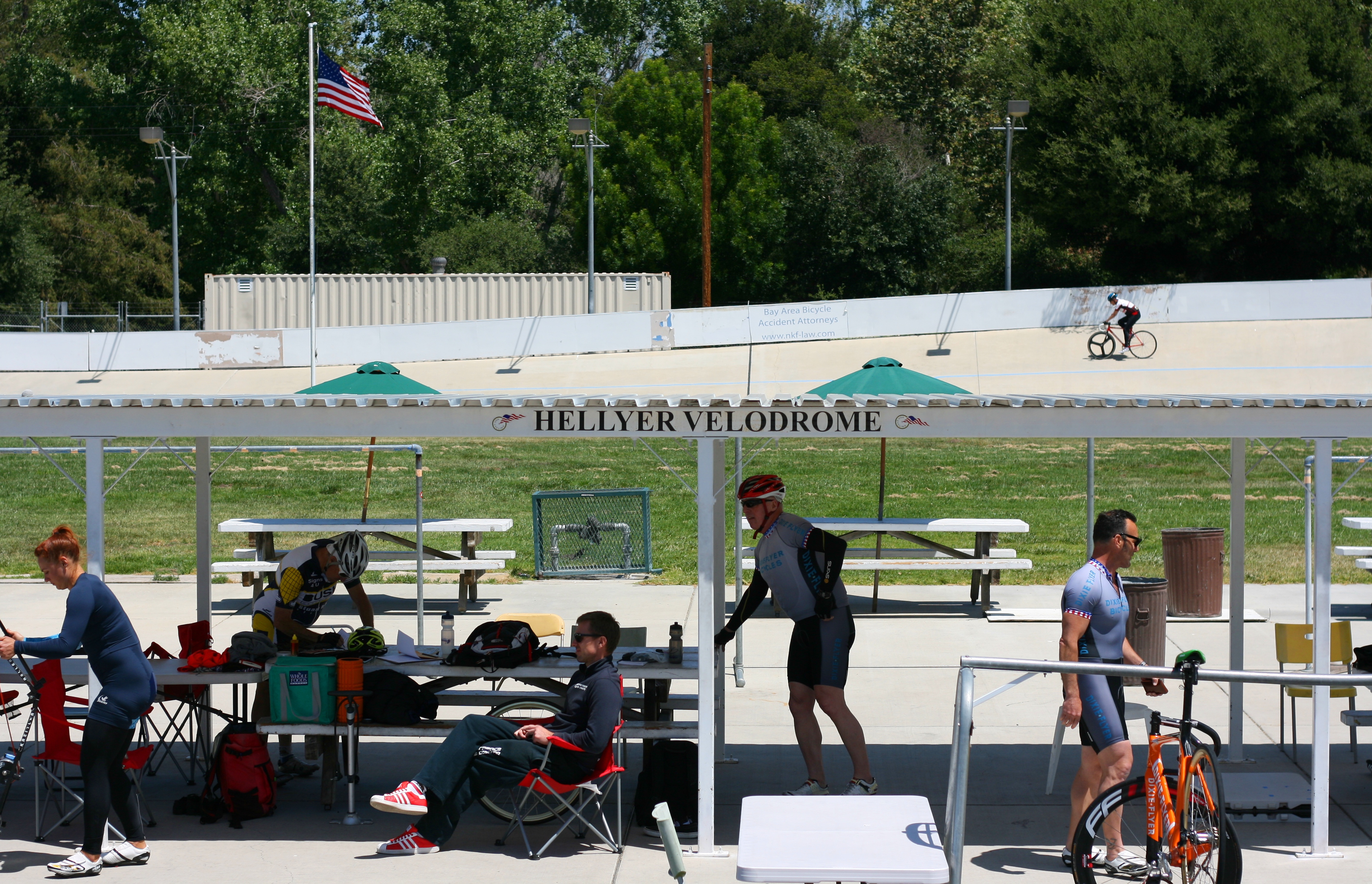
Hellyer Park Velodrome
On a summer evening in 1972, the fastest cyclists in the United States leaned into banked turns at twenty-three degrees, fighting for a spot on the Olympic team. The venue was not some grand stadium but a concrete oval nestled in a county park along Coyote Creek in south San Jose. Hellyer Park Velodrome has never tried to be glamorous. Built in 1963, its 335-meter track sits between a creek trail and picnic grounds, a place where serious racers and curious beginners share the same asphalt. That modesty is exactly what has kept it alive for more than six decades.
Concrete, Creek, and Cold War Speed
The velodrome arrived during a boom in American cycling infrastructure, when Cold War-era Olympic ambitions drove investment in track cycling facilities. At 335 meters with a maximum banking of 23 degrees, the Hellyer oval is longer and gentler than international competition tracks, which typically measure 250 meters with steeper banks. That geometry makes it forgiving for newcomers while still rewarding experienced riders who can hold a tight line through the turns. The track was built inside Hellyer County Park, a ribbon of green space along Coyote Creek in south San Jose, where the Coast Range foothills begin to flatten into the Santa Clara Valley floor. Riders finishing a lap on the back straight can see the creek trail below, joggers and dog walkers passing oblivious to the speeds above.
The Olympic Trials of 1972
The velodrome's proudest chapter came in 1972, when it hosted the United States Olympic Bicycling Trials. Riders from across the country descended on San Jose to compete for berths on the team headed to the Munich Games. For a modest county park facility, it was a remarkable selection. The trials put Hellyer on the national cycling map and cemented its reputation as a serious track despite its public-park setting. That same year, Mark Spitz was training for his seven-gold-medal swim performance at Munich, and the cycling trials shared the same restless energy of American athletes preparing for what would become one of the most turbulent Olympic Games in history.
Low-Key Laps
A 2004 San Francisco Chronicle article captured the velodrome's enduring character with the headline: "They aren't big wheels." The piece described a scene of weekend warriors and weeknight regulars chasing each other around the oval, nobody famous, nobody paid, everyone hooked on the particular thrill of riding fixed-gear bikes at speed on a banked surface. That grassroots atmosphere has defined Hellyer for decades. The Northern California Velodrome Association, a nonprofit, operates the facility and organizes race nights, training clinics, and introductory sessions for riders who have never clipped into a track bike. There are no grandstands packed with spectators. The audience is mostly other riders waiting for their race, leaning against the rail, studying the lines they plan to take.
A Survivor Along the Creek
Velodromes across America have a history of vanishing. Tracks get paved over for parking lots, fall into disrepair, or lose their constituencies to road cycling and mountain biking. Hellyer has endured partly because of its location within the Coyote Creek Parkway, a chain of county parks that protects the land from development, and partly because the NCVA has kept the facility maintained and programmed. The creek trail that runs beside the velodrome connects it to a network of paths stretching from the neighborhoods of south San Jose toward Morgan Hill, giving the park a steady stream of visitors who discover the track by accident. Some stop to watch. A few come back with a bike. The velodrome does not advertise. It does not need to. Sixty years of banked turns along a creek have been advertisement enough.
From the Air
Located at 37.29N, 121.81W in south San Jose, California, within Hellyer County Park along Coyote Creek. The oval track is visible from the air as a distinctive loop shape amid parkland and creek vegetation. Nearest airports: Reid-Hillview (KRHV, 4nm NW), San Jose International (KSJC, 8nm NW), San Martin (E16, 10nm SE). Best viewed at 1,500-2,000 feet AGL where the track geometry and surrounding park layout are clearly distinguishable from the suburban grid.