Helsinki Cathedral
Climb the granite steps of Senate Square and look up. The dome floats above you in white and pale green, surrounded by four smaller domes and crowned at the corners with twelve zinc apostles staring out over the city. This is Helsinki Cathedral now. Until 1917, it was Saint Nicholas's Church, named for the Russian tsar who reigned when its first stone was laid. The cathedral has had two identities, two names, and one architect who did not live to see it finished.
Engel's Vision
When Tsar Alexander I made Helsinki the capital of the Grand Duchy of Finland in 1812, he wanted a city that looked the part. He found Carl Ludvig Engel, a Berlin-trained architect with a clear vision of neoclassical order, and turned him loose on a marshy peninsula. Engel laid out Senate Square as a single composition. The Senate building on one side, the University on the other, the cathedral rising at the head of a long flight of steps - everything in white stucco and Doric columns, everything answering to the dome above. Construction of the cathedral began in 1830. Engel died in 1840, twelve years before its completion. His successor, Ernst Lohrmann, made changes Engel never approved. He added the four small corner domes - a deliberate echo of Saint Isaac's and Kazan Cathedrals in Saint Petersburg, the imperial models the Finnish church was meant to recall. Lohrmann also added the apostles along the rooflines, sculpted in Berlin and shipped north.
A Greek Cross on the Baltic
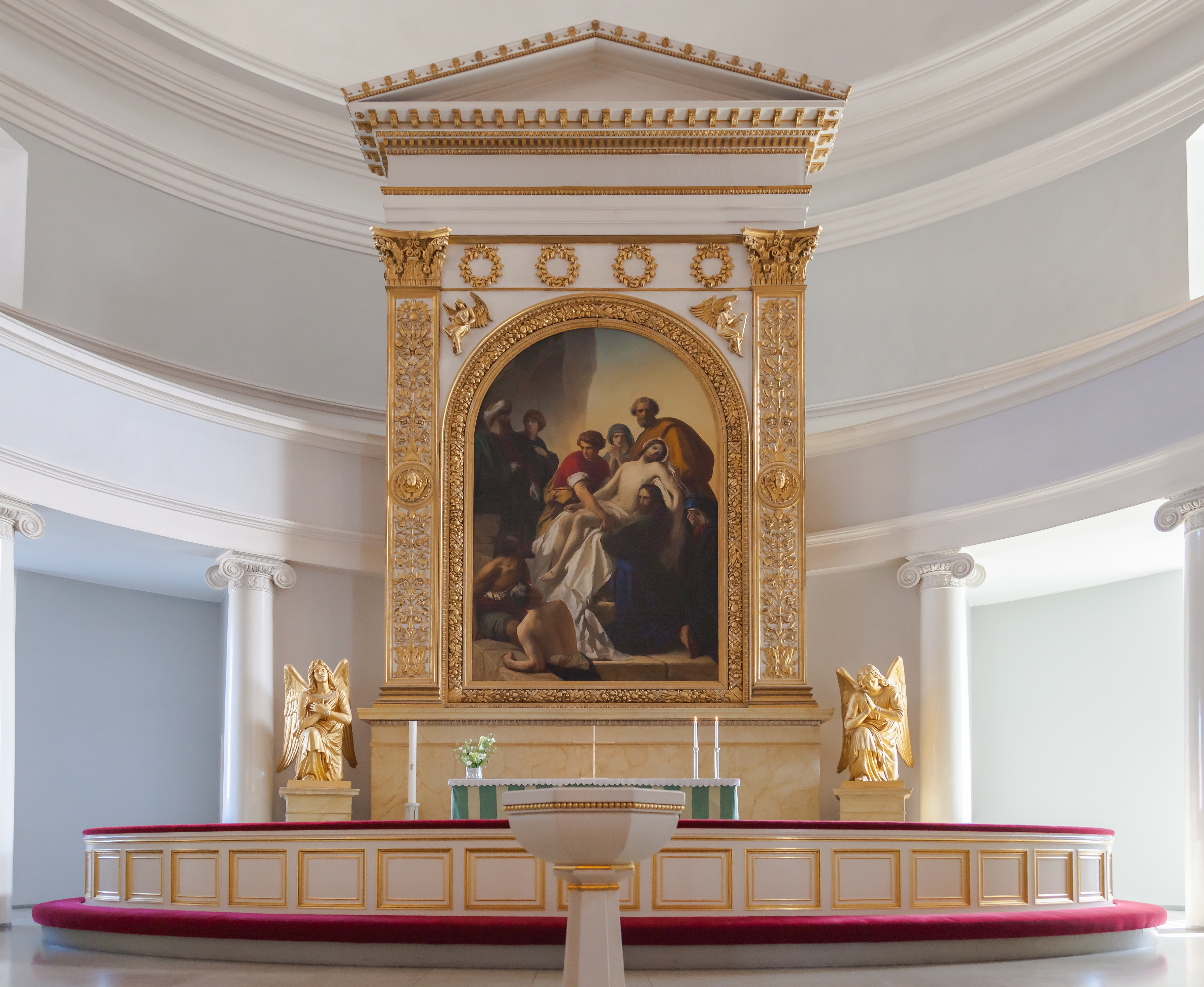
The plan is austere. A Greek cross - a square center with four equal arms - so the building looks identical from north, south, east, and west. Each arm presents a colonnade and a pediment. There is no obvious front. Engel had originally drawn an extra row of columns for the western entrance to mark a main facade, but it was never built, leaving the cathedral with the curious dignity of a building that faces every direction at once. The interior is plain by cathedral standards - whitewashed walls, restrained Lutheran ornament, light pouring down from the central dome. The altarpiece was painted by Carl Timoleon von Neff and donated by Tsar Nicholas I himself, the man for whom the church was originally named. The bells came from the smaller Ulrika Eleonora Church that had stood on this same site, demolished to make room. Some continuities outlast empires.
From Saint Nicholas to Helsinki
The funding mechanism reveals everything about how Russian Helsinki worked. In 1814, Alexander I decreed that fifteen percent of the salt import tax would build two churches - one Lutheran, one Orthodox. Salt money built both Helsinki Cathedral and, eventually, Uspenski Cathedral up the hill. The cathedral was inaugurated on 15 February 1852, eleven years after Engel's death. For sixty-five years it bore the name of the tsar. When Finland declared independence in 1917, the church kept its function but quietly shed the imperial association. It became simply Suurkirkko - the Great Church - and then officially Helsinki Cathedral in 1959 when it was elevated to seat of the Diocese of Helsinki. The name change was less a rejection than a translation. What had been built as a monument to Russian patronage became a monument to the city itself.
The Square Below
Look down from the cathedral steps and Senate Square spreads before you in cobblestones, a vast empty space that fills only a few times a year. Finland's national Saint Lucy's Day celebrations happen here each December, with a procession of candle-crowned children climbing toward the cathedral. The cathedral receives roughly half a million visitors a year. Most never go inside. They come for the steps, the view, the photograph. The opening sequence of Darude's Sandstorm music video was filmed in this square in 1999, the cathedral white in the background while figures sprinted across the stones. For Finns of a certain generation, that thirty-second clip is as much a part of the cathedral's identity as Engel's drawings. The building has become a stage as much as a sanctuary.
What Stays White
Helsinki sits at sixty degrees north, where winter light is thin and brief and summer light pours through the long days like something poured. The cathedral's whitewash is maintained obsessively because the city needs it that way. In summer the building blazes against the deep blue Baltic sky. In winter it glows above the snow, the green dome the only color in a monochrome world. Lutheran restraint and imperial ambition met here in the 1830s, and what was meant to honor Saint Petersburg ended up defining a Finnish capital that would soon stop looking east at all. The cathedral is still in regular use - weddings, services, state funerals. The bells, originally hung in a small wooden church demolished a hundred and seventy years ago, still ring.
From the Air
Helsinki Cathedral sits at 60.17°N, 24.95°E, atop Senate Square in central Helsinki. The white dome with four smaller domes and bronze apostles is visible from the harbor and from inbound approaches to Helsinki Vantaa Airport (EFHK), about 20 km north. Best viewed from approach altitudes between 2,000-5,000 feet AGL on clear days. The cathedral anchors a tight cluster of neoclassical buildings that read clearly from the air against the Gulf of Finland's coastline.