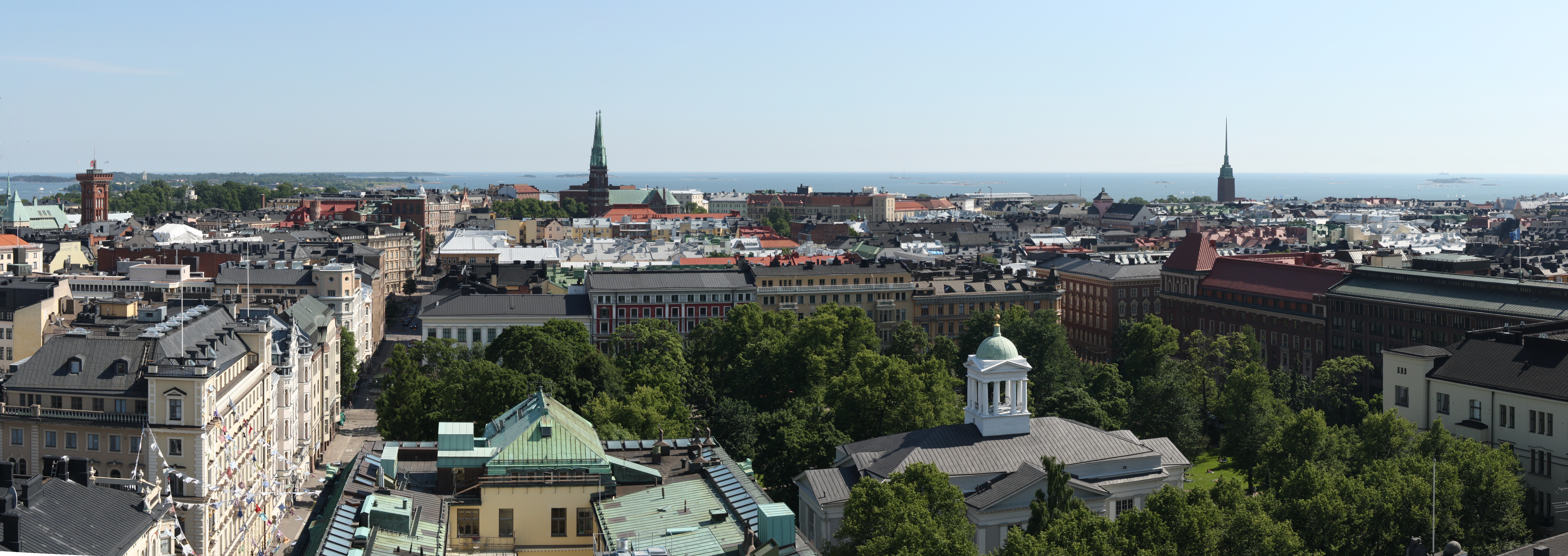
Helsinki
Gustav Vasa founded Helsinki in 1550 as a commercial weapon. The Swedish king wanted a Baltic port that could compete with Tallinn for the lucrative Russian trade across the gulf, so he ordered merchants from four other Finnish towns to relocate north and build one. Many of them refused. Many of those who came died of plague. The town stayed small for centuries - a fishing harbor, a garrison, an afterthought. It became the capital of Finland in 1812 not because it had earned the role but because Tsar Alexander I wanted the seat of government farther from Sweden and closer to Saint Petersburg. Almost everything Helsinki is today follows from that one decision.
An Imperial Project
When Russia took Finland from Sweden in 1809 and made it an autonomous Grand Duchy, the old Swedish capital of Turku felt too western, too Lutheran, too Swedish. Alexander wanted his Finnish capital to look toward Saint Petersburg. So he hired a Berlin-trained architect named Carl Ludvig Engel and turned him loose. Engel designed Senate Square as a single composition - cathedral, senate building, university, all in white neoclassical stucco - and it became the calling card of the new capital. Around it grew a city of straight streets and harbor warehouses, government offices and merchant houses. The university moved here from Turku in 1828. By the 1870s, Helsinki had streetcars, electric lights, and a population that had passed thirty thousand. The capital that nobody had wanted was suddenly the most modern city in Finland.
The Long Twentieth Century
Independence in 1917 was followed almost immediately by civil war, and Helsinki became the prize. White and Red factions fought for the city in early 1918. The Reds held it briefly. The Whites took it back with German help. Two decades later came the Winter War, then the Continuation War, and Soviet bombers visited the city repeatedly between 1939 and 1944. Helsinki survived better than most Finnish cities - the bombings concentrated on industrial areas, and Finnish anti-aircraft defenses were unusually effective - but the years left their mark. The 1952 Summer Olympics announced a different Helsinki. The Olympic Stadium with its slim white tower, designed in the 1930s, became the symbol of a small country that had survived two wars and was ready to rejoin the world. The Cold War kept Finland balanced uneasily between East and West, and Helsinki became the city where superpowers met to talk - the 1975 Helsinki Accords took their name from this city, signed in Finlandia Hall.
Aalto's City
Walk through Helsinki today and you walk through layers. The neoclassical core around Senate Square. The art nouveau riot of buildings around the central station, designed by Eliel Saarinen at the turn of the twentieth century. The functionalist housing of the postwar decades. And Alvar Aalto - everywhere Aalto. The Finlandia Hall in white Carrara marble. The cultural buildings of the 1970s. The Aalto-designed lamps and chairs and door handles in apartments and cafes across the city. Finnish design did not stay confined to Finland. Marimekko, Iittala, Artek, Nokia in its heyday - all carried Helsinki's particular blend of austerity and warmth into the world. The city was World Design Capital in 2012, an honor that recognized something the locals already knew: design here is not decoration but infrastructure.
Sea-Bound
Helsinki sits on a peninsula, but it does not feel like a peninsula city. It feels like an archipelago that happens to have grown together. Look at a map and the city dissolves into islands - Suomenlinna, the eighteenth-century sea fortress that defends the harbor, now a UNESCO site reached by a fifteen-minute ferry. Vallisaari, recently opened to the public after a century as a military island. Lonna, Pihlajasaari, the dozens of smaller skerries where Helsinkians keep summer cottages or simply boat out for an afternoon swim. The Baltic freezes here some winters, and in deep cold you can walk to islands you would normally need a ferry to reach. The city is also one of the world's busiest passenger ports - in 2017 it overtook Dover for the title - because ferries to Tallinn, Stockholm, and the Aland Islands run constantly. Cruise ships dock by the hundreds each summer.
Sauna and the Long Light
There are nearly as many saunas in Helsinki as there are apartments, because almost every apartment has one. The sauna is not exotic here, just normal - a place to think, talk, sit in silence with friends or strangers. Public saunas dot the harbor: Loyly, Allas Sea Pool, Kulttuurisauna. The summer ritual is sauna then plunge into the Baltic, even in February when you have to break a hole in the ice. Light shapes everything. In June, the sun barely sets - just dips below the horizon and rises again, leaving the sky a blue-pink twilight all night. In December, daylight lasts perhaps six hours. Helsinki has built itself around this rhythm. Cafes are designed for long winter afternoons. Streetlamps are tuned to warm wavelengths. Public spaces are heated and bright. The Finns have a word for the long northern dark - kaamos - and another for the moment in spring when the snow finally melts and people emerge blinking into the light. The city year is built around these turnings.
From the Air
Helsinki sits at 60.17°N, 24.95°E on a peninsula jutting into the Gulf of Finland. The city's distinctive coastline of small islands extends south and southwest from the urban core. Helsinki Vantaa Airport (EFHK) is about 18 km north of downtown. Approach over the Gulf of Finland reveals the white dome of Helsinki Cathedral, the green copper roof of Uspenski Cathedral, and the dark red brick of the harbor warehouses against the Baltic. Best viewed from 3,000-8,000 feet on clear summer days when the long light keeps the city visible until almost midnight.