Hembrug
On the night of 26 September 1944, two members of a local swimming team named Jaap Boll and Remmert Aten slid into the dark water of the North Sea Canal near Zaandam and dove. They were looking for an underwater opening in the central pier of the Hembrug, the railway bridge between Amsterdam and Zaandam. The Germans had stuffed that pier with four hundred boxes of explosives - twelve hundred kilograms in all - rigged to blow the bridge if Allied troops moved north. Boll and Aten found the opening, swam in, and pulled the boxes out. When the Germans discovered the empty pier and refilled it, Remmert Aten swam back down a second time and did it again. The bridge they saved is now gone anyway. The factory whose workers depended on it is now an art district. The story is one of those Dutch resistance episodes that very nearly nobody outside the Zaanstreek has heard.
A Headland Becomes a Bridge
Before any of this, Hembrug was a piece of land. The hem in the name is an old Dutch word for headland - a tongue of higher ground projecting into water. The area was originally De Hem, diked in over centuries to become part of a polder. The name shifted to the bridge when the bridge arrived in 1878: a swing bridge built to carry the new railroad between Amsterdam and Zaandam across the North Sea Canal. The North Sea Canal itself had been dug only a few years earlier, in 1865-76, to give Amsterdam a direct industrial route to the sea. When ship traffic grew faster than the engineers had projected, the original 1878 swing bridge proved too small. Between 1903 and 1907 a longer, higher replacement went up, with long approach embankments to lift the railroad to deck level on a gentle slope. The second Hembrug is the one the swimmers would later save.
The State Munitions Plant
The Hembrug area on the north bank of the canal was, for most of its modern existence, a place ordinary Dutch civilians could not enter. The Artillerie-Inrichtingen - a state-owned munitions factory tracing its lineage back to the 17th century - began construction here in 1895 and completed its move by 1899, eventually sprawling across more than seventy hectares of concrete bunkers, test ranges, and brick workshops behind security fences. Alongside it grew the Norit factory, which made activated carbon, and a third plant producing doors and kitchens. Together these three industries needed a train station, so a halt called Hembrug opened on the rail line on 1 January 1907, with a station master and timed services. The platforms were thick with workers at the early-morning and evening shift changes; in between, the station sat almost empty. The munitions complex ran until 2003. The Hembrug Terrein became, in the years that followed, a redevelopment zone of artists' studios, restaurants, and small businesses - one of those Dutch post-industrial regenerations that quietly preserves the gritty bones of what came before.
Two Swimmers, One Bridge
Late summer of 1944 brought the Allied push toward the Netherlands. The Germans, anticipating that the rail bridge would matter for either advance or retreat, wired the central pier with demolition charges. The Dutch resistance in the Zaanstreek heard about it. The plan they came up with was modest in its means and audacious in its method: send two local swimmers in at night, have them find the underwater inspection opening that the bridge's maintenance crews used, and pull the explosives out by hand. Jaap Boll and Remmert Aten knew the water. They knew the bridge. The first night, they got in, removed the boxes, and got out. The Germans discovered the empty pier when packaging material started bobbing to the surface; they reloaded it with fresh explosives. Aten swam back down alone and emptied it again. The bridge stayed standing. After the war neither man became famous, the way underground operators rarely do, but the story is one of the cleaner small triumphs of the Dutch resistance.
The Bridge That Outlived Its Job
Peace did not save the Hembrug. By the 1970s the bridge was a chokepoint - too narrow, too low, prone to ship strikes. On 20 October 1974 a semi-submersible derrick barge called Choctaw II rammed the bridge while transiting the canal, doing damage that was never fully repaired. The Dutch government built the Hemtunnel, an underwater rail crossing of the North Sea Canal, which opened in 1983. On 27 May 1983 the last train rumbled across the Hembrug. The Rijksmonument committee considered the bridge for protected status and declined: it was not, they decided, of sufficient historical significance. The spans were removed later that year. In spring 1985 explosives - the kind the Germans had once intended for the same job - brought down the bridge piers. What remains is open water, a former factory complex slowly becoming a creative district, and a story about two swimmers that the Zaanstreek still tells.
From the Air
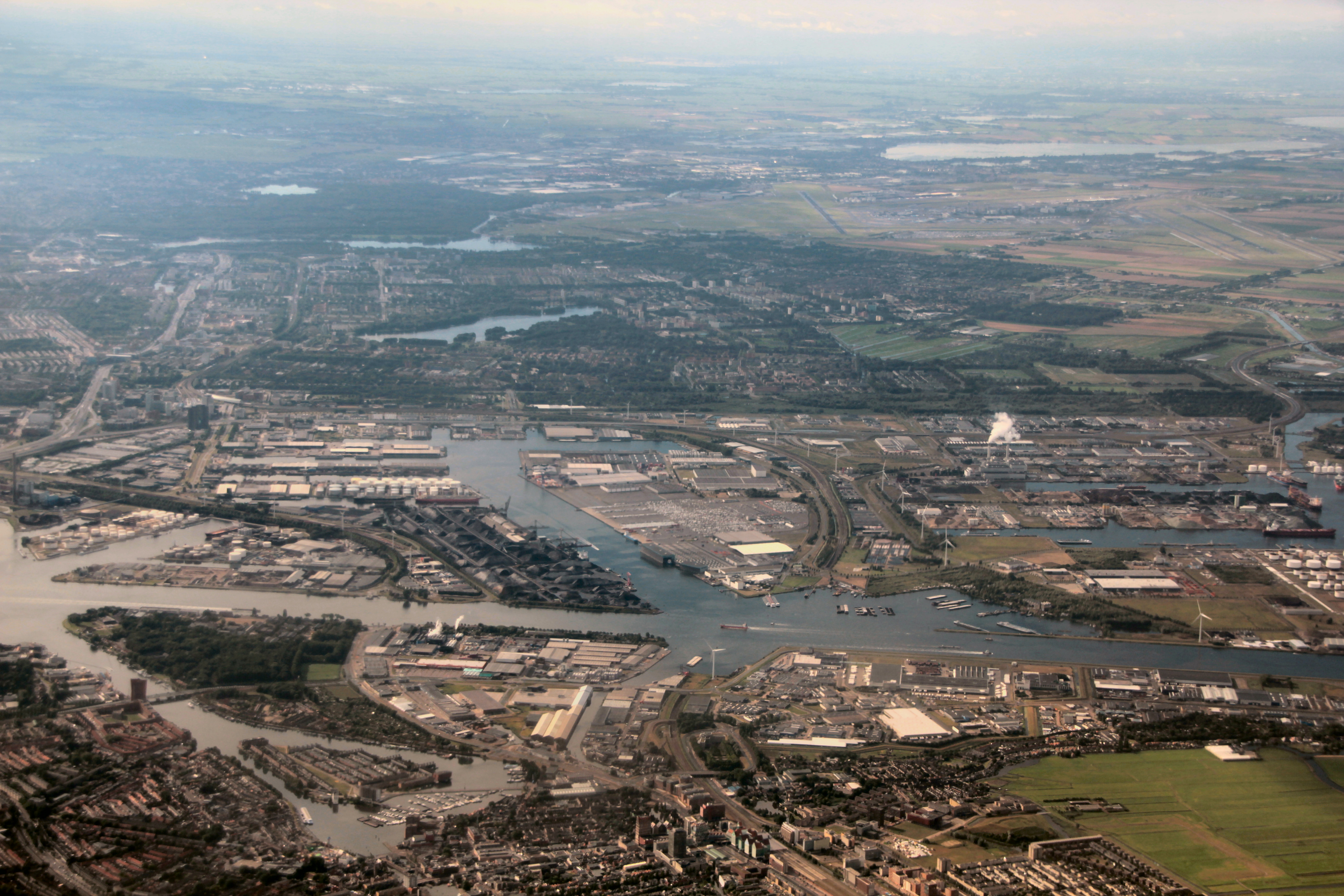
The former Hembrug location sits at 52.420 N, 4.828 E across the North Sea Canal between Amsterdam-Noord and Zaandam, Zaanstad. From the air, look for the broad east-west cut of the North Sea Canal and, on the north bank, the distinctive industrial-heritage cluster of the Hembrug Terrein with its red-brick munitions buildings. The Hemtunnel rail crossing now runs underneath the canal nearby. Nearest airport: Amsterdam Schiphol (EHAM), 17 km southwest. Best viewed at 2,000-4,000 feet.