Hendrik Conscience Heritage Library
There is a small bronze man on the square, seated, holding an open book. His name is Hendrik Conscience, and the square and the library beside him were renamed after his death because he was, more than any other writer, the man who taught Flemings to read in their own language. His 1838 novel De Leeuw van Vlaanderen, The Lion of Flanders, became the founding text of Flemish national consciousness, a Romantic historical epic about a fourteenth-century peasant army defeating French knights at the Battle of the Golden Spurs. The library at his back is the city's memory palace, one million volumes deep, founded in 1481 by a city secretary who simply gave it his 41 books and walked away.
Forty-One Books and a Long Silence
Willem Pauwels, secretary to the city of Antwerp, made his bequest in 1481. The 41 volumes he donated were placed in the city hall in 1505, where they sat as the seed of what was meant to grow into a civic library. Then, in November 1576, mutinous Spanish soldiers torched the city hall during the rampage history calls the Spanish Fury, and the entire collection burned. The city began again. Christopher Plantin, who ran one of the most important printing houses in sixteenth-century Europe, started donating a copy of every book he printed, including the celebrated Biblia Polyglotta. A second collection grew up in parallel at the Antwerp seminary, curated by the humanist librarian Aubertus Miraeus, who in 1609 catalogued 356 works including 32 manuscripts under the title Bibliothecae Antverpianae Primordia. In 1617 the two libraries merged. The collection drifted through the seventeenth and eighteenth centuries, parked in the trade house, then in the city hall's grim "pest room" where plague-prevention plans were drafted alongside the books.
A New Home in a Jesuit Sodality
The French period brought a fresh infusion. When Napoleon's administrators founded an Ecole Centrale in Antwerp in 1795, they assembled a library out of the works of suppressed monasteries, and when the school closed in 1802 many of those books stayed in city hands. The library opened to the public in 1805. The nineteenth century was its great expansion. Librarian Frans Henry Mertens, appointed in 1834, built the Dutch literature collection that still defines the library's identity. By the 1880s the books had outgrown the city hall, so the city bought the old seventeenth-century Jesuit sodality house on what was then called Jezuietenplein, opposite the Carolus Borromeus church. After a thorough renovation, the new library opened on 13 August 1883. On the day of the opening, the bronze statue of Hendrik Conscience was unveiled at the entrance, and the square was renamed Hendrik Conscienceplein. Conscience himself, by then full of honours and recognised across Flanders as the writer who had restored Dutch as a serious literary language, died just a few weeks later in September 1883.
The Nottebohmzaal
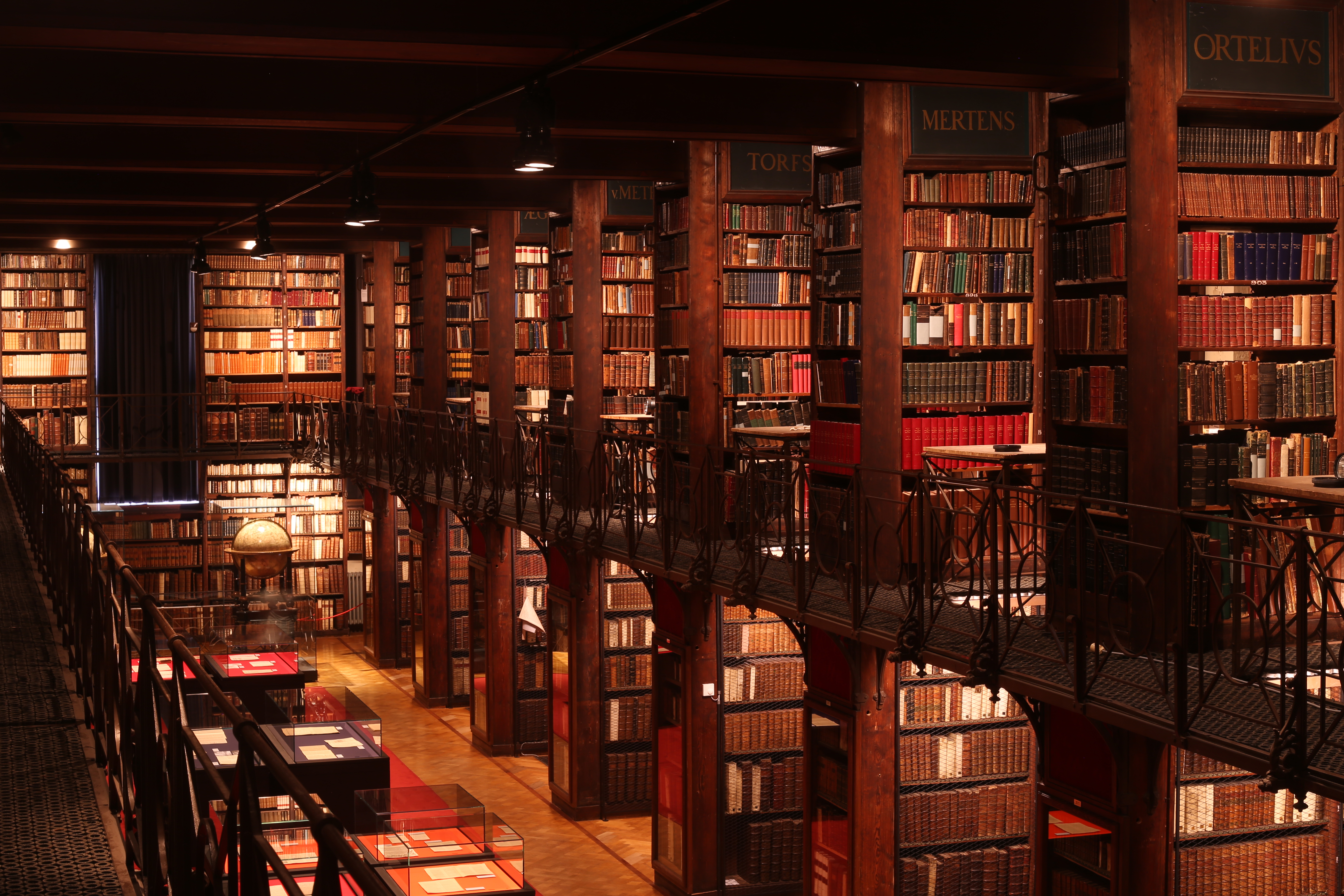
Inside, behind the public reading room, lies the Nottebohmzaal, a room that looks like the platonic ideal of a heritage library: two-storey wooden galleries, leather spines, brass railings, busts of European authors gazing down on visitors who stop and forget to take photos. Oscar Nottebohm, a German-born businessman who became one of nineteenth-century Antwerp's most generous cultural patrons, left a substantial bequest in his will, and the room bears his name. It still functions as it was designed to function: a space for exhibitions, lectures, and the storage of the library's foremost treasures. Inside are an Egyptian cabinet, celestial and terrestrial globes made by Willem and Joan Blaeu in seventeenth-century Amsterdam, busts of authors who travelled here only in the form of their bindings. The room is sometimes used as a film set, and you may have seen it without knowing where it was.
A Million Books About Being Flemish
In 2008 the institution officially renamed itself: no longer the City Library of Antwerp, but the Erfgoedbibliotheek Hendrik Conscience, the Hendrik Conscience Heritage Library. The change clarified its purpose. This is not a place to borrow a novel for the weekend; it is a repository, a conservation library, and you read its books in the reading room and leave them on the cart when you go. The collection holds more than a million volumes, focused on Dutch literature, Flemish history, the history of the Flemish Movement from its eighteenth-century pioneers to political devolution, Flemish folk culture, Flemish art, and a deep specialist collection called the Antverpiensia: anything ever written about Antwerp, anything ever printed in Antwerp, anything ever written by an Antwerper. The pre-1830 collection includes manuscripts dating to the tenth century, pamphlets, almanacs, emblem books, atlases, occasional poems printed for a single funeral and then forgotten by everyone except this library. It is, in a quiet way, the memory of how a language survived.
From the Air
Located at 51.22N, 4.40E on Hendrik Conscienceplein in central Antwerp, just east of the Cathedral of Our Lady. The library occupies a former Jesuit sodality house directly opposite the baroque Carolus Borromeus church, which dominates the small square. Antwerp Central Station is 1.5km east; Antwerp International Airport (EBAW) is 5km southeast; Brussels Airport (EBBR) is 40km south. The Scheldt River runs immediately west of the historic centre.