Henry Art Gallery
For a decade before the Henry Art Gallery existed, you could visit it anyway. Starting in 1917, Horace C. Henry opened a wing of his Capitol Hill home to the public ten hours a week, hanging the paintings he and his late wife Susan had been collecting since the 1890s. No admission fee, no docents, no institutional apparatus. Just a businessman who had visited the 1893 Chicago World's Fair, caught the collecting bug, and decided his neighbors ought to see what he had found. When Henry donated 178 works and the funds to build a proper museum on the University of Washington campus, he did something unusual for a Gilded Age philanthropist: he attached no strings. Unlike Charles and Emma Frye, whose Seattle museum bears strict conditions on how their collection is displayed, Henry specifically disavowed any intention to control the institution's future. That gesture of trust opened the door for the Henry to become something its founder could never have predicted.
First in the State
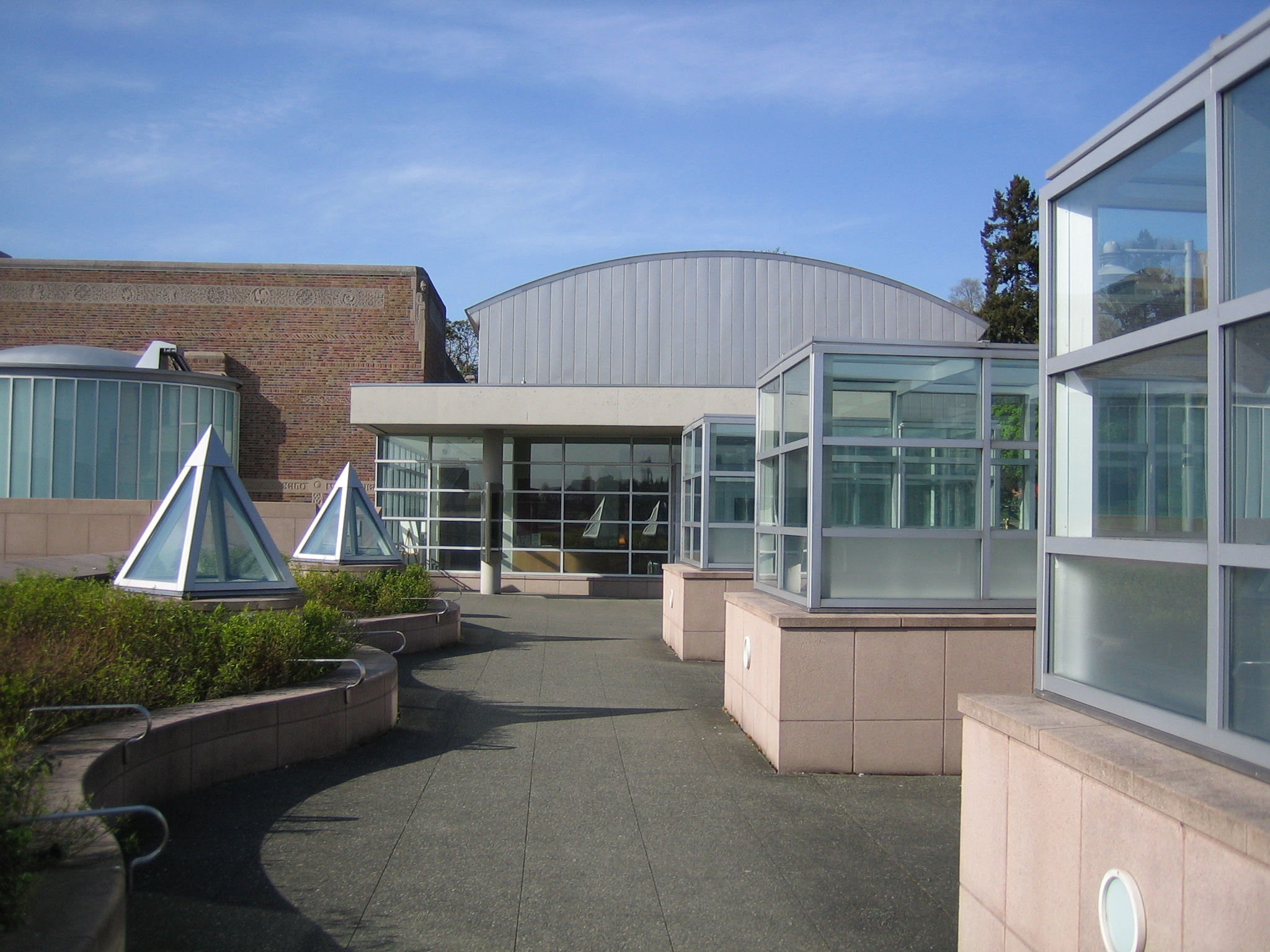
The Henry Art Gallery opened to the public on February 10, 1927, becoming the first public art museum in the state of Washington. The original building, designed by the prominent Seattle architectural firm Bebb and Gould, sat on the west edge of the university campus along 15th Avenue NE in the University District. For decades, it operated as a modest campus gallery, anchored by Henry's original collection but gradually expanding its scope. The transformation came in 1997, when the gallery expanded to 40,000 square feet with an addition designed by Gwathmey Siegel & Associates Architects. The renovation added a 154-seat auditorium and brought the gallery's architecture into conversation with the contemporary art it increasingly championed. What had started as a repository for one man's nineteenth-century paintings had evolved into a laboratory for art that challenged and provoked.
A Hole in the Ceiling
Among the Henry's most striking possessions is a James Turrell Skyspace, a site-specific immersive sculpture completed in 2003. Turrell, the celebrated light artist, designed the installation as an enclosed chamber with an aperture cut in the ceiling, framing a rectangle of sky that shifts in color and intensity as the day progresses and the weather changes. Like Seattle's baseball stadium, the Skyspace features a retractable roof, allowing the work to function in the region's famously variable weather. Sitting inside the chamber, you watch clouds pass through the frame, the gray of a November afternoon becoming its own form of art. Turrell's work has been exhibited in museums worldwide, but the Henry's permanent installation offers something most exhibitions cannot: the chance to return again and again, watching the same opening reveal a different sky each time. The 2003 Turrell exhibition was part of a broader commitment to immersive and experiential art that has defined the Henry's curatorial identity.
28,000 Objects and Counting
The Henry's collection has grown to more than 28,000 objects, a remarkable expansion from Horace Henry's original 178 works. Photography forms a major pillar, drawing from the partial gift and purchase of the Joseph and Elaine Monsen collection, which gave the museum significant depth in both historical and contemporary photographic practice. In 1982, the Henry inherited a large collection from the University of Washington's former Costume and Textile Study Center, adding another dimension to holdings that now stretch from nineteenth-century paintings through textile arts to cutting-edge digital installations. The Eleanor Henry Reed Collection Study Center makes these holdings available for research by appointment, while an online database opens the collection to anyone with an internet connection. Major exhibitions have featured artists including Maya Lin, Doug Aitken, Lynn Hershman Leeson, and Ann Hamilton, whose 2014 installation explored the boundaries of sensory experience.
Nurturing the Northwest Edge
In 2008, the Henry established the Brink Award, a biennial prize of $12,500 for an emerging artist from Washington, Oregon, or British Columbia. The award recognized that the Pacific Northwest had developed a distinctive artistic identity, one that deserved institutional support at the moment when careers were still forming. Past winners include Vancouver-based Isabelle Pauwels in 2009, Andrew Dadson in 2011, Seattle's Anne Fenton in 2013, Jason Hirata in 2015, and Demian DinéYazhi' in 2017. The exhibition program has followed a similar regional-meets-global philosophy, staging shows that place Northwest artists alongside internationally recognized figures. It is an approach that reflects Horace Henry's original impulse: collecting art not as a display of wealth or status, but as something a community does together. The old man who opened his living room to strangers would recognize the spirit, even if the James Turrell installation and the twenty-eight thousand objects would leave him blinking in astonishment.
From the Air
Located at 47.656N, 122.312W on the western edge of the University of Washington campus in Seattle's University District, along 15th Avenue NE. The museum is part of the broader campus complex visible between Portage Bay and University Village. Nearest airports: Boeing Field/King County International (KBFI) 7nm south, Seattle-Tacoma International (KSEA) 15nm south, Kenmore Air Harbor (S60) 7nm north. Best viewed at 2,000-3,000 feet AGL; the UW campus is identifiable by Husky Stadium, the Drumheller Fountain axis, and the dense cluster of buildings along Rainier Vista.