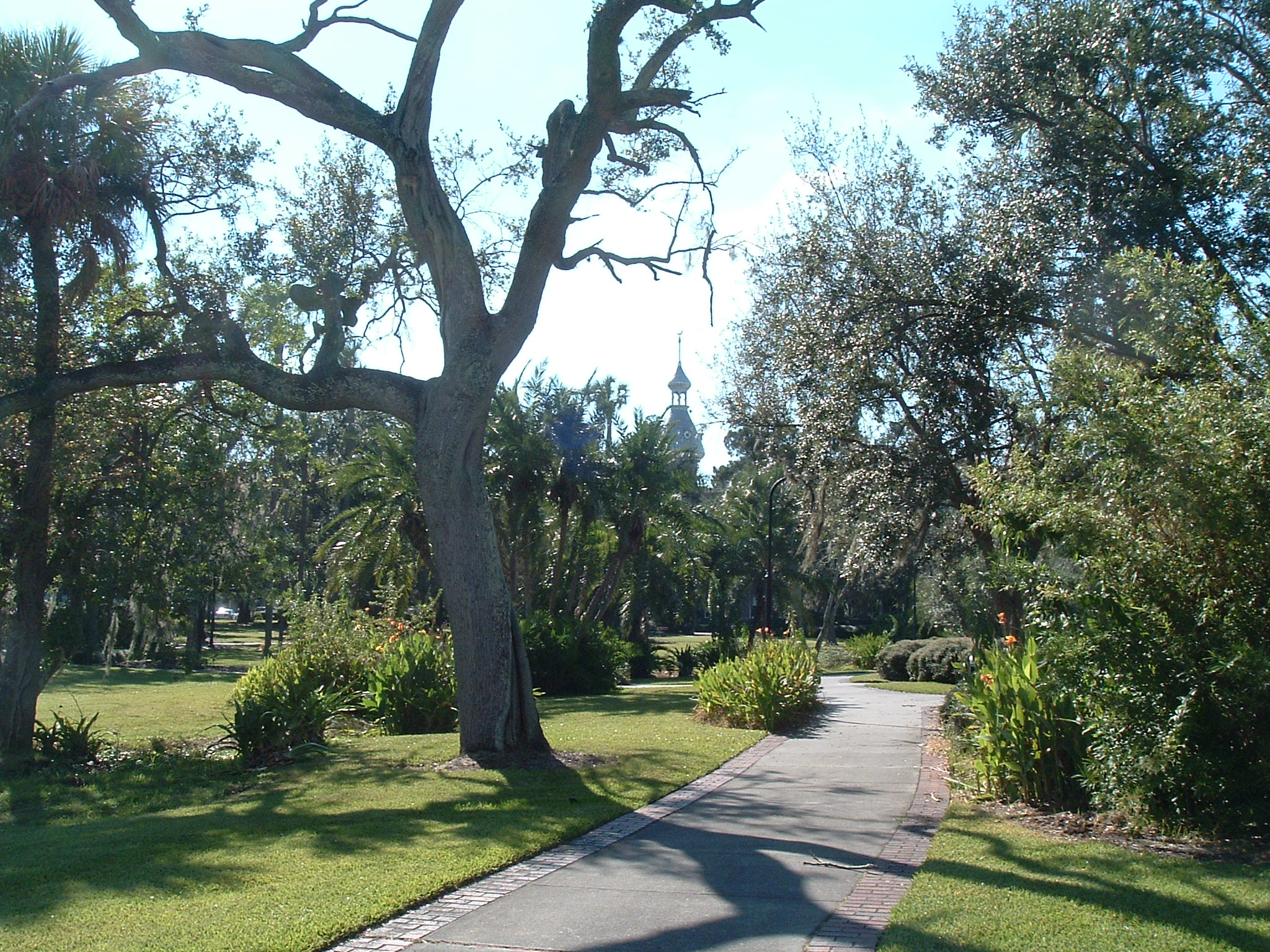
Henry B. Plant Museum
Six silver minarets rise above the Hillsborough River like something lifted from a fairy tale and dropped into downtown Tampa. The building is real, though its origin story reads like fiction: a Connecticut railroad tycoon spent over three million 1890s dollars building a 511-room Moorish Revival hotel in what was then a remote Florida frontier town, stuffed it with European art that arrived by the trainload, and charged guests up to fifteen dollars a night when the average Tampa hotel cost a dollar and a quarter. The Tampa Bay Hotel opened on February 5, 1891, and for four decades it served as the most extravagant destination on Florida's Gulf Coast. Today, a wing of that building survives as the Henry B. Plant Museum, preserving the bewildering grandeur of an era that believed bigger was always better.
A Palace at the End of the Line
Henry B. Plant built his fortune connecting the American South by rail, and his Tampa Bay Hotel was the crown jewel anchoring the terminus of the Plant System rail line. Designed by architect J.A. Wood and constructed between 1888 and 1891, the hotel stretched a quarter mile long, with six minarets, four cupolas, and three domes spanning five stories, all trimmed in ornate Victorian gingerbread. Plant chose the Moorish Revival style deliberately, calculating that its exotic European appeal would attract the well-traveled Victorians who were his target clientele. The hotel boasted Florida's first elevator, which remains operational today as one of the oldest continually functioning elevators in the nation. Its 511 rooms were the first in the state to feature electric lighting and telephones, and most included private bathrooms with full-size tubs. The grounds sprawled across acres that included a golf course, bowling alley, racetrack, casino, and an indoor heated swimming pool, with 21 buildings in total.
Art by the Trainload
From 1889 to 1891, Plant scoured Europe on a shopping spree that would make a modern oligarch blink. He filled entire rail cars with rococo bronzes, tapestries, clocks, paintings, and furniture, shipping everything to Tampa. The purchases were so vast that even the enormous hotel could not contain them all, and the surplus had to be sold at auction. A vase gifted by the Emperor of Japan sat alongside French furniture and Italian bronzes. After Plant's death in 1899, his wife Margaret commissioned the Henry Bradley Plant Memorial Fountain at the park entrance, a stone sculpture carved by George Grey Barnard depicting trains and ships that symbolized her husband's transportation empire. It remains the oldest piece of public art in the city of Tampa. The museum wing that survives today houses what curators describe as a bewildering assortment of the original collection, displayed in the Historic House Museum style to reflect how these objects once filled the hotel's lavish rooms.
When War Came to the Veranda
In 1898, the Tampa Bay Hotel found an unlikely second purpose. When the Spanish-American War erupted, Plant convinced the United States military to use his hotel as a base of operations. Generals and high-ranking officers planned invasion strategies from its rooms while enlisted men camped on the hotel's grounds. Colonel Theodore Roosevelt kept a suite and spent his days leading the Rough Riders through battle exercises on the manicured acreage. The guest registry during this period reads like a who's who of the era: actress Sarah Bernhardt, Red Cross founder Clara Barton, journalist Stephen Crane, the Queen of the United Kingdom, the Prince of Wales, Winston Churchill, and pianist Ignacy Paderewski all passed through these halls. In the hotel's final years before closing in 1930, Babe Ruth stayed as a guest and signed his first baseball contract in the Grand Dining Room.
Ghosts of Fort Brooke
The museum's surrounding Plant Park holds its own layers of history. Two iron cannons near the University of Tampa's library date to Fort Brooke, the military post established in 1824 around which Tampa itself developed. These model 1819 seacoast guns once guarded Tampa Bay as part of a Confederate battery during the Civil War. On May 6, 1864, a Union naval raiding party captured the fort and disabled the three cannons by blowing off their trunnions, damage still visible today. Plant moved two of the abandoned guns to his hotel grounds in the 1890s as curiosities for guests. The third cannon spent decades as a lawn ornament on Bayshore Boulevard before being donated to a World War II scrap metal drive in 1942. Facing Kennedy Boulevard, a Spanish-American War memorial gun points symbolically south toward Cuba, though the weapon on display is actually a replacement obtained from Fort Morgan, Alabama, after the original was also lost to a wartime scrap drive.
A Landmark Preserved
The Tampa Bay Hotel ceased operations in 1930, but the building found new life as the campus of the University of Tampa. The south wing was preserved as the Henry B. Plant Museum, and on December 5, 1972, the structure was designated a U.S. National Historic Landmark. The American Institute of Architects' Florida Chapter placed Plant Hall on its list of Florida Architecture: 100 Years, 100 Places. Today the museum hosts events that evoke its Gilded Age origins: Victorian Christmas strolls through decorated galleries, Great Gatsby parties in the Fletcher Lounge complete with 1920s music and a vintage 1929 Bentley, and moonlit October tours filled with ghost stories. Plant Park's Biology Creek, once fed by an underground spring beneath the hotel, supported a small zoo whose bear and alligator eventually became the founding residents of what is now Tampa's Lowry Park Zoo.
From the Air
Located at 27.95°N, 82.46°W on the banks of the Hillsborough River in downtown Tampa. The Moorish Revival minarets and silver domes of Plant Hall are unmistakable from the air and serve as one of Tampa's most distinctive landmarks. Best viewed at 1,500-2,500 feet AGL. Nearby airports include Tampa International Airport (KTPA) approximately 5 nm to the northwest, Peter O. Knight Airport (KTPF) about 2 nm to the south, and MacDill AFB (KMCF) roughly 5 nm to the south-southwest. The Hillsborough River and the University of Tampa campus provide clear visual references.