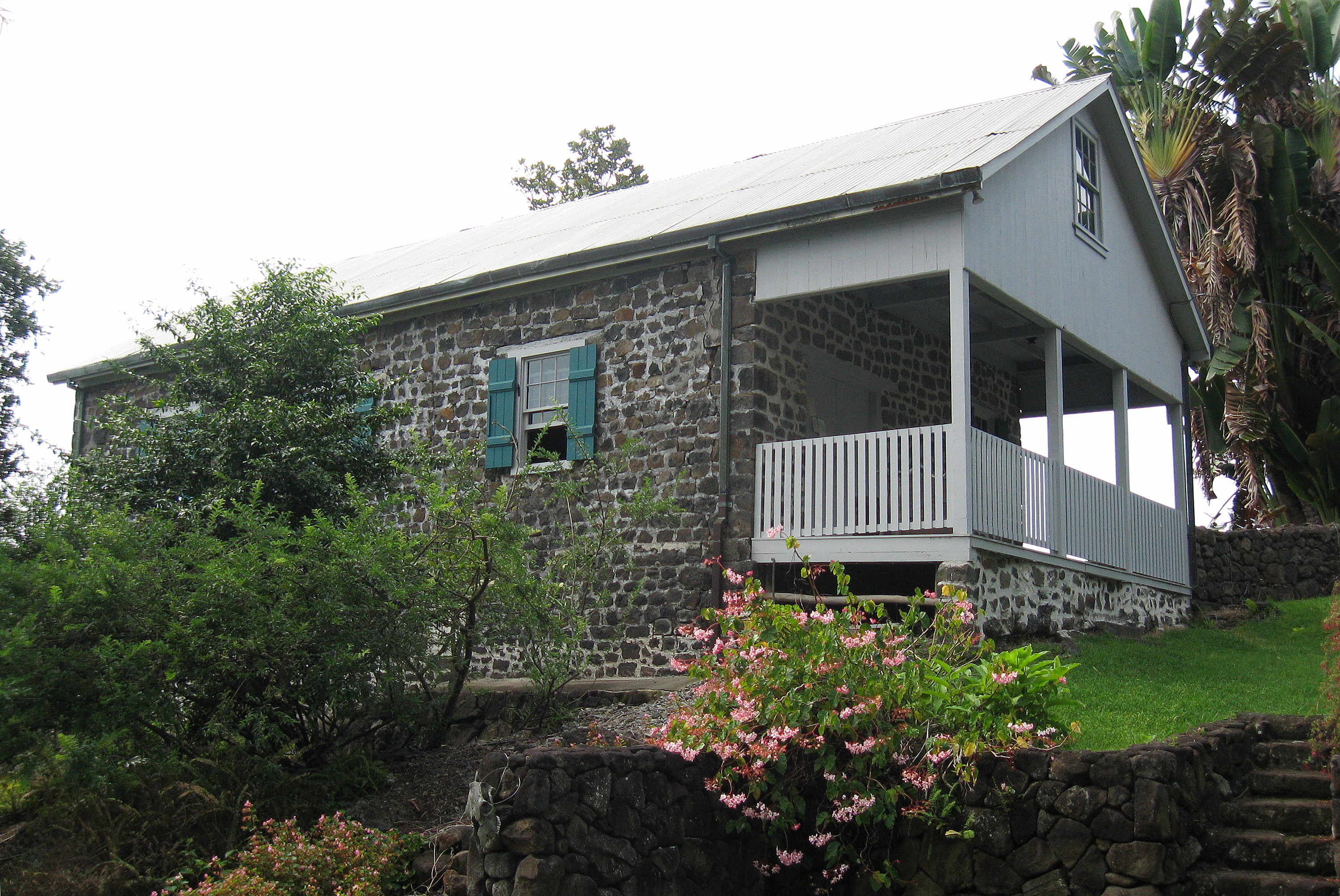
Henry Nicholas Greenwell
When the ship reached San Francisco in 1849, the entire crew abandoned it and ran for the gold fields. Henry Nicholas Greenwell, a former British Army lieutenant with goods to sell and no one to help him unload them, injured himself hauling cargo alone. He sailed to Hawaii in January 1850 to recover. He never left. Within two decades, this fourth son of a County Durham family -- with no hope of inheriting the family estate -- would put Kona coffee on the world stage.
From Sandhurst to the Sandwich Islands
Born on January 9, 1826, in Lanchester, County Durham, Greenwell trained at Durham School and the Royal Military Academy Sandhurst for a military career. In 1844, he purchased a lieutenant's commission in the 70th Regiment of the British Army, stationed in Ireland during the Great Famine. What he witnessed there disillusioned him. He sold his commission in 1847 and set off for Melbourne, Australia, looking for a sheep or cattle station. Finding none, he followed the Gold Rush to California, where fortune eluded him once more. After his injury in San Francisco and brief convalescence in Honolulu, he moved to Kailua-Kona and opened a retail store in the Kona District by late 1850. Four continents, three years, and a string of failed plans had deposited him exactly where he needed to be.
Coffee, Oranges, and a World's Fair
Greenwell first found success growing oranges for the booming California market, but when blight destroyed the crop in 1866, he diversified. In 1867, he circumnavigated the globe, visiting New Zealand, returning to England, and picking up new orange varieties in Brazil. He also met his future wife on the voyage. His stone store at Kealakekua Bay, built in the traditional land division known as Kalukalu, became the commercial heart of the district. Coffee, though, would be his lasting legacy. Greenwell's Kona coffee won recognition at the 1873 World's Fair in Vienna and appeared at the 1876 Centennial Exposition in Philadelphia. The family traded in sheep skins and dairy products as well, using the profits to acquire more land. Coffee grows only in a narrow elevation band along the Kona slopes, so drier ground above the cloud line served as pasture for cattle, sheep, and horses.
An Empire of Small Farms
The Reciprocity Treaty of 1875 pushed most Hawaiian coffee plantations to convert to sugarcane -- but the steep Kona hillsides made sugar impractical. Instead of large-scale operations, small plots were leased to individual families: Chinese, Japanese, and Portuguese immigrants whose labor contracts on sugar plantations had expired. This small-farm model, born of geography as much as intention, gave Kona coffee a character distinct from plantation monocultures. Quality improved further when the Guatemalan coffee variety, introduced via Hermann A. Widemann, proved well-adapted to higher elevations. It remains a popular variety in modern Kona. Greenwell died on May 18, 1891, aboard a steamer between the islands, but his family continued the business for generations.
Greenwells Across the Kona Slopes
After Henry's death, his descendants divided the operation into three ranches stretching across the slopes of Hualalai. William H. Greenwell managed the business until 1927, when his wife Maud ran the store until the 1950s. Frank "Palani" Greenwell -- whose Hawaiian nickname became the name of Palani Road -- ranched farther north and served in the territorial legislature. Amy Greenwell, an Arthur's granddaughter, attended Stanford, served as a wartime nurse, and established a garden to preserve the Kona Field System, which she left to the Bishop Museum on her death in 1974. Sherwood Greenwell founded the Kona Historical Society and donated land for a county park. James Mallaby Greenwell was inducted into the Paniolo Hall of Fame in 2001. The original stone store is now a museum on the National Register of Historic Places, and Thomas Frederick Greenwell, Henry's great-grandson, still grows and sells coffee on a farm adjacent to the original homestead. Some of the trees were planted in 1903.
From the Air
The Greenwell Store sits at 19.69°N, 155.97°W along the Mamalahoa Highway (Hawaii Belt Road) on the Kona Coast. From the air, the narrow coffee belt is visible as a green strip between the coastline and the bare volcanic slopes of Hualalai. Nearest airport is Ellison Onizuka Kona International (PHKO). Best viewed at 3,000-5,000 ft AGL, with the contrast between lava rock and green coffee orchards clearly visible.