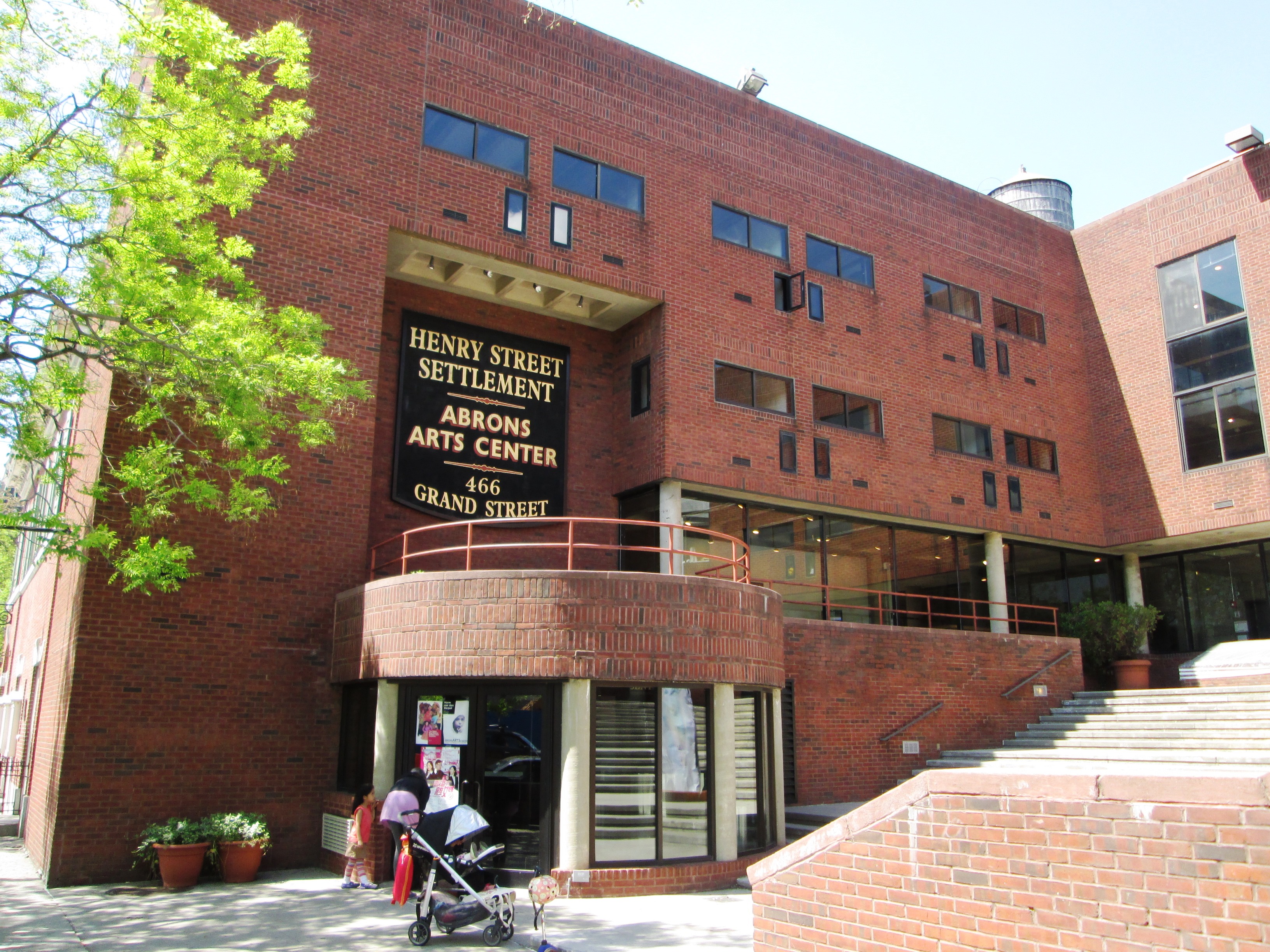
Henry Street Settlement
"Mommy... baby... blood." In 1892, a young girl tugged at the sleeve of Lillian Wald, a 25-year-old nursing student teaching a home health class to immigrant women on Manhattan's Lower East Side. Wald gathered sheets from her bed-making lesson and followed the child through the tenement streets to a cramped two-room apartment, where she found the girl's mother hemorrhaging after childbirth. The doctor had left because the family could not pay. Wald called the experience her "baptism by fire." Within a year, she had founded the Nurses' Settlement, dedicating her life to bringing health care, education, and the arts to the immigrant poor. That settlement, renamed for the street where it still stands, became one of the most consequential social service organizations in American history.
Three Row Houses, One Mission
The Henry Street Settlement has operated from three Federal-style row houses at 263, 265, and 267 Henry Street since its earliest years. The buildings date to around 1832, their brick facades quietly aging while the neighborhood transformed around them. In 1895, banker and philanthropist Jacob Schiff purchased the townhouse at 265 Henry Street for Wald's growing organization, adding an extra story for more space before donating it outright in 1903. Chemist Morris Loeb acquired 267 Henry Street in 1906, a Greek Revival townhouse whose facade the architectural firm Buchman & Fox had redone in Colonial Revival style. The Settlement leased 263 Henry Street beginning in 1938 and purchased it in 1949. These three buildings became New York City designated landmarks in 1966, and in 2022, the buildings at 265 and 267 were re-added to the National Register of Historic Places under the name Lillian Wald House.
A Stage for the Lower East Side
Wald believed that the arts were as essential as medicine. In 1915, sisters Alice and Irene Lewisohn created the Neighborhood Playhouse at the corner of Grand and Pitt Streets, one of the first "Little Theatres" in America, bringing classical drama to a neighborhood where Yiddish theater and vaudeville were the norm. Supporters included Aaron Copland and Walter Damrosch. In 1937, the theater premiered a remarkable collaboration: a play-opera called The Second Hurricane, with music by Copland, a libretto by Edwin Denby, and direction by a young Orson Welles. The theater continues today as the Harry De Jur Playhouse. The Settlement's music school produced alumni including violinist Berl Senofsky and pianist Jacob Lateiner, with faculty like the legendary violin teacher Ivan Galamian. Today, the Abrons Arts Center at 466 Grand Street offers affordable instruction in dance, music, visual arts, and theater, alongside performances in three theaters and artist-in-residence workspaces.
Fifty Thousand Lives a Year
The scale of the Henry Street Settlement's work defies its humble row-house origins. Approximately 50,000 people pass through its programs each year. Four homeless shelters, including one specifically for survivors of domestic violence, provide immediate refuge. Supportive permanent housing serves formerly homeless individuals managing mental health challenges. Youth programs stretch from day care through college preparation, covering after-school services, summer camps, sports, and peer HIV prevention. Seniors find community through the Good Companions Senior Center, a companion program, and Meals-on-Wheels. A workforce development center handles job training and placement. State-licensed mental health and primary care clinics offer counseling and treatment. Across 17 program sites, many housed in New York City Housing Authority buildings, the Settlement reaches deep into the neighborhood Lillian Wald first walked as a student nurse.
The Family That Built a Legacy
In 2021, the New York State Historic Preservation Office recognized the Settlement's headquarters as an LGBT historic site, a designation rooted in Lillian Wald's own life. Wald maintained deep romantic and platonic relationships with the women she affectionately called "The Family" -- a term common among women-run settlement houses of the era. These women formed the essential support network that sustained Wald's work from the 1890s until her retirement in the 1930s. The recognition added another dimension to an already layered history. At his passing, actor and comedian Jerry Stiller bequeathed funds to the Settlement's Abrons Arts Center and Boys & Girls Republic, programs aiding the educational and artistic development of Lower East Side youth. In 2018, the artist KAWS collaborated with the Settlement on an interactive workshop for local art students, demonstrating that after more than 130 years, the organization Wald founded in response to one child's desperate plea continues to draw people who believe in the power of showing up for their neighbors.
From the Air
Located at 40.7139N, 73.9853W on Manhattan's Lower East Side, visible amid the dense tenement grid south of Houston Street. The three Federal-style row houses at 263-267 Henry Street are small-scale buildings in a neighborhood of walk-ups and housing projects. Nearby landmarks include the Williamsburg Bridge to the east and the Manhattan Bridge to the south. Closest airports: KJFK (John F. Kennedy International, 13 nm SE), KLGA (LaGuardia, 8 nm NE), KEWR (Newark Liberty, 10 nm W). Best viewed at 1,500-2,000 ft AGL for neighborhood context.