Herculaneum: Pompeii's Forgotten Sister
When Vesuvius erupted in 79 AD, it didn't just bury Pompeii. Four miles closer to the volcano, the wealthy resort town of Herculaneum met an even more dramatic fate. While Pompeii was slowly buried under ash, Herculaneum was overwhelmed by pyroclastic surges - superheated gas and rock that killed instantly and buried the town under 60 feet of material that solidified like concrete. The result was paradoxical: more violent destruction but better preservation. In Herculaneum, scientists have found organic materials that disappeared elsewhere - wooden furniture, food, fabric, and a library of carbonized scrolls that new technology is finally making readable.
The Different Death
Pompeii's residents had hours to flee as ash slowly accumulated. Many escaped. Those who stayed suffocated or were killed by collapsing roofs. Herculaneum's residents had less warning. The town was upwind of the initial eruption and wasn't receiving the ash that was burying Pompeii.
Then, around midnight, the eruption column collapsed. A series of pyroclastic surges swept down the volcano's slopes at hundreds of miles per hour, reaching temperatures of 500 degrees Celsius. The surges hit Herculaneum first. Death was instantaneous - not from suffocation but from thermal shock. The same surges would reach Pompeii hours later, killing those who remained.
The Boat Houses
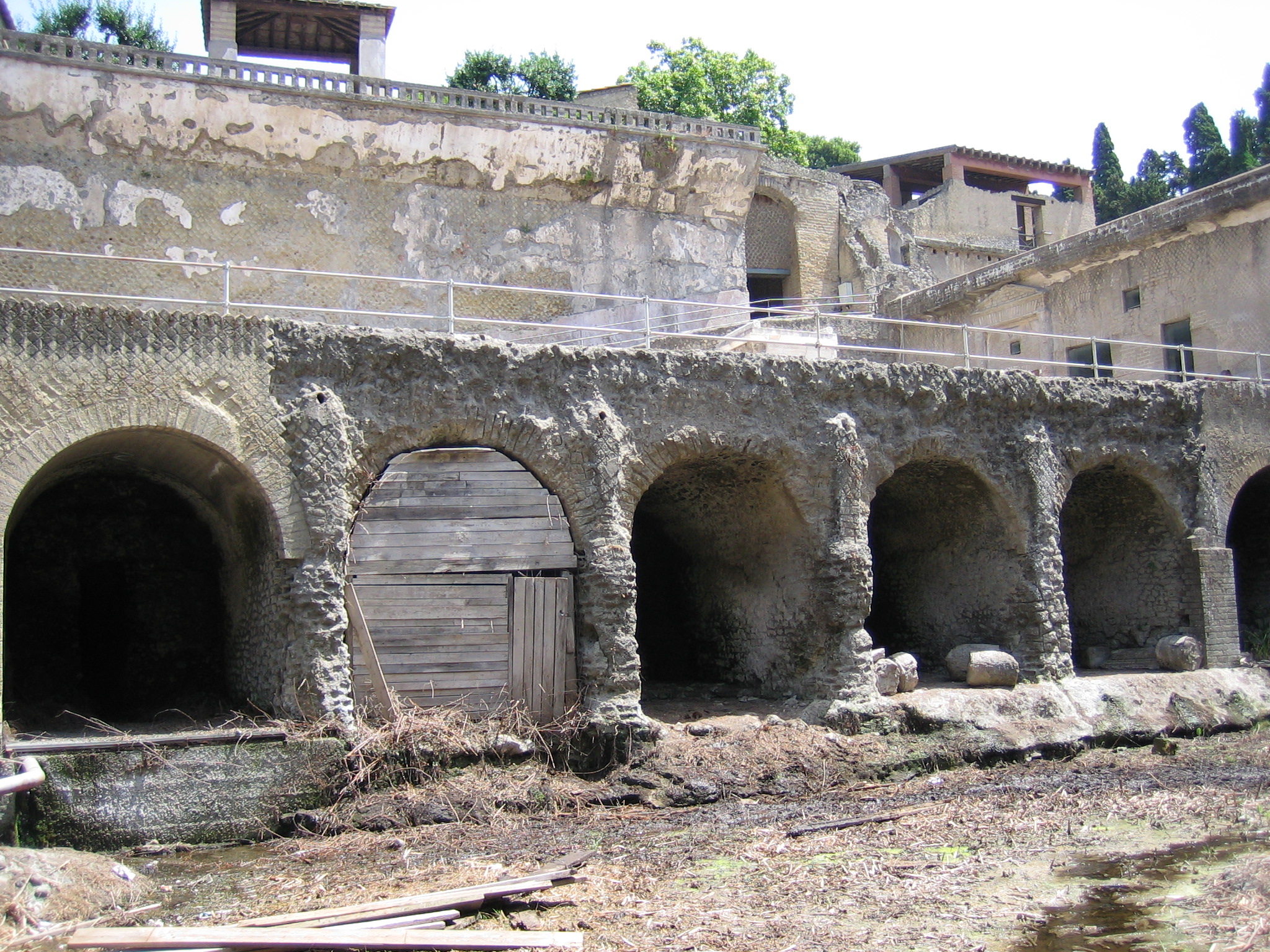
For centuries, scholars believed most of Herculaneum's residents had escaped. Then, in the 1980s, excavations of the ancient waterfront revealed a horror. In the boat houses - vaulted storage chambers along the harbor - archaeologists found over 300 skeletons huddled together, waiting for rescue that never came.
They had fled to the water's edge, expecting boats to carry them to safety. Instead, the pyroclastic surges found them. The remains show people in final embraces, mothers sheltering children, a soldier with his sword still at his side. Unlike Pompeii's hollow casts, these are actual skeletons, preserved by the same material that killed them.
The Preservation
Herculaneum's burial was violent, but the volcanic material that covered it created exceptional preservation conditions. Unlike the relatively loose ash at Pompeii, Herculaneum was sealed under hardite - volcanic debris that set like concrete, creating an oxygen-free environment that preserved organic materials.
Wooden furniture survives intact. Food remains identifiable. A wooden cradle was found with its ropes still attached. Fabric, leather, rope, and other organic materials that decay elsewhere survive here. Herculaneum offers a window into Roman daily life that even Pompeii cannot match.
The Scrolls
The Villa of the Papyri - a luxury home owned by the father-in-law of Julius Caesar - contained a library of approximately 1,800 papyrus scrolls. The scrolls were carbonized by the eruption, transformed into brittle, charred cylinders that disintegrate when touched. Early attempts to unroll them destroyed many.
New technology is changing everything. Using X-ray CT scanning and AI, scientists are reading scrolls without unrolling them, detecting the carbon-based ink against the carbon-based papyrus. In 2023, researchers deciphered the first word from an unopened scroll. The library appears to contain mostly Epicurean philosophy. Who knows what other texts await?
The Unexcavated City
Only about one-quarter of Herculaneum has been excavated. The rest lies beneath 60 feet of hardened volcanic material and, more problematically, beneath the modern town of Ercolano. The Villa of the Papyri is only partially uncovered - more scrolls almost certainly remain underground.
Excavation is expensive and slow. The material is far harder to remove than Pompeii's ash. And above the ancient town, 50,000 people live their modern lives. Herculaneum's secrets are being revealed one painstaking layer at a time. The carbonized scrolls offer hope that ancient knowledge, presumed lost, may still be recoverable. Vesuvius destroyed a town and preserved a library.
From the Air
Herculaneum (40.81N, 14.35E) lies at the western base of Mount Vesuvius, 4 miles closer to the volcano than Pompeii. Naples International Airport (LIRN/NAP) is 12km northwest. The archaeological site is partially visible beneath the modern town of Ercolano. The excavated area is compact compared to Pompeii. Vesuvius dominates the landscape to the east. The Bay of Naples is visible to the west. Weather is Mediterranean - hot dry summers, mild wet winters.