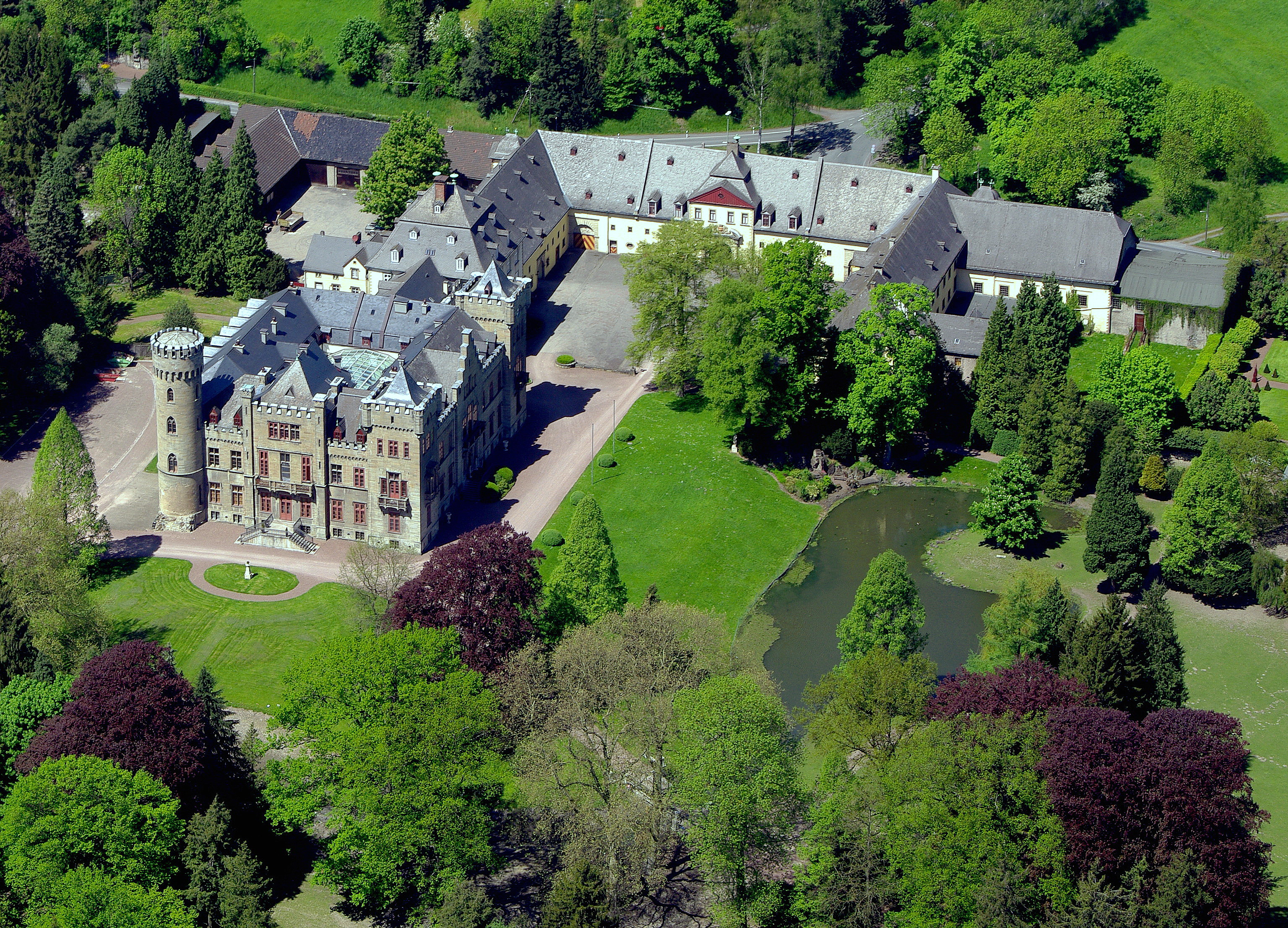
Herdringen Castle
The man who completed Cologne Cathedral also designed a country house. In the wooded hills above Arnsberg, Schloss Herdringen rises in pointed arches and stone tracery, a private fantasy of medieval Christendom built between 1844 and 1853 for the Barons of Fürstenberg. Its architect was Ernst Friedrich Zwirner, the master builder who, in his other working life, was orchestrating the resumption of construction on the great cathedral at Cologne after centuries of standstill. You can read the kinship if you know what to look for. The castle's chapel echoes the cathedral he was finishing fifty kilometers to the west, as if a Gothic genius were unable to keep two projects entirely separate. A king came to see it the year it was completed. The hall where he stayed still carries his name.
Before the Pinnacles
The site is older than the building. A manor at Herdringen first appears in a document in 1376, and for the next century and a half it belonged to the von Ketteler family, then the von Westrem family, before the prince-bishop of Paderborn, Dietrich von Fürstenberg, bought it in 1618 and passed it to his nephew. The Fürstenbergs have owned it ever since. Long before Zwirner sketched a single pinnacle, masons were already at work here. Between 1683 and 1723 they raised a three-winged baroque outer bailey, the working hub of any noble estate of the period, with stables and quarters and storerooms arranged around a courtyard. That earlier complex still stands at the foot of the castle, the practical Baroque ancestor of the romantic Gothic descendant on the rise above it.
A Cathedral Architect Goes Domestic
By the 1840s the Fürstenbergs wanted something grander, and they hired the most fashionable architect in Catholic Westphalia to design it. Ernst Friedrich Zwirner had taken charge of the resumption of work on Cologne Cathedral in 1833, transforming the medieval ruin into the soaring monument that would not be completed until 1880. Working for the Barons of Fürstenberg between 1844 and 1853, he turned his cathedral-trained eye to a private residence and produced one of the most ambitious secular Gothic Revival buildings in Westphalia. The chapel, in particular, is built in deliberate homage to Cologne, as if Zwirner could not resist treating one corner of the house as a small sermon on the building that defined his career.
The King's Hall
On the rolls of those who have crossed the threshold, one visit stands above the rest. In 1853, the year construction ended, Friedrich Wilhelm IV of Prussia was a guest at Herdringen. The romantic king who had championed the completion of Cologne Cathedral, and whose enthusiasm for medieval Christianity helped fuel the Gothic Revival across Prussia, came to see what his favored architect had built for one of his Catholic nobles. The hall in which he was received is still called the Königssaal, the King's Hall. It is a small, particular memory of a moment when royal taste, religious revival, and aristocratic ambition met under one freshly slated roof.
Quiet Centuries, Quiet Decades
After the Second World War, the castle entered a long second life as a tenant of the church. From 1947 to 1968 it housed the Paderborn Diocesan Caritas Association, and from then until 1998 it served a private school authority. For roughly fifty years, Gothic windows looked out on classrooms and welfare offices instead of dinner parties. Around the turn of the millennium, the current head of the family, Wennemar Freiherr von Fürstenberg, set about restoring the place. For two decades the castle has hosted weddings, concerts, and conferences in the kind of historic ambience that German venues advertise with no exaggeration at all. The pandemic closed the gates in 2020 and prompted another round of restoration. Plans now point toward a future as a museum under the Schloss Herdringen Cultural Foundation.
The Cinema's Borrowed Manor
There is one more career to mention. In the early 1960s, Edgar Wallace adaptations were a German cinema craze, and producers needed English-looking houses to play English manors. Herdringen, with its English landscape park laid out in the 1840s and its pointed Gothic profile, was almost too perfect. In 1961 it appeared in Der Fälscher von London, directed by Harald Reinl. Two years later it stood in for Chelford Manor in Der Schwarze Abt, directed by Franz Josef Gottlieb. For a brief moment, a Westphalian castle by the architect of Cologne Cathedral was working as a stand-in for an England that existed mostly in pulp fiction.
From the Air
Coordinates 51.4206°N, 7.97022°E, in the wooded Sauerland east of Dortmund. The castle sits on rising ground above the village of Herdringen in the Hochsauerland district, with the Möhne Reservoir about 7 km to the north and the Ruhr valley a few kilometers south. Best viewed at low cruising altitudes between 2,500 and 5,000 ft AGL when light angles catch the slate roofs and tower pinnacles against the surrounding forest. Nearest airfields: Arnsberg-Menden (EDKA) about 17 km west and Meschede-Schüren (EDKM) about 22 km east. Dortmund (EDLW) lies roughly 45 km to the west.