Herero uprising
Samuel Maharero's letter to Hendrik Witbooi carried four words that compressed a people's desperation into a battle cry: "Let us die fighting." It was January 1904, and the Herero chief was calling for an alliance of indigenous peoples against German colonial rule in South West Africa. The Herero had watched their land taken, their cattle seized, their women violated. The legal frameworks the Germans imposed had no basis in the Herero system of communal ownership -- yet they were enforced at gunpoint. Maharero chose war, knowing the odds. What followed was not merely a colonial conflict. It was the first genocide of the twentieth century.
The Breaking Point
The grievances ran deep. German settlers had steadily dispossessed the Herero of their ancestral lands and cattle, using European property law to legitimize what amounted to theft. A veterinary cordon fence introduced in 1896 to control rinderpest had become a tool of political control, restricting Herero movement and economic life. Settler violence against Herero people, including sexual violence against women, went largely unpunished. Governor Theodor Leutwein's attempt at control through a patchwork of treaties and punitive expeditions had subjugated some groups -- the Witbooi Nama had been forced into submission after guerrilla resistance in 1893 -- but resentment only deepened. When most German troops were pulled south to deal with the Bondelswarts rebellion, the Herero saw their chance.
"Let Us Die Fighting"
On January 12, 1904, the Herero clans struck. The rebellion was carefully planned to exploit deception and surprise. Farms and businesses were plundered. Between 123 and 160 Germans were killed, most of them farmers and traders rather than soldiers. The Herero generally spared women, children, missionaries, and non-German Europeans -- a deliberate restraint that the colonial government would not reciprocate. Maharero's fighters seized weapons and supplies, razed buildings, and attempted to destroy the settlers' economic foundations entirely. The goal was not merely revenge but the permanent end of German colonization. The Herero surrounded Okahandja and Windhoek, destroyed the railway bridge to Osona, and fought a guerrilla campaign that exploited their knowledge of the terrain. The colonial Schutztruppe of just 766 troops was overwhelmed. Governor Leutwein's desperate attempts at negotiation were rejected by Herero leaders emboldened by their early success.
Extermination
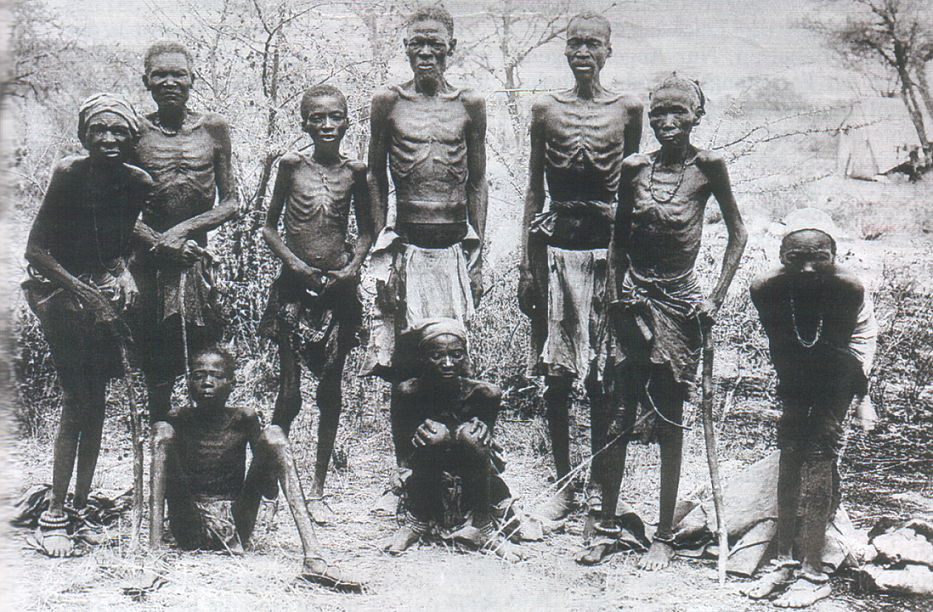
Berlin's response was not negotiation but annihilation. Kaiser Wilhelm II replaced Leutwein with General Lothar von Trotha, who arrived with 14,000 troops and an explicit intent to destroy the Herero as a people. At the Battle of Waterberg on August 11, 1904, Trotha's forces defeated 3,000 to 5,000 Herero combatants, then pursued the survivors into the waterless Omaheke Desert -- a western arm of the Kalahari. Von Trotha issued his extermination order: the Herero were denied the right of being German subjects and commanded to leave or be killed. German soldiers guarded every water source. As exhausted Herero collapsed, unable to continue, soldiers killed men, women, and children. There was no military necessity in this. It was a policy of deliberate destruction. The Nama, who entered the war in late 1904 under leaders Hendrik Witbooi and Jakobus Morenga, faced similar brutality. Survivors of both groups were confined to concentration camps and forced into slave labor in mines and on railways.
The Human Cost
The numbers carry the weight of what was lost. Of approximately 80,000 Herero, some 65,000 died -- more than eighty percent of the population. At least 10,000 of 20,000 Nama perished. These were not soldiers. They were families, elders, children -- an entire civilization brought to the edge of extinction. The concentration camps, with their disease, starvation, and forced labor, killed many whom the desert had not. Those who survived were stripped of their land, their cattle, their political structures, and their freedom of movement. The system of dispossession, forced labor, and racial segregation that followed anticipated apartheid by decades.
Reckoning
Recognition came slowly. It took until August 16, 2004 -- exactly one hundred years -- for Germany to officially apologize. "We Germans accept our historic and moral responsibility and the guilt incurred by Germans at that time," said development minister Heidemarie Wieczorek-Zeul, acknowledging that the massacres constituted genocide. But the formal governmental recognition of the events as genocide did not come until May 2021. In 2021, Germany announced 1.1 billion euros in reparations to Namibia. The fighters of the Herero Wars are now honored as national heroes of independent Namibia. Thomas Pynchon wrote the genocide into his novels V. (1963) and Gravity's Rainbow (1973). Mari Serebrov's Mama Namibia (2013) traced its toll on individual lives and the fabric of Herero culture. The land itself remembers. The Omaheke Desert, where thousands died of thirst while German soldiers guarded the water, remains as featureless and unforgiving as it was in 1904.
From the Air
The Herero uprising centered on present-day central Namibia, approximately 22.00S, 17.00E. Key sites include Okahandja (where the rebellion began), Windhoek (FYWH), and the Waterberg Plateau northeast of Windhoek -- site of the decisive August 1904 battle, visible as a dramatic sandstone mesa rising from the surrounding plains. The Omaheke Desert extends eastward toward Botswana; this is where thousands of Herero died fleeing German forces. The landscape is semi-arid savanna transitioning to desert, with scattered settlements and cattle farms.