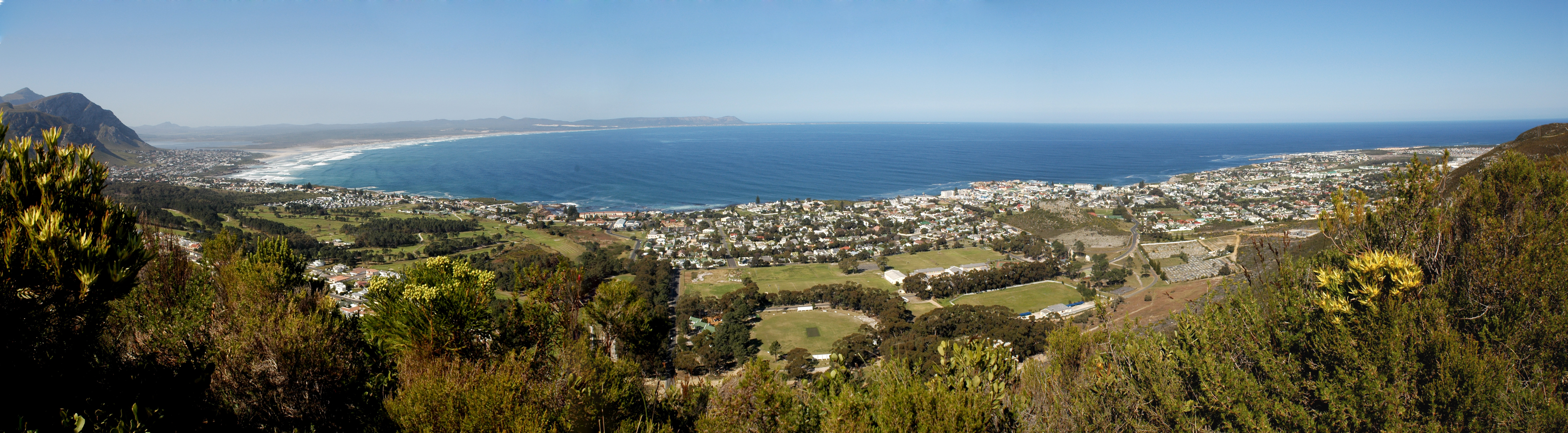
Hermanus
Since 1992, a man has walked the shores of Hermanus carrying a kelp horn. His job title is whale crier, and his sole professional responsibility is to spot southern right whales in Walker Bay and announce their presence by blowing the horn. It is possibly the most South African job description ever conceived: part public servant, part showman, part naturalist. Hermanus has earned its self-proclaimed title as the best land-based whale watching destination in the world, and the whale crier is both its marketing department and its proof of concept. Every winter, from June through December, these massive creatures migrate along the South African coast, choosing Walker Bay as a place to calve and nurse their young. They come close enough to shore that binoculars are optional.
The Bay Where Whales Come to You
Walker Bay curves in a broad arc along the Overberg coast, about 90 minutes' drive from Cape Town. The bay's sheltered waters and relatively shallow approaches make it ideal calving grounds for southern right whales, which can reach lengths of 15 metres and weights of 60 tonnes. From the cliffs and coastal walkways of Hermanus, watchers can observe mothers with calves, breaching displays, and the characteristic V-shaped blow of a surfacing whale -- all without setting foot on a boat. For those who want a closer encounter, boat trips depart regularly from the harbour. But the magic of Hermanus is that the whales come to the watchers, not the other way around. The Hermanus Whale Festival, held annually during peak season, draws crowds from across the country and beyond, combining whale watching with live music, food stalls, and marine education programmes.
Cliffs, Caves, and the Fynbos Edge
Hermanus is more than its whales, though the whales understandably dominate the conversation. The town perches on cliffs above the bay, with a coastal walking path that winds along the shoreline for kilometres, offering views of rocky coves, tidal pools, and the open ocean. The surrounding Overberg region is one of the most botanically diverse places on Earth, part of the Cape Floral Kingdom, where fynbos -- the scrubby, fire-adapted vegetation unique to the Western Cape -- covers the hillsides in a tapestry of proteas, ericas, and restios. Diving in Hermanus offers kelp forests and encounters with Cape fur seals, while the Hemel-en-Aarde Valley just inland has become one of South Africa's most celebrated wine regions, known particularly for its Pinot Noir and Chardonnay. Hamilton Russell and Bouchard Finlayson are among the estates that have put this valley on the international wine map.
A Fishing Village That Grew Up
Hermanus began as a fishing village, and the old harbour still carries traces of that origin. Small museums document the town's whaling and fishing past, a history that sits uncomfortably alongside its current identity as a whale-watching destination. The transition from killing whales to celebrating their annual return is a story of shifting values that mirrors broader changes in South Africa's relationship with its marine environment. Today, the town's economy runs on tourism, wine, and the hospitality industry. Restaurants serve umngqusho, a traditional Xhosa dish of samp and beans, alongside seafood platters. The town has hundreds of accommodation options, from modest guesthouses to luxury lodges perched on the cliffs, and except during the high season, finding a room on arrival is straightforward.
Gateway to the Overberg
Hermanus sits at the western edge of the Overberg region, making it a natural starting point for exploring one of South Africa's most beautiful and least crowded coastal stretches. De Hoop Nature Reserve, further east along the coast, offers more whale watching in an even wilder setting, with fynbos-covered dunes and pristine beaches. Gansbaai, across Walker Bay on the Danger Point Peninsula, is known for great white shark cage diving. Betty's Bay, back along the Whale Coast toward Cape Town, is home to a colony of African penguins at Stony Point and the Harold Porter National Botanical Garden, a pocket of indigenous forest in a landscape otherwise dominated by fynbos. The drive to Hermanus from Cape Town follows the N2 through Caledon before dropping down to the coast on the R43, a route that transitions from the wheat fields of the interior to the blue edge of the Atlantic in a single hour.
From the Air
Located at 34.42S, 19.30E on Walker Bay in the Overberg region, approximately 120 km southeast of Cape Town. The curved bay and coastal cliffs are visible from altitude. During whale season (June-December), southern right whales may be visible in the bay from low altitude. Cape Town International Airport (FACT) is the nearest major airport, about 90 minutes by road. Recommended viewing altitude: 2,000-4,000 ft for coastline detail and possible whale spotting.