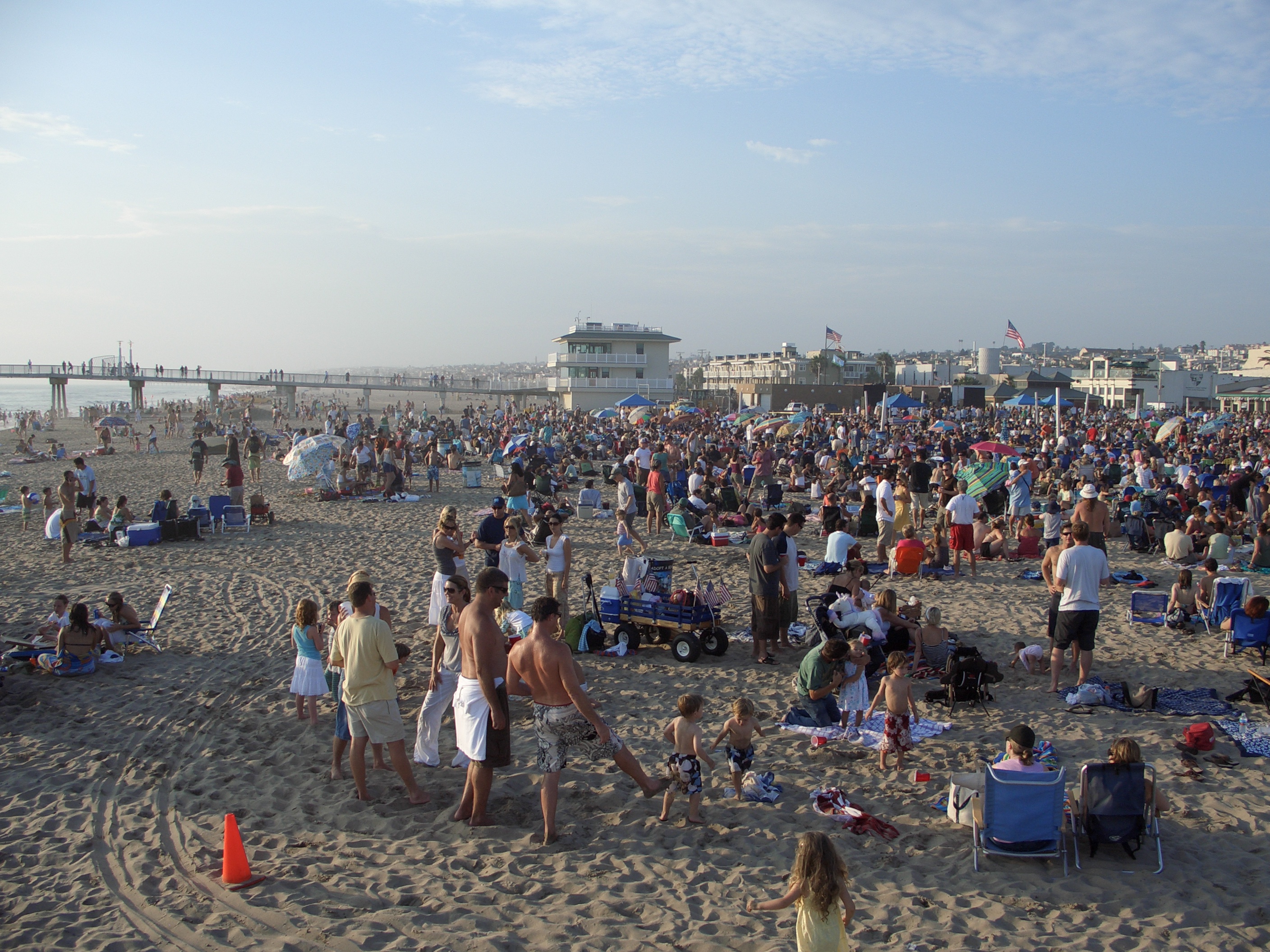
Hermosa Beach, California
Hermosa is the Spanish word for beautiful, and the city incorporated in 1907 earned its name honestly. The beach is wide and white, the waves run consistently, the bluffs above the Strand glow at sunset in the particular warm light that makes Southern California coast towns look like movie sets. But beauty alone doesn't explain what Hermosa Beach became. In a strip of 1.4 square miles bounded by Manhattan Beach to the north and Redondo Beach to the south, the city developed a cultural personality stubbornly its own — part beach volleyball temple, part jazz incubator, part birthplace of California punk rock.
The Original Land and the Rancho
Before incorporation, the land that became Hermosa Beach was part of Rancho Sausal Redondo — the great Spanish land grant whose name referred to the round grove of willows that once marked the area. The coastal plain was mostly undeveloped through the rancho era and into the American period, used for grazing and seasonal agriculture. Pacific Electric Railway's extension south from Los Angeles in the early 1900s opened the coastline to subdivision. Developers laid out streets, sold lots, and incorporated the City of Hermosa Beach on January 14, 1907. It was immediately a beach town and nothing else, which turned out to be a sufficient identity for a long time.
The Strand and the Volleyball Courts
The Strand — the paved pedestrian path that runs along the beachfront from Santa Monica twenty miles south to Torrance — passes through Hermosa's heart, and the city treats it accordingly. Hermosa Beach's volleyball courts, set in the wide sandy margin between the Strand and the water, have been the site of some of the most important beach volleyball competition in the world. The city claims the sport itself, arguing that beach volleyball as a formalized game was invented in Hermosa Beach in the 1920s. The courts have hosted professional tournaments, Olympic qualifying events, and the daily pickup games that are the real soul of the sport. The beach volleyball culture of Southern California runs through Hermosa as surely as The Strand does.
The Lighthouse Cafe
The Lighthouse Cafe on Pier Avenue became, in the 1950s and 1960s, one of the most important jazz venues in California. Chet Baker played there regularly. Howard Rumsey's Lighthouse All-Stars made it a home base. The Pacific Jazz Records label grew partly from recordings made at the Lighthouse. In the geography of cool jazz's westward migration from New York, the Lighthouse Cafe was a destination — a room where musicians who wanted to play west coast jazz could find an audience willing to sit close and listen. The venue still operates, though the jazz emphasis has softened over the decades. The building carries a historical weight disproportionate to its size.
The Punk Scene
In the late 1970s and early 1980s, Hermosa Beach became the incubator of Southern California's hardcore punk movement. Black Flag formed in Hermosa Beach in 1976. The Descendents formed in nearby Manhattan Beach in 1977. The Circle Jerks, Pennywise — all of them traced roots to the South Bay, to garages and small venues in and around Hermosa where kids with no particular connection to the music industry were figuring out how loud and fast they could play. The scene was geographically specific in a way that matters: Hermosa punk grew from the same coastal community that produced beach volleyball culture, a collision of sunlit leisure and deliberate noise that says something about California contradiction.
The Permanent Town
Hermosa Beach has resisted most of what the rest of Southern California became. No major freeways run through it. No large-scale development disturbed its residential grid. The city's 19,700 residents live within walking distance of the water and The Strand, in a community that functions at human scale in a region built for cars. The pier juts into the Pacific. The beach volleyball courts fill on weekends. Somewhere on Pier Avenue, someone is playing jazz. Somewhere else, someone is playing punk. The city has been all of these things simultaneously for a hundred years, and it remains, in the Spanish sense, beautiful.
From the Air
Located at approximately 33.86°N, 118.40°W between Manhattan Beach and Redondo Beach on the South Bay coast. Hermosa Beach Pier is a navigational landmark visible from altitude, extending west from Pier Avenue into Santa Monica Bay. Torrance Municipal Airport (KTOA) is approximately 2 miles east. Approach from the west over the Pacific for best coastal orientation; The Strand's paved path along the beachfront is visible at lower altitudes.