Heroes' Acre (Namibia)
A bronze soldier stands on a hilltop 10 kilometers south of Windhoek, rifle raised, grenade in hand, facing a country he helped to free. Look closely and you will notice something the Namibian press noticed immediately: the Unknown Soldier has the face of Sam Nujoma, Namibia's founding president. That blurring of the personal and the national runs through every element of Heroes' Acre, a 732-acre war memorial that opened on 26 August 2002 -- Namibia's Heroes' Day -- and has been generating admiration and controversy in roughly equal measure ever since.
Pyongyang's Hand in the Desert
Heroes' Acre was designed and built by Mansudae Overseas Projects, a North Korean state enterprise that has constructed monuments, museums, and government buildings across Africa and Asia. In Namibia alone, Mansudae built four major public works: Heroes' Acre, the Okahandja Military Museum, a new State House, and the Independence Memorial Museum in downtown Windhoek. The contract for Heroes' Acre, initially set at 60 million Namibian dollars, was awarded without competitive tendering. By the time construction finished, costs had doubled. Critics called the memorial "monstrous" and speculated that outsourcing it to North Korea revealed a lack of African self-confidence. Defenders countered that Mansudae had built similar monuments across the continent and that the scale of the memorial matched the scale of the sacrifices it honored.
The Nine Who Started It All
At its inauguration, nine national heroes and heroines were identified, each commemorated with a cenotaph bearing a name and photograph -- though none are buried at Heroes' Acre. Their stories span a century of resistance. Kahimemua Nguvauva, chief of the Ovambanderu, was executed by German colonial forces in 1896 after his surrender at the Battle of Sturmfeld. Nehale Lya Mpingana, King of Ondonga, defeated the Dorsland Trek settlers in 1886 and routed German forces at Fort Namutoni in 1904. Jacob Morenga waged guerrilla war against the German Schutztruppe from the fortress of Khauxanas. Mandume Ya Ndemufayo, the last king of the Kwanyama, died fighting South African colonial forces in 1917. Hosea Kutako, Paramount Chief of the Herero, lived to be a hundred and spent decades petitioning the United Nations for Namibian independence. Together, the nine represent every major ethnic group and every era of resistance, from the 1890s to the 1970s.
Where Presidents Come to Rest
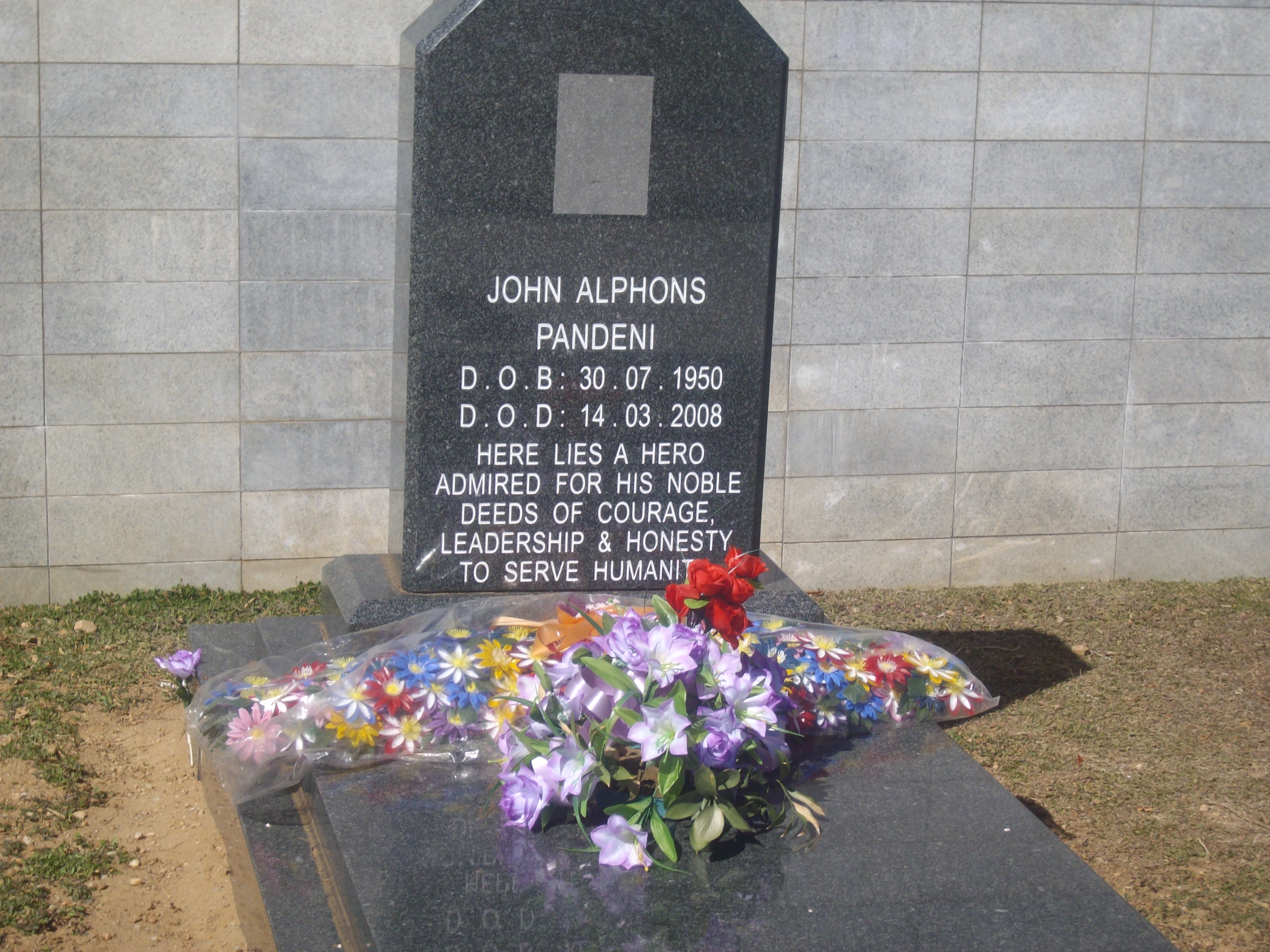
Heroes' Acre has grown beyond its original purpose. In the years since its opening, dozens of additional national heroes have been declared and buried on the grounds -- commanders of the People's Liberation Army of Namibia, founding members of SWAPO, former prime ministers, Robben Island prisoners who became cabinet ministers. Gerson Veii, buried here in 2015, was the first opposition party member to receive a hero's burial, a gesture toward political inclusiveness. In 2014, seven veterans of the liberation struggle were reburied at the site after their remains were repatriated. President Hage Geingob, who died in 2024 during his second term, became the first leader interred in the presidential mausoleums he himself had helped commission. Sam Nujoma, who died in 2025, followed him. The site has become less a static memorial and more a living cemetery, its meaning deepening with each burial.
Stone, Bronze, and Contested Memory
Carved into uninhabited hills of scrub and rock, Heroes' Acre is designed for ascent. Visitors climb a long staircase flanked by bas-relief murals depicting scenes from the liberation war, arriving at the crest where the Unknown Soldier stands against open sky. The landscape is deliberately austere -- no trees soften the approach, no shade tempers the Namibian sun. The monument was created, in President Nujoma's words, to "foster a spirit of patriotism and nationalism, and to pass this to the future generations of Namibia." Whether it achieves that depends on whom you ask. For many Namibians, the site is a place of genuine reverence, particularly on Heroes' Day each August 26th. For others, the North Korean aesthetic and the SWAPO-dominated roster of honorees raise questions about whose heroism gets remembered and whose does not. The memorial stands, either way -- monumental, polarizing, and impossible to ignore from the highway south of the capital.
From the Air
Heroes' Acre is located at 22.66S, 17.08E, approximately 10 km south of Windhoek along the B1 highway. From the air, the memorial complex is visible as a cleared, terraced hillside with a prominent stairway and statue at the summit. Nearest airports are Eros Airport (ICAO: FYWE) for domestic flights and Hosea Kutako International Airport (ICAO: FYWH) approximately 45 km east. The surrounding terrain is arid, open hills with sparse vegetation. Best viewed below 5,000 feet AGL on approach from the north.