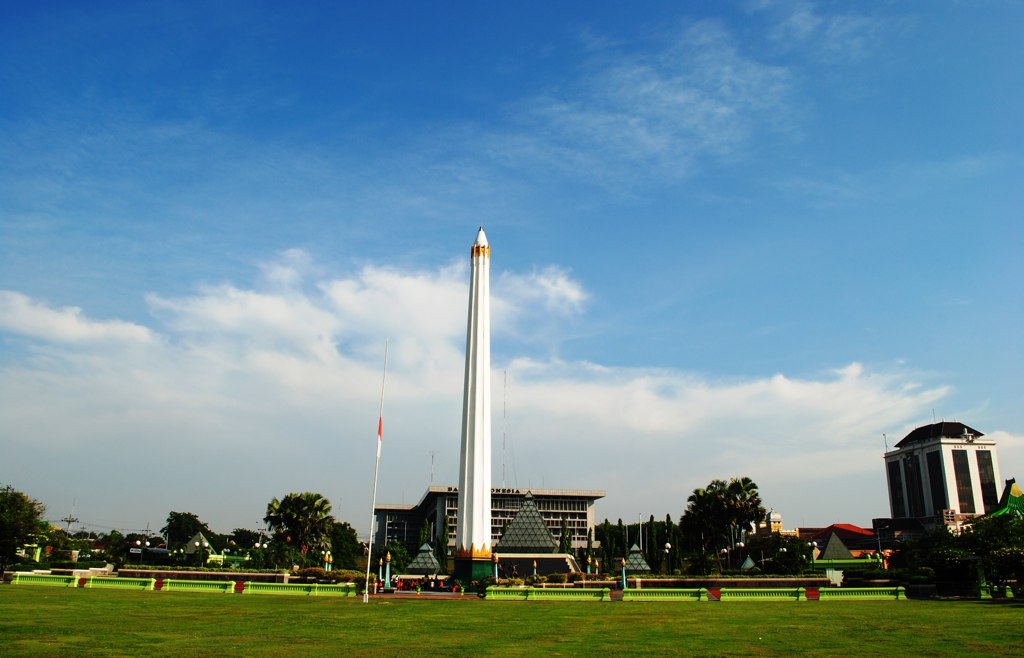
Tugu Pahlawan: The Inverted Nail That Honors a City's Defiance
When the architect presented his first design for Surabaya's war memorial, President Sukarno rejected it. The model featured human statues - soldiers frozen in heroic poses. Sukarno picked up a steel nail from the desk, turned it upside down, and set it before the architect. Humans are temporal, he said. But the strength of the human spirit is eternal. That should be the shape. Today, Tugu Pahlawan rises 41.15 meters above downtown Surabaya, a tapered pillar that resembles nothing so much as an inverted nail driven into the earth - a marker for something that cannot be pulled out.
Three Weeks That Forged a Nation
The monument commemorates the Battle of Surabaya, the largest single engagement of the Indonesian National Revolution. On 10 November 1945, barely three months after Sukarno proclaimed independence, British forces launched a coordinated assault on the city. They came with tanks, warships, and air support to accept the Japanese surrender and reassert Dutch colonial control. The Indonesians who fought back were mostly civilians and irregular fighters - the arek-arek Suroboyo, the youth of Surabaya - armed with bamboo spears, captured Japanese rifles, and whatever else they could find. The British expected to take the city in days. The resistance lasted three weeks. Between 6,300 and 15,000 Indonesians died in the fighting, and an estimated 200,000 civilians fled to the countryside. British casualties numbered around 600. The battle did not save Surabaya, but it proved something the Dutch and British had not expected: Indonesia would bleed for its independence.
The Spark at the Hotel
The chain of events that led to the battle began weeks earlier, at a hotel less than two kilometers away. On 19 September 1945, a group of Dutch nationals hoisted the Dutch tricolor atop the Hotel Yamato - now Hotel Majapahit - to celebrate Queen Wilhelmina's birthday. Indonesian youth, furious at what they saw as an insult to their newly declared sovereignty, stormed the building. In the scuffle, they tore the blue stripe from the Dutch flag, leaving only the red and white - the colors of Indonesia. Tensions escalated through October. On 30 October, Brigadier General A.W.S. Mallaby was killed in circumstances that remain disputed to this day - shot by a young republican, or killed by an explosion, depending on which account you trust. His death triggered the British ultimatum that preceded the 10 November assault.
Built on Contested Ground
The monument's location is itself a palimpsest of power. The land in downtown Surabaya, near the East Java Governor's Office, was formerly occupied by the Raad van Justitie - the Dutch colonial court of justice. During World War II, the Japanese military police, the Kempeitai, commandeered the same site. Dutch justice, Japanese occupation, Indonesian remembrance - three regimes layered onto one patch of ground. Sukarno laid the foundation stone on 10 November 1951, exactly six years after the battle, accompanied by Surabaya's mayor, Doel Arnowo. Construction took precisely one year. On 10 November 1952, Sukarno returned to inaugurate the finished monument, with Mayor R. Moestadjab Soemowidigdo presiding. The symmetry was deliberate. Every ceremony, every anniversary, every act of remembrance returns to the same date.
What Lies Beneath
Below the monument sits the 10 November Museum, a two-story facility built to give context to the pillar above. The ground floor holds an auditorium; the upper level contains reproductions of documentary photographs and eight dioramas depicting the events surrounding the battle. The exhibitions are not subtle. They are designed to convey the spirit of struggle - the Surabaya people's perjuangan, their fight. Every 10 November, the site becomes the venue for national commemoration. Hari Pahlawan, Heroes' Day, is observed across Indonesia, but its emotional center remains here, at the base of an inverted nail in a city that chose to fight when surrender would have been easier. The monument appears on stamps, in textbooks, on the city's official imagery. It is Surabaya's defining symbol - not because it is beautiful, but because it marks the moment when a city's sacrifice became a country's resolve.
From the Air
Tugu Pahlawan stands at 7.25S, 112.74E in central Surabaya, near the East Java Governor's Office. The 41-meter pillar is visible as a distinctive vertical landmark amid the surrounding low-rise urban fabric. Juanda International Airport (WARR/SUB) lies approximately 20 km to the south. The monument sits roughly 2 km from the coastline along the Madura Strait, with Madura Island visible across the water. Expect tropical monsoon conditions with high humidity; clearest visibility during the dry season (May-October).